Monday, October 31, 2005

Sea of Studies Doesn't Help Restoration of Great Lakes

Rep. Rahm Emanuel (D-Ill.), who joined Kirk in developing a $4 billion Great Lakes cleanup bill now stalled in Congress, said the administration has spent $4.5 billion on water projects in Iraq.

"This is not a mystery anymore. We know what needs to be done," Emanuel said. "The Great Lakes has gotten nine studies in four years from this administration, and Iraq has gotten $4.5 billion. Give Iraq the studies, and we'll take the money."

Iran: Rich, armed and angry, how dangerous is it to the world?

A must read article. Detailed and well informed.

-------------------------------------------------------------------------------------

From one perspective, Iran is a country dominated by a small clique of hardline revolutionaries who keep the young population disenfranchised by manipulating a false democracy. In another, the Islamic republic has been granted legitimacy by its people, who regularly turn out to vote in large numbers, and ensure that enough interest groups are represented in decision-making to give balance to the state.

At the very top, the system is opaque. The Supreme Leader, Ayatollah Ali Khamenei, holds ultimate authority. He inherited the role from the charismatic Ayatollah Khomeini on the latter's death in 1989. Under Iran's system of Vilayat-e Faqih ­ rule of the jurisprudent ­ power is vested in the clergy because they can best interpret God's intentions for mankind.

Under the Supreme Leader is the elected government ­ the President with his cabinet, and the Majlis, as the parliament is known. Arch-conservatives took control of the Majlis in February 2004 after an election many Iranians thought was rigged by the banning of reformist candidates. Mr Ahmadinejad then won the presidential election this summer, promising to improve conditions for Iran's poor by better sharing the $37bn (£21bn) of oil revenues earned last year.

But a series of other groups have a stake in the process too. The Islamic Revolutionary Guards Corps has grown in power in recent years, and many Iranians believe it controls most of the voices around the Supreme Leader, to whom it expresses total devotion. Mr Ahmadinejad is a former guardsman, as are many of the new Majlis deputies.

The force, 150,000 strong, receives all the best military equipment, and has started to play a significant role in Iran's economy, bidding to take over big oil engineering projects. It is also in charge of the Islamic Basij militia, formed during the 1980-88 war with Iraq as a volunteer unit comprising young boys and old men who wanted to seek martyrdom for the revolution. It was block voting by the millions of Basij members that ensured Mr Ahmadinejad's June election victory.

http://news.independent.co.uk/world/middle_east/article323335.ece

Sunday, October 30, 2005

Indian Middle Class Grows, But Ugly Tradition Persists

Looking at the current population trends of India, I'm at a loss to figure out, shouldn't the groom's family give dowry to the bride's family? After all, there is a shortage of eligible brides in India and an excess of grooms. China did not follow this dirty practice and doesn't do so now too. The shortage of brides in China is already being felt among young men of marriageable age. I'm waiting for this to become noticeable in India. Then dowry will flow the other way round. :)) In a village in Punjab or Haryana, there are many 40-50 year old bachelors because women aren't willing to get married to anybody in this village as it located on a island and is therefore isolated. Such stories will become more common in the next decade as Punjab has only 750odd females for every 1000 males.
 
======================================================================
 
 
In particular, the death of the young newlywed -- a shy, deeply religious schoolteacher's daughter whose husband had a college degree and worked in computer graphics -- shows that the age-old practice endures even, and perhaps especially, among the educated urban middle-class.

Despite laws barring dowry, and decades of protests and public awareness campaigns, a nationwide survey of 10,000 households by the All-India Democratic Women's Association in 2002 found that the practice was no longer confined to the Hindu upper castes, where it originated, but had spread across a broad range of classes and communities, including Muslims and Christians.

Mexicans have the hots for instant ramen

French pastries, and Spanish citrus have left lasting impressions on Mexico's cuisine. Now Japanese fast-food noodles, first imported here in the 1980s, are filling pantries across the country.

Time-pressed schoolchildren, construction workers, and office drones have helped turn Mexicans into Latin America's largest per-capita consumers of instant ramen. Diners here slurped down 1 billion servings last year, up threefold since 1999, according to a Japanese noodle association.

Urban convenience stores do a brisk trade selling ramen ''preparada," providing customers with hot water, plastic forks, and packets of salsa to prepare their lunches on the spot.

People in the countryside also developed a taste for it. As part of a food assistance program, the Mexican government distributes ramen to commissaries in some of the most remote pockets of the country, where it is supplanting rice and beans on many tables.

The product is so pervasive that a national newspaper recently dubbed Mexico ''Maruchan Nation."

Purveyors say you don't have to strain your noodle to figure out why. Nearly 60 percent of Mexico's workforce earns less than $13 a day. Instant ramen is a hot meal that fills stomachs, typically for less than 40 cents a serving. The product doesn't need refrigeration and it's so easy to make that some here call it ''sopa para flojos," or ''lazy people's soup."

Sold here mainly in insulated, disposable containers that resemble styrofoam coffee cups, instant ramen starts as a clot of precooked dried noodles topped with seasoning and dehydrated vegetables. Boiling water turns it into tender strands of pasta in broth, ready to eat in three minutes.

That's a profane act for some Mexicans whose relationship with food is so sacred that their ancestors believed humankind was descended from corn.

Food here is history. It is religion. It is patrimony. Ask anyone who has savored such delights as ''chiles en nogada," poblano chilies stuffed with spiced pork and topped with creamy walnut sauce and pomegranate seeds to replicate the green, white, and red colors of the Mexican flag.

It's also passion. In Laura Esquivel's popular novel ''Like Water for Chocolate," the sensuous alchemy of Mexican cooking unleashes a family's ravenous desires.

Small wonder that defenders of the nation's cuisine, such as Gloria Lopez Morales, an official with Mexico's National Council for Culture and Arts, are appalled that Mexican palates have been seduced by this ramen import.

Lopez is leading an effort to have UNESCO recognize Mexican food as a ''patrimony of humanity" that should be nurtured and protected. She worries that globalization is disconnecting Mexicans from their life source, be it US corn displacing ancient strains of maize or fast food encroaching on the traditional ''comida," or leisurely afternoon meal.

''For Mexicans, food is basically culture. The act of eating here in Mexico is an act of enormous significance," she said. ''We have entered a period of threat, of crisis."

Nutritionists likewise are alarmed that instant ramen, a dish loaded with fat, carbohydrates, and sodium, has become a cornerstone of the food pyramid.

With the majority of the population now urbanized and on the go, Mexicans are embracing the convenience foods of their neighbors in the United States while abandoning some healthful traditions. The result is soaring levels of obesity, diabetes, and heart disease, particularly among the poor.

''It's cheap energy," said Dr. Gustavo Acosta Altamirano, a nutrition specialist at Juarez Hospital in Mexico City, of the nation's growing addiction to soft drinks, sugary snacks, and starchy foods such as ramen noodles. ''But it's making us fat."

SYSTEMS FAILURE? Bangalore

A former Prime Minister takes on Bangalore’s foremost icon, even as the city crumbles. Is this the beginning of terminal decline for India’s Silicon Capital? Or can it find a killer app for the infrastructure bug? Sunday Times logs in.

By Jayanth Kodkani


   It was a ‘bad weather' fortnight for Bangalore. It began with a lot of heat being generated over former Prime Minister H D Deve Gowda’s remarks that Infosys chairman and Bangalore airport project chief N R Narayana Murthy had contributed little to the mega project. Murthy quit the project in protest, but Gowda went ahead and charged Infosys with landgrabbing and political interference. Then the city was lashed by heavy rain. Roads and colonies were inundated, lakes overflowed and our Silicon Valley's infrastructure collapsed, raising the question: As other major metros go all out to woo IT and FDI, why is the IT hub in a seeming state of collapse? Is the great Bangalore dream over?
   Not if you believe the growth statistics. Texas Instruments made its bow in 1984. That grew to 13 companies and software exports worth Rs 5.6 crore in 1991 and 1,457 firms and Rs 18,100 crore in 2004. On a roll, still.
   So what's the fuss about? Bangalore is creaking under the weight of its boom: the city's population has doubled in the last 18 years, the number of vehicles has spiralled, as has the cost of living, and the infrastructure simply hasn’t kept pace.

TRAFFIC TRAUMA

Traffic is a major bellyache. As Fortune magazine notes in its recent issue, “In Bangalore, executives visiting the immaculate campuses of software firms like Infosys and Wipro marvel that while their data can travel to- the other side of the earth at the speed of thought, they must crawl along in bumper-to-bumper traffic for more than an hour to get back to their hotels.”
   Techie Manish Chok says when he came to Bangalore five years ago, it was a dream city but now the one-and-ahalf-hour commuting time to his workplace irritates him. And George Kuruvilla, urban planner, believes Bangalore still lives on past glory. “There will be first a decline and then demise, unless things turn around. You need proper traffic planning.”
   It has indeed been a swift journey that Bangalore has made in just over a hundred years — from a small garrison town, which bored the young Winston Churchill enough to make him read books by the dozens and collect butterflies — to a city where Mamas serve breakfast to children in traffic jams on the way to school. The Rama Rajya, as Gandhi described Bangalore's advanced environs in the 1930s, is unable to cope with the Information Age. For a city with about 100 years of technical expertise, lodged in the state that was the first to get electric power in Asia, enterprise doesn't come at a premium. Unlike many other world cities, Bangalore grew not on the strength of traditional wealth, but its professional repertoire.
   The key is in a business plan for the city. A killer application for the infrastructure bug. As James Heitzman, author of Network City: Planning the Information Society in Bangalore, puts it: “There is no upper limit on the population of the city in the 21st century, and we may reasonably expect the number of people living in Bangalore to double within the lifetimes of our children. This challenge may seem daunting to some long-time residents, who remember the good old days when traffic was less and face-to-face interactions were standard. In fact, for a nation the size of India, a population of 12-15 million in the largest metropolis in the southern Deccan would seem appropriate. So far, Bangalore has demonstrated the ability to attract and support large populations, even if the opportunities of many citizens remain limited. By the standards of the South Asian city, this is success.” 
 
APATHETIC ADMINISTRATION

Dipti Nambiar, an IT professional who recently moved to Bangalore from
Pune, gives Bangalore 7 points on a scale of 1 to 10. “I come from Pune, which is smaller and more manageable... ”
True, it isn't easy to do business in a city where the domestic airport is not of international class, as Kean Walmsley, senior manager, DevTech, Autodesk, points out. “It doesn't look good when CEOs and decision makers come here... I’m sure some companies are considering other places. It's difficult to buy a house and difficult to travel around the city....”
   Yet the argument that major firms are packing up only because of Bangalore’s poor civic infrastructure, can only be half true. IT, after all, is business: if a particular design doesn't work, the manufacturing unit is shut down; if a product doesn’t do well in one sphere, other avenues are explored. And costs, benefits and concessions matter as much.
   At the same time, there seems to be little response to frequent complaints by the IT industry about how the city’s infrastructural flaws create bottlenecks for it. That’s ironic because in many ways, the industry’s own rapid growth led to the boom that now has Bangalore bursting at the seams.
   Infotech in Bangalore has transformed from an independent and selfsufficient enterprise to a giant industry that needs an efficient, well-run city. An industry that also needs a congenial environment for its practitioners to express themselves culturally.

POLITICAL FAILURE

But the political leadership — both local and national — has failed to come up with a compelling vision for Bangalore, or stay ahead of the curve.
   Ramesh Ramanathan, campaign coordinator of Janaagraha, a people's movement for participatory budgeting in Bangalore, points out that knee-jerk and band-aid reactions won’t do. “Saying that we should build a flyover is solving yesterday's problem. It’s not planning for the future. We should get into a proactive, not reactive mode. Else Bangalore will go the Mumbai way in the next five years.”
   From the administration’s point of view, the rubber has met the road — not only in catering to the IT sector but to Bangalore's seven million-odd citizens. The political class has rained on the parade with its blow-hot blowcold approach.
   The fact is, IT will make inroads wherever its convenient. If Hyderabad, Chennai, Gurgaon and Pune are in line, it is a reflection of a global paradigm — anywhere is home.
   But in terms of sheer volume of software exports, Bangalore still remain king. And Brand IT Bangalore will be a trademark hard to erase. Just as Bollywood is to Mumbai.
   (With inputs by Sharmishta Koushik)

Downpour in city inflicts Rs 300.85-cr damage

TIMES NEWS NETWORK

Bangalore: The torrential rain that lashed Bangalore over the week has amounted to damages worth Rs 300.85 crore. And this is only within the BCC limits.
   The cumulative figure is an estimate of damage done to property, life (in terms of compensa- tion) health-related issues. Giving out a comprehensive details at the BCC council meeting on Saturday, commissioner K Jothiramalingam said that a memorandum inclusive of all reports would be submitted to the state government, as per the dictum of CM Dharam Singh. This memo would in turn be submitted to PM Manmohan Singh on Monday.
   Of the Rs 300.85 crore, the east zone has had damages amounting to Rs 100 crore, west, Rs 92 crore and south zone Rs 94.36 crore, as also Rs 8 crore for public health. The week’s rain has ensured that a total of 3,329 persons were distributed cheques as they were affected by either losing houses or had been displaced. The cheque amount alone stands at Rs 62.66 lakh. 
The BCC would also be taking up remodelling of storm water drains and valleys in the CMC areas, as per government orders. “Because of the intensive desilting work taken up since April on Koramangala and Challaghatta valley, areas in the BCC have not been as acutely affected as they would have been otherwise’’ said Jothiramalingam.
Losses elsewhere: The heavy rain that lashed the state recently will bring down the targetted food crop production as 20,764 hectares of paddy, sugarcane and ragi cultivated land have been inundated. Cultivated lands have been affected more in Mysore, Mandya, Chamarajnagar, Haveri, Raichur, Kolar, Bangalore urban and rural districts.


They created the mess, and now blame everyone but themselves

H S Balram

When sleepy Bangalore rose to become the hub of software technology, everyone basked in its glory. Successive chief ministers, from Deve Gowda to S M Krishna, claimed credit for putting the
city on the world IT map. They invited MNCs and investors with open arms. The city flourished. Other cities looked at it with envy. Its share in the state GDP rose sharply. Now, when Bangalore is bursting at its seams, and its infrastructure crumbling, no one is coming to its rescue. And those who led the city to its present state are now blaming everyone but themselves.
   The powers that be in the coalition government choose to blame the mess on the IT industry. They accuse it of congesting the city, grabbing land, and not contributing towards its upkeep. When the industry protests, they charge it with carrying on a whispering campaign to destabilise the government. They even play urban versus rural and language cards to divert the issue. When the industry offers to participate in public-private partnerships, they suspect motives. And when a well-meaning IT czar tries to bring about a rapprochement and makes suggestions to set things right in Bangalore, he is humiliated and forced to retreat.
   It is sad that those who matter look at Bangalore with blinkered eyes. If Bangalore earns, the state progresses. Such is its status in the IT arena. The city’s contribution to the state exchequer is high. But it needs to be cared for. Its infrastructure has not kept pace with the city’s growth. The population has risen manifold. So too has the number of vehicles. Citizens go through a harrowing time everyday due to badly maintained roads, traffic jams, choked drains, waterlogging during rain, and erratic power and water supply. They do protest, but their voice is not heard. When the powerful IT sector protests, the authorities at least wake up and react, if not act.
   Take the case of the downpour a few days ago that paralysed Bangalore. The entire city was waterlogged. Sewage and rain water entered houses. Buildings collapsed. Tanks and lakes breached. Roads were flooded causing traffic jams. Power and drinking water supply were badly affected. Many localities lay inundated for days. Civic agencies looked on helpless. The policemen did their best, but in vain, to streamline traffic. VIPs who visited the affected areas tried to derive political mileage by attacking their rivals, offered lip sympathy, made hollow promises, sought hefty compensation from the Centre, and disappeared.
   Who then is to blame? Everyone. From political rulers, officials, builders, encroachers to citizens. Bangalore’s undulating topography prevents it from being flooded. But, the city was allowed to develop haphazardly, flouting all norms of
proper infrastructure. Natural valleys and lakes, which took in excess rain water, were encroached upon. Most of the 2,789 lakes in and around Bangalore at one time were converted into stadia, commercial complexes, bus stations and layouts. Now, when Bangalore is in the pits, the very persons responsible for the mess are trying to pass the buck.
   It is no use crying over spilt milk. We cannot turn the clock back. But we can certainly stop further deterioration, and make sincere efforts to improve infrastructure. Put politics on the backburner, identify problems, find solutions, fix deadlines and appoint go-getting officials to implement them. Encourage publicprivate partnership. Proceed fast on short- and long-term plans. Come down heavily on encroachers. Bangalore must be protected and developed at any cost for the good of the state.

PA RT I N G S H OT

Destabilisation theory

Finally, Nature had to intervene to let those who call the shots in the state realise the depth to which Bangalore has sunk in terms of infrastructure. Who knows, they may find a hidden hand here too. Like in the case of Narayana Murthy, they may accuse the rain gods of conniving with detractors to destabilise the coalition government!

India's electricity reforms (not going too well)

An electricity shortage may thwart India's rush to modernity

ITS organisers are calling it a victory for people power. They even invoke the name of Mahatma Gandhi, icon of India's independence struggle. For economic reformers, however, it is a depressing defeat: by making a huge fuss and refusing to pay their bills in full, Delhi's middle class last month persuaded the local government to withdraw an increase—of about 10%—in the residential electricity tariff.

The protesters alleged they were being robbed by rigged meters and forced to pay exorbitant first-world prices for an unimproved, erratic third-world service. They had a point. But if not even well-off citizens in the capital will pay an economic rate for their power, what hope is there for the rest of the country, where politicians habitually offer free power to farmers in the hope of winning their votes? And while electricity boards continue to rack up huge losses, what chance is there of finding the money so desperately needed for investment in new generating equipment? More fundamentally, where will the fuel come from?

Power cuts are a way of life in India, at least in parts of the country lucky enough to regard them as an interruption rather than the norm. There is a worsening shortage. Over the past decade, electricity generation has grown at a compound annual rate of 5.5%, but demand has grown even faster. Peak demand exceeded supply by 11.3% in 1998 and by 12.1% in the last financial year (ending this March).

That, moreover, is to define demand in the narrowest of senses. The countryside, where more than two-thirds of India's people live, accounts for no more than 13% of electricity consumption. India's 1.1 billion people use on average just 526 units (kilowatt-hours) of electricity a year, compared with 1,247 units in China. Where electricity is available it is often only for a couple of hours a day, unusable for industry and of such poor quality that power surges routinely wreck equipment.

Yet India wants electricity to reach every village by 2008—demanding the electrification of 110,000 villages—and every household by 2012. At present, 56% of India's households, and just 44% of those in rural areas, have connections to the grid. Meanwhile, it is hoped that India's economy, already growing at an average of more than 6% for the past 15 years, will expand even faster, meaning more electricity-intensive manufacturing and air-conditioned shopping malls. The government talks of adding 100,000 megawatts (MW) of new generating capacity over the next ten years—a virtual doubling.

Indian industry, long used to the failings of the national grid, has survived by building its own “captive” generating plants. Azim Premji, chairman of Wipro, one of India's information-technology stars, senses that the electricity shortage is “coming to enough of a crisis now that we have to fix it, like we fixed telecoms.”

T.L. Sankar, an energy expert at the Administrative Staff College of India in Hyderabad, likewise draws succour from past successes in other fields, such as the near-doubling of food production in India during the “green revolution” of the late 1960s and 1970s. Something similar, he argues, is needed now.

“Crisis” may be the wrong word for such a long-standing shortage, with its origins in every link in the electricity supply-chain, from fuel through generation, transmission and distribution. But crisis is how it has sometimes felt during the last few months, because of a combination of factors. Manmohan Singh, the prime minister, has often spoken of the seriousness of the needs, and has set up a committee to tackle them. This summer, too, the oil price has soared and worries have mounted about a shortage of coal, which fuels about 60% of India's electricity, compared with about 26% from hydro-electricity and 11% from oil and gas.

A.P.J. Abdul Kalam, India's president and a much-respected scientist in a largely ceremonial post, has put the electricity shortage into the broader context of insufficient supplies of energy. In his speech on the eve of Independence Day on August 15th he called for efforts to make “energy independence” “our nation's first and highest priority”.

Always the worst season for power-cuts—air-conditioning provides respite from the sweltering heat—this summer has been particularly bad in some places, notably Maharashtra, India's wealthiest and second most populous state. Meanwhile, the row in Delhi has highlighted the mess that is India's electricity distribution.

Lost in transmission

Delhi had been held up as a model of successful power-sector reform. An Electricity Act in 2003 had achieved little, perhaps because it was so ambitious. Part of the difficulty lies in India's federal system, under which electricity is a “concurrent” subject, where both the central government and the 29 states have a role.

Except in a few cities that remained exempt, distribution was monopolised by state electricity boards (SEBs). The act called for the “unbundling” of generation from transmission and distribution, which was to be opened to private competition. Independent regulators would adjudicate tariffs, and the cross-subsidies that penalise industry to the benefit of the domestic consumer and farmer were to be removed. At present less than 42% of electricity is sold to industrial and commercial users, but that yields more than 70% of the SEBs' annual revenues.

Only two states—Orissa, in the poor east, and Delhi—have privatised distribution. The Delhi government claims that privatisation has brought big benefits. The two private firms involved, affiliates of the big national conglomerates, Reliance and Tata, succeeded in cutting losses to theft from about 50% of supply to about 40%—the national average. The government claims electricity was on its way to being “self-sustaining”.

This picture of healthy progress, however, does not match popular perceptions. Reliance, in particular, is accused of having behaved badly. Much suspicion has centred on new digital meters. Reliance denies they run too fast, arguing they are more sensitive than the old mechanical ones. So electricity bills would have risen sharply anyway.

Degenerating

The timing of the furore in Delhi is unfortunate. Electricity reforms have stalled, and may slip into reverse. Communist parties, on whose votes the government led by Mr Singh's Congress Party relies for a parliamentary majority, want to water down the 2003 Electricity Act. Jealously protective of the interests of public-sector workers, they oppose unbundling and privatisation, and support cross-subsidies.

Already, Congress-led state governments have been among the worst offenders in using electricity to buy votes and popularity. Some of Maharashtra's troubles, for example, can be traced to elections held last year, when the government offered farmers free power for irrigation pumps. Maharashtra was forced to remove the sop this June, but other Congress-led governments, most recently in Punjab, have offered the same handout.

One consequence of failing to fix the SEBs is fiscal. Their average tariff has risen by 20% since 2000, compared with a rise in the cost of their supplies of just 4%. But still, tariffs, on average, are just three-quarters of supply costs. Some estimates suggest that the SEBs lost 10 trillion rupees ($215 billion) over the past decade. This has damaged their ability to add distribution capacity, and even to carry out basic maintenance. The Planning Commission has pointed out that more than 90% of the investment in the power sector goes into generation and transmission rather than distribution, akin, it argues, “to building a superstructure without a foundation”. Still, the money needed for new generating capacity is huge—estimates range between $10 billion and $15 billion a year.

Efforts to attract private investment, including from abroad, into power generation have been largely unsuccessful. The most spectacular failure was the impressively modern 2,200MW Dabhol power project in Maharashtra, which started operation in 1999, only to shut in 2001 after a row between its promoter, Enron, a collapsed American energy giant, and the SEB. Years of legal wrangling have ensued, with damaging effects all round. Many Indian observers drew the lesson that privatisation and foreign investment in power did not work and meant high prices. Foreign firms wondered whether power-purchase commitments signed by bankrupt SEBs were worth anything. Only now is the project restarting, having, in effect, been nationalised. It will be at least a year before it is producing electricity.

Despite Dabhol and a huge gas-fired plant that Reliance is building in Uttar Pradesh, a northern state, coal is expected to remain India's “mainstay” fuel for decades to come. Its proven reserves, of 92.4 billion tonnes, are just over 10% of the global total. But it is of low quality, with a high ash content and low calorific value. It is also, by international standards, expensive (perhaps twice the cost of South African coal), and production is not growing fast enough. Rajiv Sharma, a senior official in the Ministry of Coal, blames this on underinvestment in the 1990s, when coal became a “condemned fuel”, because of its polluting effects and contribution to global warming.

Coal India, the state's near-monopoly, was unprepared when demand took off in 2003. So India has been importing more coal—nearly 11m tonnes last year. Vipul Tuli, of McKinsey's, a consultancy, predicts a “massive” shortage of 100m tonnes by 2011-12. Domestic coal usage is constrained and made more costly by an inadequate rail network. Imports are hampered by a lack of capacity at the ports.

Recent months have seen a scramble by India to secure fuel supplies. There is talk of pipelines to bring gas from countries such as Turkmenistan, Bangladesh, Myanmar and, most controversially, Iran. Meanwhile ONGC, a state-owned oil exploration and production company, has teamed up with Lakshmi Mittal, a steel tycoon, to bid for foreign oil assets.

India's nuclear industry, which at present supplies about 2% of electricity, received a big boost in July, when Mr Singh went to Washington, DC, and secured an American offer of help for it. Despite having nuclear weapons, which it tested in 1998, India has never signed the international non-proliferation treaty. So this was a diplomatic coup. Mr Singh has suggested India could have 30,000 to 40,000MW of nuclear capacity for the next 20-30 years. But that optimistic figure is still a fraction of requirements.

There may be more potential in hydro-electricity, which already produces a quarter of India's needs, in renewable forms of energy, and in moderating demand by enhancing energy-efficiency. India has an estimated 120,000MW of untapped hydro-electric potential. Big dams are controversial, but much of this could be realised through small, run-of-the-river projects. It is hoped to increase hydro's share in production to 40%. The “most significant” strategic goal set by Mr Kalam in his Independence Day speech, however, was to increase the share of renewable energy in generation from around 5% now to 20-25%. Wind power already accounts for about 2%. Solar power is negligible now, partly because of the high capital cost of solar plants, but the president was optimistic that new technology would soon bring the cost down. He estimated, moreover, that 30m hectares of wasteland in India are available for the cultivation of “bio-fuels”, such as Jatropha, an oil-producing shrub.

An obsession with “energy security” may not be wise in a world where, in Mr Singh's words, borders are becoming less relevant. But it must make sense to look at options other than coal and imported hydrocarbons. The impediments to meeting India's needs through increases in thermal-power generation seem likely to dog the country's progress for years. They lie not just in the present shortages of fuel and capacity, but in the structure of an industry too long governed by political rather than economic concerns. They are not insuperable. But they are so complex and daunting that one leading industrialist privately argues that the only solution is for electricity to be declared a national emergency. That way, the general recognition of the scale of the challenge might actually turn into action.

http://economist.com/research/articlesBySubject/displayStory.cfm?story_id=4423894&subjectid=348879

Fishy economics: Exploitation of the deep seas

As the crustaceans became harder to find, canned lobster ceased to be profitable. Live lobsters, by contrast, grew in status as they became dearer. A meal that cost $4 (in today's money) in the 1870s cost $30 or more a century later. What was once a manure substitute is now a prized delicacy. What the lowliest servant once refused, the swankiest restaurateur now offers with pride. Mr Jones's menus may reveal something about the historical fate of fish, crustaceans and molluscs. But there is no accounting for that peculiar land-based mammal that eats them.
Reforms in India: Democracy's drawbacks

An excellent article. Very blunt and beats around no bushes. Expands on the term "India has a democratic govt and communist economy".
-----------------------------------------------------
Sustained growth in India would be all the more impressive if the government could pass its reforms. But the road is blocked by politics.

Out of this IT infrastructure has grown a huge business in “outsourcing” almost any business process that can be performed remotely, from answering a call in a help centre to interpreting an X-ray. The largest outsourcing firm relaunched itself in September as Genpact, partially disguising its origins as the Indian back-office of General Electric, and expects to exceed $1 billion in annual sales by 2008.
These service businesses have thrived because they have capitalised on India's strengths—computer skills, fluency in English—and are not hostage to its weaknesses. Yet those weaknesses are all too obvious, and are the reason why India on many counts still lags behind its neighbour-rival, China. India has lousy infrastructure, bumbling and burdensome regulation and restrictive labour laws. And economic reform now appears to have stalled in political recriminations.

Last year's election gave no party a clear majority. A delicate arrangement allowed Manmohan Singh, of the left-of-centre Congress party, to take office as prime minister, while a committee was set up to negotiate policy between Congress and its coalition partners (together called the United Progressive Alliance or UPA) on the one side, and the Left Front of Communists and other left-wing parties on the other. The committee, however, has not managed to meet since June, though on October 26th there were rumours that it was about to. Meanwhile, the Communists—without whom the coalition has no majority in Parliament—are getting truculent. They staged a four-month boycott of the co-ordination committee to press their policies and then, in concert with the trade unions, called a one-day general strike on September 29th. It was ignored in many places, but the banks, along with the Communist stronghold of Kolkata (Calcutta), were paralysed.

When Mr Singh was finance minister, in the 1990s, it was he who pushed through the measures that kick-started reform in India. Without the support of the Left Front, however, he can do nothing more. His most significant legislative achievement to date has been a law that guarantees 100 days' employment to every household in India's 200 poorest districts. Though the Left Front loves it, many economists reckon that much of the money—as much as 1% of GDP, by some estimates—will be wasted or stolen.

The Left Front, which draws most of its support from organised labour, does not greatly care. Its eyes are on state elections due next year in West Bengal (whose capital is Kolkata) and Kerala, the two biggest states where the Communists are strong. Those who are losing out from unreformed labour laws are hundreds of millions of people now marginally employed in the countryside. These people need jobs in manufacturing if India is to improve its record on poverty, as well as growth. Jobs could be found in the labour-hungry textile industry, especially now that, with the ending of the developed world's protectionist Multi-Fibre Arrangement, India's textile exports are booming. As it is, a jobless boom is going on in manufacturing, which is growing at 7% annually, but without increasing employment.

Touches of xenophobia
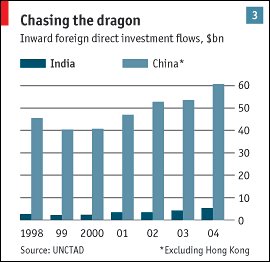
India's antiquated laws are not only preventing it from exploiting the textile boom as successfully as China (whose textile businesses are so successful that they provoke retaliation). They are also pushing it far behind China in terms of foreign direct investment. FDI has been the most important driver of China's growth, not just because of the money involved (more than $60 billion last year) but also because of the technology, expertise, marketing relationships and much else that this money represents. India's showing has been far less impressive: about an eleventh of China's haul last year (see chart 3).

One chief reason for the discrepancy is that India imposes caps on FDI in a host of economically important, or politically sensitive, sectors: insurance, aviation, coal-mining, media and much else. Chief among these is retailing. Though franchise operations are allowed, foreign direct ownership is banned, which explains why even Delhi's smartest shopping areas are scruffy and chaotic places with limited stock.


Mr Singh's government would like to raise the caps, and had some success at first. It proposed in February, for example, that the cap for telecoms investment should be lifted from 49% to 74%, and this has just, at last, been approved. But the Left Front is violently opposed to any tinkering with the rules for FDI in retailing. Its leaders appear to accept that the advent of, say, Wal-Mart would generate many jobs, since much of what the company sold would be domestically produced (Wal-Mart spends $15 billion a year in China). But they worry that millions of small retailers would be put out of work. For those who want to move out of farm work, a small shop is often their first choice.

Mr Singh remains optimistic, but on slender grounds. With the Left Front so adamant, nothing is likely to happen. And the same is true of privatisation, or its younger sibling, disinvestment, the selling of minority stakes in state-controlled companies. From the very start of its tenure, the government was forced by the Left Front to agree not to privatise nine so-called “crown jewels”, or leading state-owned companies. But the Left has taken advantage of its position to go beyond what was originally agreed. When, in June, the government announced plans to sell a 10% stake in Bharat Heavy Electricals, an engineering firm, the Left Front vigorously objected. Although the sale does not require legislation, and so could be enacted by the minority government, the government shows no stomach for doing so.

Another disappointment—though the word is perhaps inappropriate, since no one ever expected a Congress government to have the necessary courage—is the failure even to attempt to do anything about the mountain of subsidies that distort the Indian economy. Often badly targeted, benefiting middle-class people more than the poorest, they consume a shocking 14-15% of GDP.

Worst of all, Indian politics may actually be retreating to its bureaucratic past. Take oil pricing, a complex statist rigmarole that had been moving from the hands of government to those of a regulator. Under Mr Singh, price decisions are again being taken by the government.

The prime minister's instincts are sometimes depressingly bureaucratic. Faced with obvious and longstanding problems, he commissions a study on them. The latest strategy document appeared in September from a specially convened National Manufacturing Competitiveness Council. It listed the most pernicious difficulties for manufacturers: power shortages, taxes and the “inspector raj”. No one was surprised by these, or felt much hope they would be fixed.

Removing the brake
It may seem odd, if reform is so important, that the economy is doing so well without it. There are a number of reasons. The biggest is that the Indian economy is so strong, structurally and cyclically, that it can ride out a period of wobbly policy. India's young population gives it a fast-growing workforce and a declining proportion of dependants. Over the next few decades, that will be good for savings and investment. Industry, meanwhile, has recovered from a splurge of over-investment in the mid-1990s. It has improved efficiency and is now both reaping the benefits and investing again in new capacity.

The government started to get out of business's way in the 1980s and, especially, after a balance-of-payments crisis in 1991. At that point Mr Singh, as finance minister, was given the freedom to bring in reforms by an unexpectedly brave prime minister, Narasimha Rao. Since then, government has been unable to put an absolute crimp on growth. Many important reforms—especially trade liberalisation, but also the dismantling of the “licence raj” of bureaucratic obstacles to enterprise—are well in train and not in reverse.

Too many are still losing out
Almost every budget since 1991, including this year's, has cut import tariffs and freed more industries from “reservation” for small firms, a big hindrance to competitiveness in businesses that might benefit from economies of scale. This year, moreover, saw the introduction of one long-planned reform, a standardised value-added tax imposed at state level. Typically, politics meant that not all states fell into line, and implementation has been patchy. Yet the tax may eventually not only bring new fiscal stability, but also reduce the burden of cascading excise and sales taxes that is one of the biggest handicaps facing manufacturers. Modest, piecemeal reform, in other words, is not quite dead.

The government's priorities—investment in infrastructure, agriculture, basic education and primary health care—are also right, given that the big macroeconomic stuff was mostly done in the 1990s. But they all need money, and that requires fixing the budget. India's fiscal deficit is now 8% or so of GDP if both state and central governments are counted—an improvement after six years of double-digit deficits, but still too high. Public finances have been in a mess for so long that it seems almost impolite in government circles to mention them.

The deficit, which goes largely on interest payments (40% of recurrent spending), defence, subsidies and civil-service wages and pensions, leaves little room for big capital investments. Some new airports, ports and roads are being built, and the “Golden Quadrilateral” highway, linking India's four biggest cities, is being expanded to six lanes. But Mr Singh wants a good deal more. Improving India's infrastructure, he says, is his top priority. Hence his government's zeal for “public-private partnerships” to finance and construct it.

A standard concession agreement is to be produced soon, modelled on successes with toll roads, where concessionaires have put in competitive bids for government grants. For some projects, the government does not need parliamentary approval and can proceed anyway. Other projects, however, such as airports, will run into objections from the left. It is therefore hard to see these partnerships making much of a dent in what Montek Singh Ahluwalia, the prime minister's chief planner, calls India's “infrastructure deficit”.

Might the left-wing parties ever become less obstreperous, and realise that reforms like these are of benefit to all Indians? It is possible. Jairam Ramesh, a Congress member of parliament who played a big role in writing the “common minimum programme” that defines relations between the UPA and the Left Front, floats the interesting theory that, now that Congress has enacted the Employment Guarantee Act that the Left was so keen on, the Left may prove a little keener on asset sales. They would, after all, be a way of paying for all those jobs.

From the Left Front come faint signs of accommodation. Prakash Karat, the general secretary of the CPI (M), the most important party within the group, is, like Mr Ramesh, adamant that full-scale privatisation of profitable public enterprises is not on the agenda. But he says the party is “ready for a discussion” on how to raise resources for spending on the poor.

Among the most eloquent advocates of a re-think is, in fact, a senior Communist, Buddhadeb Bhattacharjee, chief minister of West Bengal, a state of 82m people run for 28 years by the Communists and their allies. On September 30th, the day after Communist-affiliated trade unions had brought his capital, Kolkata to a halt, he could scarcely conceal his exasperation. He told The Economist that the trade unions—and many of his party comrades—had become “one-dimensional”, representing only the interests of the 30m or so workers in India's “organised” sector.

Mr Bhattarcharjee concedes that some of his colleagues in Delhi do not seem to grasp that economic reform could benefit a much bigger number of workers than those who belong to unions. If they do, they perhaps see political benefits in ignoring it. But “Here, we are running a government. We have to fulfil the aspirations of the people.” To that end, he is trying to turn Kolkata into a hub for the information-technology industry by declaring it a “public utility” where strikes are banned, and has started going abroad to bang the drum for inward investment.

Jobs for the poor
Such enthusiasm may start to shift the political balance back towards reform, but it looks unlikely. For the foreseeable future, both left-wing intransigence and lack of decent infrastructure—in particular, a chronic shortage of electricity—will constrain India's growth. An average annual rate of 6-7%, as in the past decade, does not seem a tall order. But a gear-shift to a durable growth rate of 8-10% still seems out of reach.

Without it, that burgeoning workforce may seem less of an advantage. Shankar Acharya, a former government economist now at a Delhi think-tank, worries that between now and 2051 nearly 60% of India's population increase will come from four “populous, poor, slow-growing northern states with weak infrastructure, education systems and governance”.

China has sucked surplus agricultural labour into factories by the tens of millions. India's manufacturing industries, by contrast, have progressed by becoming more productive. They are still not a big source of rural employment. As a good liberal economist, Mr Singh says he does not believe in having an “industrial policy” or picking favourites. Create decent infrastructure, and industry will come—and he sees huge potential, as do many others, in food-processing. His finance minister has spoken of 12m new jobs in the textile sector alone in the next five years.

They are sorely needed. India's information-technology firms are world-beaters, but the entire IT and office-service industry employs only about 1m people. None of the Asian tigers, not even Singapore, managed its rapid climb into the ranks of middle-income and rich countries without a boom in export-oriented manufacturing. India is unlikely to be different.

When he speaks of following the “Chinese model”, Mr Singh seems to admit this. But it remains sadly true that the free market that has helped the tigers so much often works better in Communist China than in India—not least thanks to India's own democratically elected Communist politicians.

http://economist.com/displaystory.cfm?story_id=5081267

China's Next Big Boom Could Be the Foul Air

The severity of the situation has created an opening for environmentalists in and out of the government. Environmentalism is a chic issue for college students, who have participated in garbage cleanups and joined the growing number of nongovernment organizations focused on pollution. The once-meek State Environmental Protection Administration, or SEPA, has become more aggressive in identifying and going after polluters and calling for reforms.

But the political and practical obstacles are formidable. Car ownership has become part of the Chinese middle-class dream, and the car industry has become a major contributor to tax coffers and a force in the overall economy.

Industrial pollution is difficult to control because local officials often ignore emissions standards to appease polluting factories that pay local taxes. SEPA has closed factories, only to see them reopen weeks later. To make a serious reduction in air pollution, experts say, tougher, enforceable standards are needed, and many factories would need new pollution control equipment.

"There has to be the political will," said Steve Page, director of the E.P.A office of air quality planning and standards. "The challenge they face is how will these plants be lined up and told this will happen?"

Underfunded and Overrun, 'Harvard of Africa' Struggles to Teach

Sitting on a grassy expanse outside of one of the main buildings, Olivia Akullo, a 21-year-old business student, said she usually gets to class at least an hour early just to secure a seat. She laughed as she watched students sitting on window ledges, their legs dangling outside.

"It's really scary because this school represents Uganda and Africa," Akullo said. "We want to show the outside world that we are something. But there are 300 people in some of my classes. We can't even meet with the professor if we don't understand something."

Two computer science students stood in the hall of Lumumba talking about how hard it was to get computer time.

"There are 20 students per one computer," lamented Issac Jugume, 21, who had handwritten his latest paper -- on computer programming. "I think computers are the best way to get a job. But it's really hard to learn about them when we have to wait a week to get on one."

Saturday, October 29, 2005

A Word to Finns: 'For Your Own Good, Blow Your Top'

By LIZETTE ALVAREZ

Published: March 11, 2004

Turo Herala is the first to admit that his mission to teach Finns how to get angry and make a scene, or even to feel joy and happiness is, in all likelihood, bound for failure.

Three months ago, Mr. Herala, a theater director with a yen for therapy, took it upon himself to bring ''anger venting'' classes to Helsinki on the theory that his famously silent and stoic compatriots were about to combust from repressed emotion.

Finland, while infinitely livable and likable, suffers from some of the world's highest rates of suicide, depression and alcoholism. ''How to control and express anger safely,'' read his classified advertisement in a local newspaper.

He has had few takers. An organization that handles domestic violence called to enlist, as did a smattering of individuals. But it was so odd a notion -- tutorials in how to get angry -- that Mr. Herala made headlines in the largest daily newspaper here.

''Yes, it has been difficult to get people to sign up,'' he said over a glass of white wine at a local bar, pleased nonetheless at all the attention. ''Anger in Finland is a bigger taboo than sex.''

Psychologists and academics here said they were not surprised that Mr. Herala's advertisement would attract attention as a novelty, and then go largely ignored.

''Self-control is very important in Finland,'' said Dr. Liisa Keltikangas-Jarvinen, a professor of psychology at the University of Helsinki. ''You cannot show anger; it means you can't cope. If a person is very temperamental and alive, expresses emotions like anger and happiness, the person is seen as infantile.''

Even among Nordic peoples, the Finns' stolid nature stands apart.

Ben Furman, a psychiatrist who until recently was the host of a popular, but very serious, television talk show here, was pilloried last year for suggesting that the government should stop paying for psychotherapy sessions. As he prepared to defend himself in interviews, over and over again, Mr. Furman said the one piece of advice he consistently got was ''don't get angry, no matter how much you are provoked.''

''People would assume I was guilty if I got angry,'' said Mr. Furman, co-director of the Brief Therapy Institute here. ''I had to rehearse and behave in a way where no emotion was shown. A normal person would react emotionally to these charges. If I was in Italy, I believe I would receive the opposite advice. You must be guilty because you are not reacting emotionally enough.''

Here, experts say, a car accident brings, not blame and insults, but a polite exchange of information. A bus breakdown causes no complaints; rather, the Finns on the bus will file off and try to push it to the next stop. It is no coincidence that 80 percent of women who give birth here refuse pain-killing epidurals, according to one study. In America, 90 percent of women ask for them.

But Dr. Keltikangas-Jarvinen said suppressing anger in Finland was only one piece of the country's entrenched cultural code.

Here, it is not unusual to walk into a restaurant and spot most people eating dinner in silence, content to chew and not chatter. Silence is a sign of wisdom and good manners, not boredom and half-wittedness.

Some would say this taciturnity has served Finland well, particularly during the cold war, when the Soviet Union was literally a short tank roll away. ''For 30 to 40 years there,'' Dr. Keltikangas-Jarvinen said, ''it was politically very wise to be silent.''

Finns also cringe over compliments. They don't dole them out and they don't take them in. As part of a group therapy exercise, Dr. Furman asked the participants to name one thing they each could do well, he recounted. No reply. Then, he asked the people in the group to give someone else a compliment. They couldn't.

Stumped, he broke them up into groups and asked them to say one nice thing about someone outside the circle. Finally, they did. ''We needed to back up a couple of steps, to teach people how to talk positively about one another,'' he said.

Ingrained with modesty, Finns are almost physically unable to boast or show off. In an era of unattenuated hype, they cannot self-promote. ''It is considered a sin,'' Dr. Furman said, with a laugh.

Dr. Keltikangas-Jarvinen said she receives American résumés, and sometimes cannot help but view them suspiciously. To her, they throb with hyperbole. ''I feel shame when I read these 'excellent' portfolios,' '' she said.

The flip side of this modesty, Dr. Keltikangas-Jarvinen and others say, is that Finns, despite their many advances, particularly in the technological field, seem to suffer from a self-esteem crisis. Theirs is such a consensus-driven, homogenous culture that a free exchange of ideas sometimes proves difficult.

''I mean, the president has something like a 90 percent approval rating -- please,'' Dr. Furman said. ''For our country to keep up with competitiveness, we need to respond differently.''

Mr. Herala, the ''anger teacher,'' said much would be solved if people could just learn to say what they think and express their emotions, be it ''I am angry because,''or ''I love you because,'' he said.

''We are,'' he said, ''the Finnish version of the Japanese character.''

http://query.nytimes.com/gst/health/article-page.html?res=990DE7DB123EF932A25750C0A9629C8B63

The Great Pumpkin: Backyard Botanists Shoot for 1-Ton Mark

The Great Pumpkin:
Backyard Botanists
Shoot for 1-Ton Mark
 
Latest Garden Sport Bends
Scales, Rules of Nature;
Gaining 40 Pounds a Day
By SUSAN WARREN
Staff Reporter of THE WALL STREET JOURNAL
October 29, 2005; Page A1
 
WARWICK, R.I. -- After six months of tender ministrations to the hulking orange blob in his backyard garden, Richard Wallace arrived at the moment of truth earlier this month.
 
It was time to harvest his giant pumpkin and take it to the official weigh-off, where growers each year compete for bragging rights to the hugest pumpkin in the land. As the harness straps strained to lift his pumpkin off the ground, the weight-gauge on the winch rose past 1,100 pounds. Then, there was a dull crack and the bottom gave way. Out glugged a sickening sludge of fermenting pumpkin guts, filling the air with the stench of rotten fruit.
 
The rest of the pumpkin harvesters gagged, but Mr. Wallace shrugged off the demise of his gargantuan garden specimen with a wry smile. "If you can't handle defeat, this isn't the hobby for you," the 64-year-old retired manager said.
 
Shelley and Scott Palmer with their 1,443-pound pumpkin, winner of a recent weigh-off in Warren, R.I.
 
Producing the biggest and best fruit and vegetables has long been a staple of county fairs, but in recent years growing giant pumpkins has evolved into a fiercely competitive garden sport. Fanatical growers carve out half of the calendar year to devote to their pumpkin patches, working to bend the rules of Mother Nature by nurturing their monsters with thousands of gallons of water, stinky soups of manure and seaweed, and complex pruning techniques.
 
Vacations are postponed and marriages strained as growers spend up to 30 hours a week tending their pumpkins during the summer's peak growing time, when giants have been known to gain 40 pounds a day. "He spent so many nights out there," says Shelley Palmer of her pumpkin-obsessed husband, Scott. "Sometimes I think he was out there sitting in a chair just talking to it."
 
Such dedication produces pumpkins that can measure 15 feet to 16 feet around. Twenty years ago, a 500-pound pumpkin was considered a monumental feat. Now, giants regularly tip the scales at 1,200 pounds to 1,400 pounds, bringing within sight the previously incomprehensible: a 1-ton pumpkin.
 
Howard Dill, a farmer in Nova Scotia, Canada, ushered in the age of the behemoths in the late 1970s by perfecting the genetics of a seed he patented as the Dill Atlantic Giant. Mr. Dill's seed gave anyone a shot at growing a jumbo, throwing open the door to backyard enthusiasts from California to Ohio to as far abroad as Australia. Growers in the northern half of the U.S. have the best success, because cooler summers extend the growing season through September, giving the pumpkins more time to reach their humongous size.
 
But it is weight, not size, that really counts. Growers estimate the weight of their pumpkins based on tape measurements. But every grower hopes for a pumpkin that will "go heavy" -- weighing more than its measurements suggest. "It all depends on what's inside the pumpkin. If the walls are thick, then it will weigh more," explains Raymond Leonzi, a financial analyst who set a Connecticut state record this year with the 1,081-pounder he grew in his Trumbull backyard.
 
Genetics are the key. Pumpkins crossed with squash can be pale, flat and ugly, but often outweigh their prettier and plumper bright-orange cousins. That's generated a debate among growers over which is more desirable to grow. Joseph Jutras, a longtime Rhode Island pumpkin enthusiast, grows both. He grieves over the demise this year of a hulking mixed-breed "squampkin" that was on track to break 1,500 pounds: It grew too fast and split open at 1,308 pounds. But he speaks most fondly of a 1,225-pound, pure-orange pumpkin he grew in 2003. "Now that was a great pumpkin," he recalls wistfully. "The shape of it was perfect: the stem, the blossom, the ridges, the sheen."
 
Like thoroughbred race horses, progeny of exceptionally heavy pumpkins are prized. Each winter online auctions are held where the hottest seeds can go for more than $500 apiece -- even though there's no guarantee they will sprout. Most successful growers work for years before breaking the 1,000-pound mark, and they guard their secrets closely. But tiny Rhode Island has been climbing the ranks of giant pumpkin growers with a different strategy: team work.
 
Mr. Wallace and his son, Ronald, who have been refining their growing techniques since the late 1980s, save rival newcomers years of trial and error by giving away prime seeds and teaching the basics of soil improvement, planting strategy and pruning.
 
The Rhode Island-based Southern New England Giant Pumpkin Growers club is part of the Great Pumpkin Commonwealth, a kind of world sporting authority for growers. Each year, the clubs compete at 25 weigh-offs in North American, and one in Ireland. This year, the Rhode Islanders are aiming for the highest average weight for their club's top 10 pumpkins.
 
Three days before the club's Oct. 10 weigh-off, a group of growers went from patch to patch, helping members load their giant pumpkins into the backs of pickup trucks. Each pumpkin received a critical review. At the first stop, Ronald Wallace circled Steven Sperry's mammoth entry silently. He leaned over and gave it a bear hug, pressed his ear to its mottled orange skin, then slapped it with his hands, testing for thickness.
 
The disintegration of his father's pumpkin later that day was costly, depriving the club of its second potential 1,300-pound entry. The previous day, Ronald had lost his own pumpkin to rot brought on by a fungal infection. "More things can go wrong than right," Ronald Wallace noted. "Just imagine if you were putting on 40 to 50 pounds a day."
 
By the end of the day, debate raged over which of the top two Rhode Island contenders was heavier: a pumpkin grown by Fred Macari, an electrical contractor who won the state's top prize last year, or one grown by Scott Palmer and his wife, Shelley. Mr. Macari's pumpkin was rounder and bigger, but several growers were betting on Mr. Palmer's flatter, but possibly denser, pumpkin.
 
Nerves were jittery as the pumpkins made the 20-mile journey to the weigh-off spot at a local farm. One by one, they were unloaded with a forklift and lined up in a field. Mr. Palmer's pumpkin was the last to be picked up. As the forklift backed away from the truck, its lift suddenly dropped with a jarring crunch to within inches of the ground. The growers froze in horror. When they saw the pumpkin was OK, they whooped jubilantly and slapped Mr. Palmer on the back. "You broke the truck!" shouted one.
 
At the weigh-off, Mr. Palmer's forklift-breaker took first place, setting a New England record at 1,443 pounds, just 26 pounds shy of the world record set earlier this year by a Pennsylvania grower. A Massachusetts pumpkin came in second at 1,333 pounds. Mr. Sperry's pumpkin, at 1,312 pounds, was heavier than expected, earning third place by just 1½ pounds over Mr. Macari's entry. The Rhode Islanders' top 10 averaged 1,174 pounds per pumpkin, topping the charts of the Great Pumpkin Commonwealth.
 
Although his own prized pumpkin bit the dust, Richard Wallace helped run the weigh-off and took solace that many of the biggest were descendents of Wallace pumpkins, nurtured according to his tutoring. "I would have liked to have had my own pumpkin here, because I worked so hard," said Mr. Wallace, surveying the line of giants. "But there's a little bit of me in every one of those pumpkins."
 

Years Ahead of the Competition

Charles Stalzer has refined his strategy after running more than 80 marathons in nearly 40 years. At age 77, the Alexandria resident can't run as fast as he used to, but he knows what best enables him to complete each 26.2-mile race.
 
"Caffeine is terrific," Stalzer said. "So I plant Cokes here and there about every five miles or so in little special hiding places.
 
"Of course," he added half-jokingly, "the problem there is you have to remember where they are."
 
Unconventional sports drinks aside, Stalzer is one of 99 runners age 70 and older registered for tomorrow's Marine Corps Marathon. For many in this group, what began decades ago as a simple conditioning routine has evolved into a long-lasting, consuming passion for the competition, camaraderie and lifestyle associated with running marathons.
 
"It has just become part of my life," said Margaret Hagerty, 82, the oldest woman registered for the race. "I just love to compete, and I'm not quite ready to give it up."
 

Friday, October 28, 2005

Saudi Arabs, Americans and Oil

An interesting article.. the question is why isn't this success replicated in other areas of the Saudi economy? And before we gloss over, the inefficiencies within this system are quite large. Work out the math and Aramco's research and development has not kept up with that of western oil companies, who are forced to invest more and be resourceful with their R & D.

==============================================================================

Human Resources

In 1949, when Harry Snyder was hired to head up the training of Saudi Arabs for Aramco, James Terry Duce, a company executive in New York, told him what was expected:

Your task at Aramco is to train Saudis as quickly and as soundly as possible to operate the Saudi oil industry. Inevitably, the Saudi Arab Government will eventually nationalize the industry. When that occurs, we want the young Saudis to have attained the proficiency that will enable them to operate the oil industry efficiently and with goodwill toward Aramco. Thus they will be serving their country's best interests and will be protecting the interests of our parent companies.1

This vision of the training mission and its ultimate result might have appeared reasonably attainable if recruits were available from local schools, knew a bit of English, and had some exposure to industrial practices. But those conditions did not exist when the concession agreement was signed in 1933, nor in 1949 as the postwar development of Saudi Arabia's petroleum resources gathered momentum. Tom Barger, a geologist who arrived in Arabia in 1937 and rose to board chairman before retiring in 1969, recalled many years later:

[One] aspect that impressed me was the enormous, inordinate poverty of the inhabitants. As I found out later, nearly everybody was hungry most of the time. . . . There's no education, obviously. The few people who could read and write largely had taught themselves. And there were some very learned men, as a matter of fact, among this population, although most of it was illiterate. They had practically no mechanical skills. We had new employees who couldn't get out of a room because they didn't know how to use a doorknob."2

B. C. Nelson, who served Aramco in employee relations for many years, recalled in 1965 what it had been like for Saudis recruited to Aramco in the early years of the enterprise:

Word spread to the desert and townspeople that in exchange for some physical effort the blue-eyed foreigners would give a man a handful of silver! And so they flocked to Aramco's budding oil centers . . . Imagine the effect on a recruit to be plunged into the mechanical age -- none of which fit in with his prior orientation or culture -- with little or nothing in his experience to help him adjust. The most amazing thing about these times in terms of one small facet of an Industrial Relations problem -- absenteeism-was not that, when they were handed their bag of money, they returned to their tribe with their glad tidings, but rather that they ever came back to work. Industrial discipline was practically unknown, so the amazing thing was that there was only a 75 percent turnover in the first few years.3

On-the-job training began on an informal basis in the 1930s and was soon complemented by rudimentary industrial training in classrooms. But without English, Arabic literacy, and basic arithmetic, there was a limit to the progress Saudis could make in job performance and advancement. In 1944, with operations revived after a wartime suspension, the Jabal (meaning "mountain" or "hill") School was opened in Dhahran.

Surely in 1944 no one expected history to remember the humble Jabal School. Yet the little company school endures as a symbol for development -- not for the development of an oil company, but for the development of a generation of very special young men. Many Saudis were introduced to the mystery of letters and numbers at the Jabal School. Among them were future scholars, successful businessmen and powerful executives.4

The Jabal School was the beginning of an ever-evolving, structured program of job-related training and general education that replicated under corporate auspices what an American might have experienced in public institutions, with grade school-junior high (company classrooms in-Kingdom), high school (assignments abroad, often Lebanon), and college (primarily in U.S. institutions).

One Jabal School pupil learned to type at 100 wpm and expressed an early aspiration to become Aramco's "first Saudi secretary." A Bedouin boy, he had been attracted to Aramco in the first place because of the opportunity for schooling, joining in 1947 at the age of 12. Not long after he returned from the U.S. in 1963 with two degrees, including a Stanford M.S. in geology, his name appeared in a lengthy Wall Street Journal article about Aramco. At the time only one Saudi had risen as high as department manager. Asked this time about his aspirations, the 30-year-old Ali Naimi replied, tongue-in-cheek, "Becoming the first Saudi president of Aramco." That was to transpire in 1984, and in 1995 he was named Saudi Arabia's Minister of Petroleum and Mineral Resources.

Naimi's Jabal School classmates, and many who followed later on increasingly sophisticated training and education tracks in modern facilities, began filling jobs at all levels of the company, gradually populating all of the supervisory and upper management positions in addition to drilling the wells, loading the ships, and manning the refinery and other plants, as they had been doing for many years. Throughout the process it was a matter of qualifying for positions, often an arduous, step-by-step progression, in a system of meritocracy.

In 1983 alone, a record half billion dollars was budgeted for training. In that year, 85 percent of all Saudi employees attended training classes, and the company was sponsoring 1,300 Saudis for university studies.

An Evolving Concession

Two provisions of the original 1933 concession agreement were never questioned or changed. One required the concessionaire to employ Saudi Arabs exclusively if they were qualified and available. The other said the company was not to interfere with administrative, political and religious affairs within Saudi Arabia.

But the terms of the original concession agreement between the Kingdom and Standard Oil Company of California were modified and amended for other reasons, mostly involving money and concession area, at the initiation of one or the other. The first alteration was a supplementary agreement signed in 1939 -- commercial quantities of oil had been discovered the preceding year -- that agreed to various additional payments to the government and extended the concession area to its maximum historic size, about 673,000 square miles, and lengthened the concession period from 60 to 66 years.

But by far the most important of the changes was the so-called 50-50 agreement, under which the company agreed to pay income taxes (the original agreement exempted the company from all taxes):

By this agreement [signed in 1950] the Saudi government's income from Aramco's operations came to be linked primarily not to the number of barrels produced and sold, as before, but rather to how much profit the company made. After 1950, therefore, the government showed increasing interest in the prices charged for oil, the cost of running the business, and the accounting methods used in determining these things . . . At the same time, as the government was increasingly successful in developing a group of technically trained oil experts in its Ministry of Petroleum, it also became more and more interested and involved with the actual operations of the company-such things as exploration programs [and] drilling practices . . . 5

By this time, the California Arabian Standard Oil Company (CASOC), the subsidiary to which the concession was assigned by SOCAL, had brought in three other American majors to what had been renamed in 1944 as the Arabian American Oil Company. The Texas Company (later Texaco) was the first, in 1937, with Standard Oil Company of New Jersey (later Exxon) and Socony-Vacuum (later Mobil) joining in 1948.

The keen interest that the Saudi government now had in how Aramco ran its business on a 50-50 basis was expressed in several ways. The company, at the government's request, moved its headquarters from New York to Dhahran in 1952. The government began auditing Aramco's books on a regular basis. And, in 1959, two Saudis were appointed to Aramco's board of directors.

The first sign that the concession was not going to live for its full 66-year period came in 1968, when Oil Minister Ahmed Zaki Yamani first raised the issue of Saudi "participation" in Aramco, whereby the Kingdom would buy into the company in increments, purchasing for itself rights to certain quantities of oil it would market on its own as well as becoming active in management decisions. The first 25 percent interest was acquired by Saudi Arabia in 1973.

At no time did the drive for Saudi ownership imply that something was broken and needed fixing, although increased pressure was now applied on Aramco to accelerate Saudi hiring and training, and for replacement of Americans with Saudis in top management positions.

Full 100 percent ownership of Aramco was reached in 1980, with beneficial financial effect from 1976. In part to reassure the work force that no drastic change was in store, the government did not displace Aramco with its own national oil company immediately -- waiting a full eight years. As symbolic reinforcement that past and present were being merged seamlessly, the government announced that the new entity created in 1988 was to retain the old acronym and be known as "Saudi Aramco." Now the Saudi company was to invite Americans to join its board of directors as the American company had done with Saudi appointments 30 years earlier. The Americans included Harold Haynes and James Kinnear, the retired heads of Chevron and Texaco respectively.

While during the course of the concession there were on occasion sharply divergent positions on the Aramco and Saudi government sides, few left permanent scars, and only once was it necessary to resort to outside arbitration (when Aramco resisted, successfully, the government's interference with the company's prerogative of determining whose tankers would carry oil exports: the Aristotle Onassis dispute). As former Oil Minister Yamani summed up the relationship: "In a closed room we sit down and quarrel, but finally we reach an agreement."6

Character of the Saudi-American Relationship

The fact that Aramco brought on its own redundancy by training and educating Saudis to eventually displace Americans and other nationals was the most important factor in a concession relationship that was generally amiable. Another factor was the nature of the communication between the two parties. Most routine contacts with the government's municipal, provincial and ministry offices were channeled through the company's Government Relations organization. This insured a uniform approach to presenting and resolving problems. Mutual confidence grew out of the Americans making "courtesy calls," when no pressing business issues were tabled, and by the fact that individual American "relations reps" and individual Saudi counterparts would deal with each other over a period of many years, sometimes rising in their respective hierarchies together.

In addition, Aramco found itself fulfilling the role of a quasi-governmental body in its areas of operations because Saudi Arabia, at least until the late 1950s, lacked the money, expertise and structure to implement and manage public works. By this time there was a dual tension at work. Aramco knew the immense magnitude of the oil reserves embraced by the concession and wanted to preserve its exclusive access to them. Saudi Arabia recognized that Aramco had the expertise and personnel on the ground to deliver infrastructure and services beyond what had been envisioned by either side in the concession agreement. Both sides played on advantage and need.

Pressured by the government and prodded by its Saudi employees, the company embarked on an expensive program to build -- and pay the operating costs for -- public schools in the Eastern Province in a number that would accommodate on an ongoing basis a pupil population equal to the number of children of the company's Saudi employees.

There were other of these "community citizenship" programs undertaken by Aramco in the early years, most of them undoubtedly in its self-interest, such as medical care for employees (and, later, their families); health education in surrounding towns and villages; malaria control; trachoma research; farming operations; loans and technical assistance to local contractors and industry; and support for public utility development.

The early Saudi workforce was made up to a large extent of Bedouins drawn off the desert by wages and opportunity, and in the early days they lived without their families in bachelor housing, which contributed to high turnover. To address this problem, the company introduced a home ownership program that, in addition to subsidized loans and free lots, involved creating housing developments complete with utility lines and streets.

Bonds between Americans and Saudis in general also grew over time, in large part because Aramco was a company in its own right, not a consortium made up of staff seconded from member companies for short terms of one to three years. For Americans hired up until the late 1970s, remaining on the payroll was virtually assured -- poor performance cases and cyclical cutbacks excepted -- and careers of 20 to 30 years in the Kingdom were common. Business decisions were no doubt influenced by this "home town" bias, since Aramco management in Dhahran would be more inclined than the shareholder companies in the U.S. to see the value of deploying capital into non-oil activities such as public school construction. Local management could lobby successfully for "good citizenship" expenditures by arguing that such investments prolonged a lucrative investment. On a personal level, friendships and family associations formed in this environment have lasted into retirement for Saudis, Americans and other nationalities, and there are Saudis and Americans in the company today whose parents and grandparents worked together in Aramco.

The Continuing Saudi-American Energy Industry Partnership

The Saudi-owned and run company is a far more complex and far-flung enterprise than the American-owned Aramco. Aramco explored for oil, drilled wells, processed oil and gas, then filled the oil and product tankers that arrived at its loading ports. Saudi Aramco retains all of those functions, while assuming responsibility for all crude oil, gas and product marketing internationally and domestically. Saudi Aramco bought or built 21 tankers through its Vela International Marine subsidiary and entered into joint venture refining-marketing operations in the U.S., Philippines, South Korea, and Greece.

Saudi Aramco maintains business relationships with all of the former "Aramco Four." Its first joint venture abroad (through its U.S. subsidiary Saudi Refining, Inc.) was in 1988 with Texaco in what was named Star Enterprise, which included refineries and a network of Texaco gasoline stations. (Later, Star gave way to Motiva, a partnership with Shell Oil Company, and Texaco was bought out as a consequence of federal regulations relating to the Texaco-Chevron merger.) Continuing associations with former Aramco shareholders include a joint venture refinery in Yanbu (originally with Mobil, now ExxonMobil), joint ventures for in-Kingdom lubricating oil production and distribution (originally Mobil, now ExxonMobil), and an on-shore concession agreement in the Saudi Arabia-Kuwait Neutral Zone (originally Texaco -- which had bought out Getty -- now ChevronTexaco).

In 1998, Crown Prince Abdullah invited bids on projects to develop the Kingdom's natural gas resources in what amounted to competition with state-owned Aramco, fracturing the long-held assumption in the industry that inviting international oil companies to return to upstream involvement was taboo. ExxonMobil has the lead role in a proposal for developing the South Ghawar Area, potentially a multi-billion dollar project if negotiations move forward successfully.

Conclusion

Much has been written about the sheer size of Saudi Arabia's oil industry, its 100-plus years of oil reserves, and the excess (and costly) oil production capacity that it can deploy to moderate price shocks, as demonstrated during the 1991 Gulf War. Yet the more compelling story is how these assets have come to be managed in such a brief span of time by a previously unindustrialized people.

The definitive study of human resource development across Saudi Arabia up until the mid-1980s was written by Joy Winkie Viola, who was Dean of the Office of International Affairs at Northeastern University when her book was published in 1986.7 In it, she quotes Oil Minister Yamani in his foreward to Aramco's 1982 Annual Report: "Relations between the government of Saudi Arabia and Aramco, like all complex associations, were not without their ups and downs, but wisdom and rationality have always dominated." The Minister went on to recount "the creation [by Aramco] of a Saudi staff who are pioneers in the understanding of the mysteries of the petroleum industry."

Viola went on to observe:

These are not the words of an embittered government, nor are they the angry charges of a government that sought to nationalize its natural resources without compensation to the company that developed them -- as has been the case in more than one developing nation. . . . . As many scholars have attested, the Aramco experience remains the one single collaborative effort and force that cemented the economic foundation of a new nation in the 1930s and vastly contributed to the "special relationship" that still exists between Saudi Arabia and the United States today.

Endnotes:
1.  James Terry Duce speaking to Harry Snyder as recounted in Saudi Aramco and Its People: A History of Training, Aramco Services Company, 1998, p. 42.
2.  The Mulligan Papers, Special Collections, Georgetown University Library, "Presentation on International Oil," speech by T.C. Barger, Shreveport, LA, April 1977.
3.  Notes provided by B.C. Nelson to R. L. Norberg.
4.  Saudi Aramco and Its People: A History of Training, p. 19.
5.  Aramco and Its World, Arabian American Oil Company, Washington, D.C., 1980, p. 235.
6.  Ibid.
7.  Human Resource Development in Saudi Arabia: Multinationals and Saudization, International Human Resources Development Corporation, 137 Newbury Street, Boston, MA 02116. Also see Saudi Aramco and Its People: A History of Training, Aramco Services Company, Houston, Texas, 1998.

http://www.saudi-american-forum.org/Newsletters/SAF_Essay_10.htm

Thursday, October 27, 2005

For Tire Makers, An Expensive Battle At the Racetrack

Very Excellent article and quite timely too. Been wondering the cost structure of Bridgestone and Michelin when Goodyear has withdrawn from Formula 1 citing increasing costs.

Michelin, Bridgestone Promote
Products at Formula One;
Benefits Are Hard to Gauge
Money Spent Is 'Staggering'
By JO WRIGHTON and JATHON SAPSFORD
Staff Reporters of THE WALL STREET JOURNAL
October 27, 2005; Page A1


For the past five years, French tire maker Michelin SCA and Japan's Bridgestone Corp. have battled one another for the right to brag they produce the world's fastest Formula One racing tires.

At Michelin's research center, one of the largest privately owned chemistry laboratories in Europe, the world's No. 1 tire maker tinkers obsessively with a secret formula for the 150 types of rubbers, oils, resins and other materials that go into its racing tires. At its research center in Tokyo, No. 2 Bridgestone labors to perfect its own recipe.

Both efforts are cloaked in secrecy. The two tire makers send security guards to each Grand Prix racing event to watch over their tires day and night. After each race, the worn tires are shredded. Says Robert Bell, technical director of the Renault racing team: "It's a very black art."


Both companies say Formula One helps them sell more regular tires. But from a marketing standpoint, it is unclear whether either company is winning anything. Michelin spends about $70 million a year on Formula One, Bridgestone more than $100 million, people familiar with the numbers say. Neither company can point to hard evidence of an impact on sales and profits.


Companies have used big-time sporting events to pitch products for decades, and it has always proved difficult to pinpoint the benefits. Equipping a Formula One team clearly raises brand awareness, tire companies say, but it is less clear whether it directly boosts sales. A look inside the unusual duel between Michelin and Bridgestone during the 2005 Grand Prix season underscores that point, and also reveals that such marketing tactics hold serious downside risk.

In June, for example, blowouts of Michelin tires led seven teams to withdraw from the U.S. Grand Prix, infuriating 120,000 fans and Formula One racing authorities alike and striking a blow to the Michelin brand name. One month later, after a particularly poor showing in a race, the top driver using Bridgestone tires, famed German racer Michael Schumacher, delivered what may be the worst-ever plug for a sponsor: "It's obvious we have to get faster, but our main problem is the lack of grip with the tires. It was like trying to fight with a blunted weapon." To cap it off, racing authorities began openly questioning whether the corporate duel is doing the sport more harm than good.

Edouard Michelin, Michelin's chief executive, expresses faith nevertheless in the value of the effort. "Part of the adrenaline driving the company comes from the desire to win" in Formula One, he says.

Some marketing executives agree with the strategy. "Formula One is expensive but it's as close to global sponsorship as you can get," says Stephen Martin, chief executive of M&C Saatchi Sponsorship in London. It offers a way for Michelin and Bridgestone "to make tires exciting" to consumers around the world, he says.

Down on the tire lots, some retailers don't see it that way. Yoshio Midorikawa, a manager at Tire Shop Bear in Yokohama, Japan, says he can't imagine any of his Japanese customers buying a tire because its maker won a Formula One race. "Formula One racing goes on way above the clouds, and doesn't belong to us down here on earth," he says.


Jack Trout, president of marketing strategy firm Trout & Partners Ltd. in Old Greenwich, Conn., says the money spent by Michelin and Bridgestone is "staggering." He compares their competition to an arms race. "I suspect many companies feel deep down they are wasting their money," he says, "but that if they get out their competitors will take over."


Michelin currently has 20.1% of the global tire market, followed closely by Bridgestone, with 18.4%. Goodyear Tire & Rubber Co., based in Akron, Ohio, ranks No. 3 with 16.9%. Goodyear supplies tires to America's most popular racing circuit, Nascar, but withdrew from Formula One in 1998 citing escalating costs and rule changes.

High-performance tires for cars driven by ordinary folk account for a rising share of profits at both Michelin and Bridgestone. Both companies say research and development connected to Formula One leads to breakthroughs on performance and safety of mass-market tires. Bridgestone says it has updated its high-performance Potenza tires repeatedly with R&D secrets developed for the race track. Michelin says its Pilot Exalto and Pilot Sport premium tires also draw heavily on breakthroughs made in Formula One.

Technological Prowess

Formula One racing is the best opportunity to showcase technological prowess, the two companies argue. American racing enthusiasts prefer Nascar stock-car events, which involve more conventional-looking cars roaring around a track. But fans in Europe, Asia and Latin America care only about Formula One. Each season, some 500 million television viewers watch the sleek, winged Formula One racecars whip though curvy circuits from Shanghai to Monte Carlo, sometimes on city streets. It is one of the most widely watched sports in the world.

Hiroshi Yasukawa, Bridgestone's head of motorsport, calls Formula One its most powerful marketing tool. He credits it with boosting European awareness of the Bridgestone brand to 39% of those surveyed in 2004 from 13% in 1996. Bridgestone's European sales have risen 45% between 1999 and 2004.

Michelin, which is already strong in Western Europe and North America, hopes the racing exposure can help it grow in Asia, Eastern Europe and Latin America. In a company survey this year of five European countries and Russia, 46% of respondents said Formula One made them want to buy Michelin tires. In France and Russia, more than 60% said so. Overall, 82% said Michelin's participation improved the performance and reliability of its regular tires. Michelin says Formula One also helps it win other business from the European car makers whose racing teams it equips.

In Formula One racing, tires matter a lot. Over the past five years, advances in tire technology are estimated to have shaved up to six seconds from lap times of between 80 and 90 seconds. Robert Bell, technical director of the Renault team, estimates that tires alone accounted for 50% of the performance difference between the Renault and Ferrari teams this year. That places enormous pressure on Bridgestone and Michelin to keep getting faster.

Bridgestone was founded in 1931 by Shojiro Ishibashi, whose small family business made rubber-soled shoes. When he shifted into tires, Mr. Ishibashi used the English translation of his name, "Stone-Bridge," reversing it to create "Bridgestone." Long dominant in the Japanese market, Bridgestone captured American market share by buying the Firestone brand. But it struggled to make its name known in Europe. In 1998, it decided to use Formula One to try to change that.

Michelin came to racing early on. It started up in 1889 in the small town of Clermont-Ferrand in central France. Two brothers, Edouard and André Michelin, converted a struggling family factory that made farm machinery and rubber balls into a tire manufacturer, producing the first pneumatic tires for cars.

The brothers used one of the world's first motor competitions, the 1895 Paris-Bordeaux-Paris race, to promote the new tires. Although they were last among finishers, the brothers weren't among the race's many dropouts, proving their air-filled tires could run on roads.

Michelin entered Formula One in 1977, introducing belted radial racing tires that improved grip and speed. When the European economy softened in 1984 and Michelin's profits suffered, it pulled out. Edouard Michelin, the great-grandson of one founding brother and a lover of fast cars, took over in 1999. With the company's finances improved, he got back in.

The roughly $100 million that Bridgestone spends annually on Formula One includes trackside advertising and paying an undisclosed portion of the estimated $300 million it costs per year to keep the Ferrari team on the track. Michelin provides free tires to some teams, but doesn't offer other financial support. Three of the seven teams riding on Michelins, in fact, pay between about $3,600 and $6,000 for each set of four race tires. Although the tire deals differ by team, each one gives the tire sponsor a platform to claim some credit if a team wins.

The Right Balance

It can take up to a year to design and produce a new race tire, which is a far different product than any tire seen on the highway. Designers are constantly searching for the right balance between durability and speed. Race tires must withstand tread temperatures in excess of 200 degrees Fahrenheit, but must be soft enough to grip the winding courses, which is essential for speed. They need to last for only one race weekend. To further complicate matters, different tracks warrant different tires.

Until this year, Bridgestone dominated, carrying Mr. Schumacher, who drives for Scuderia Ferrari Marlboro, the Ferrari team, to five championships in a row. But during the past two years, Michelin developed innovative blends of materials that resulted in faster tires in the vital qualifying lap, according to team managers. That enabled the company to poach several of the top teams that used Bridgestones, such as B.A.R-Honda.

But the quest for speedier tires was driving up costs for racers because they necessitated more testing on the track. Keen to check escalating speeds and control team expenses, the Federation Internationale de L'Automobile, the sport's Paris-based regulatory body, instituted new rules this season. Teams could no longer change tires between qualifying laps and race day, or even during races, except to replace damaged ones. Now, tires have to last not 50 miles, but 300.

Michelin adapted well to the change. The Renault and McLaren-Mercedes teams it equipped took turns winning this season's first eight races, while Mr. Schumacher's Bridgestone-equipped Ferrari struggled. Jean Todt, Ferrari's head of motorsport, says the new rules "damaged those who were competitive before."

Bridgestone's engineers struggled to strike a better balance between speed and durability. At first, the tires were durable enough, but too slow in the qualifying lap. The engineers changed the tires to improve the qualifying performance, but that created durability problems.

In June, during a practice run at the U.S. Grand Prix in Indianapolis, Mr. Schumacher's younger brother Ralf, who races with the Toyota team, was rounding the track's final bend when his left rear Michelin abruptly went flat. His car careened into the wall at 180 mph.

Michelin hastily tested the other tires it had brought for the seven teams it equips. It concluded it couldn't vouch for their safety. All seven teams pulled out of the race, leaving the track wide open for the three Bridgestone-equipped teams. Many of the 120,000 fans were furious. Michael Schumacher won his first and only race of the season.

An angry FIA accused Michelin of taking excessive risks to win races. "It's a disastrous performance," said Max Mosley, the FIA's head, at a news conference in Paris shortly after. "Michelin failed to take the most basic precautions."

Mr. Michelin denies sacrificing safety for speed and says that Mr. Mosley was an "aggravating factor" in the Indianapolis crisis instead of "part of the solution." He maintains that his company simply miscalculated the demands of the Indianapolis track's final banked turn. "It was like having basketball shoes for a tennis game," he says. To quell criticism, Michelin agreed to pay fans who attended the race $14.6 million, in the form of cash refunds and future tickets. A spokesman for Bridgestone declined to comment on Michelin's mishap.

Bridgestone hoped to profit from Michelin's blunder by playing up its safety record, according to a person familiar with the matter. But the French company quickly returned to its winning ways.

At Germany's Hockenheim Grand Prix in July, the talk in the pit was all about tires. Mr. Schumacher, who is sometimes described as the best driver of all time, faded late in the race as his Bridgestone tires lost grip. He finished fifth with nearly bald rear tires.

"I don't think I can count myself in this battle anymore," a weary Mr. Schumacher told journalists after the race, blaming his tires.

When the Formula One season ended in mid-October, Mr. Schumacher had lost his driving title. Renault's Fernando Alonso, who drives on Michelins, became Formula One's youngest world champion. Renault also won the team championship, beating out McLaren-Mercedes, which came in second, and Ferrari which finished third.

It appears that for now, Mr. Schumacher's Ferrari team is stuck with its Bridgestones. Although neither Bridgestone nor Michelin disclose the length of their contracts with teams they equip, both companies say they extend for at least a year.

Ferrari's Mr. Todt denies the team wants to switch. Bridgestone's Mr. Yasukawa says the contract binding Ferrari to Bridgestone is "long enough." In mid-September, Bridgestone scored a surprising coup by poaching for next season one of the teams currently supplied by Michelin. Toyota, another team using Michelins, says it's also considering switching.

The FIA's Mr. Mosley and some team managers are now pressing to end the competition between Bridgestone and Michelin by designating a single tire supplier in Formula One. That would stop racing speeds from continuing to rise, thereby improving safety, and cut tire testing costs for all teams, they argue. Peter Sauber, who recently announced the sale of his Sauber-Petronas team to BMW, says having one supplier would reduce his team's costs by $10 million a year.

Michelin says the proposal is contrary to the spirit of racing, and has threatened to leave Formula One if it is adopted. If it cannot compete against another tire manufacturer, Michelin says, it cannot showcase its technology. Bridgestone says it also prefers the competition, but that it would like to remain involved in the sport no matter what.

Renault team manager Flavio Briatore says he is undecided about whether there should be one or two suppliers. But he agrees with other managers who say tires have become too important to the outcome of races. Formula One, he says, has at times "become a tire championship rather than a drivers' championship."

http://online.wsj.com/article/SB113036202331780412.html

Land Owners Sit Tight as Prices Go Over The Top

Gurbir Singh/ Mumbai

INDIA Bulls promoter Samir Gehlaut, who recently bid successfully for 2 NTC mills in Mumbai — Jupiter and Elphinstone —
has negotiated the purchase of a 4-bedroom, 3,000 sq ft apartment in Maker Tower ‘B’ in Mumbai’s posh Cuffe Parade locality
for a record-breaking Rs 33,000 a sq foot. That’s an expensive Rs 10-crore buy! The last bigprice deal in Maker Towers was
when Vinay Maloo of Himachal Futuristic paid Rs 30,000 a sq foot. Everybody thought he had gone over the top.
Brokers in south Mumbai say the value of residential stock in Cuffe Parade has shot up 40% over the last six months, while
that at Nariman Point is up 25% with vacancies coming down to negligible levels. “Cuffe Parade apartments that were quoting at
Rs 2 crore six months ago are at Rs 2.8 crore. In Colaba, prices have appreciated 30% with buildings like ‘Sagar Sangeet’ and
‘Harbour Heights’ quoting at Rs 10,000 and Rs 15,000 per sq foot, respectively,” a south-Mumbai broker Prakash Kanuga told
ET.
The spin-off of the current realty price spiral is that land-owners have been the biggest beneficiaries, walking away from
nearclosed deals to negotiate an even higher price.
Sample this: The 25-acre Mukand Iron’s foundry at Kurla has been in the market for some time with a slew of bidders, all
quoting over Rs 200 crore. The company almost inked a deal with Kalpataru Overseas Constructions for Rs 218 crore in June
this year, but walked away demanding a higher price. This month, Mukand was again on the point of selling the land to the
Neelkanth Group for a little over Rs 220 crore, but backed out at the last minute.
Commercial and office space broker Chetan Suchak too has a similar story. A big media group, keen to buy a building in the
Fort area, fixed an inspection of the property after initial talks. But the property owner failed to turn up and sent a message that
he wasn’t interested in selling.
In another deal, Mr Suchak negotiated the purchase of 70,000 sq ft of TDR at Rs 1,200 a sq foot from a TDR dealer, Natwar
Parikh. The deal did not happen as Mr Parikh thought it prudent to wait. “Property owners have adopted a wait-and-watch
attitude hoping prices will keep going up,” Mr Suchak told ET.
Among the metros, capital values of property have risen the fastest in Mumbai, averaging 25% over the last year. But more
than the metros, cities like Hyderabad and Kochi have seen a faster price spiral. According to a survey by Knight Frank Property
Consultants, capital values in ‘A’ grade residential areas in Kochi are up by 36% over June ’04. In Kochi, the highest rise was in
Diwan’s Road (Rs 1,600 per sq foot — up 71%), SRM Road (Rs 1,800 per sq foot — up 57%) and Tripunnithura (Rs1,500 per sq
foot — up 58%). Hyderabad averaged a rise of 23% over June ’04 prices. The highest was in Hyderguda (Rs 2,500 per sq foot —
up 47%), Narayanguda (Rs 2,100 per sq foot — up 40% and Secundrabad HO (Rs 2,700 per sq foot — up 42%).
This long-drawn spiral in property prices may be attributed to a variety of factors. The bullish sentiment in the economy, a
sudden spurt in purchasing power at the upper end of salary earners, combined with easy and cheap home loans have fuelled
demand. Stock market gains are being parked in the property market as well. Moreover, investors, earlier not visible in the
property market, have come back with a vengeance, driving up prices, particularly of new projects. The astounding rise in prices
in areas like Noida and Gurgaon are particularly ascribed to this tribe — they are cornering large residential and commercial
areas.
In Mumbai, the high prices are due to a few unnatural factors. For instance, a PIL to end TDR as an instrument in the building
industry has caused a run for this development paper pushing prices over the brink. Within a year, TDR prices have risen from
Rs 600 per sq foot to Rs 1,200 a sq foot. This, in turn, has skewed the pricing formula of developers.
“My Excel project in Andheri Oshiwara has a booking price of Rs 4,200 a sq foot. It included Rs 1,700 per sq foot for
construction and TDR costs, Rs 1,500 as land costs and Rs 1,000 per sq foot as profit. But with TDR prices touching Rs 1,400
-1,600 a sq foot, I may land up making a loss of Rs 200 a sq foot if I don’t revise my booking price,” says Vikas Oberoi of Oberoi
Constructions.
In Mumbai, there is a contrarian view that too much hoopla being made of the price rise and the impact of the mill land
judgement on prices. “Prices have begun to plateau out in the western suburbs, from Goregaon to Borivali, and are currently just
10% above the peak in 1995,” says a developer and industry watcher Ashok Goyal. He, however, acknowledged that in Mira
Road, a distant suburb of Mumbai, prices have shot up 40% after piped water connections were made available last year. In
Goregaon’s Oberoi Greens project, bookings opened six months ago at Rs 3,400 per sq foot. Today, bookings are at Rs 4,000 a
sq foot— an appreciation of 20% in just 6 months.

Toyota and Infy say Bangalore.out

Eyes other states for 2nd plant
 
By Byas Anand/TNN

Tokyo: You saw the infrastructure woes. Now see this: Karnataka’s showpiece auto investor, Toyota, is seriously thinking beyond Bangalore for its second plant for the small-car project. If Toyota walks out, Karnataka will lose a whopping investment of Rs 800 crore and the multiplier effect in the local economy.
   “The infrastructure in the state has not developed the way we had expected it to. We have expressed our concern to the state government,’’ Toyota executives said.
   The carmaker is in talks with several states to work out the sops and other modalities for this second plant. “We are very close to finalising our decision. Though we do have the option of expanding the current facility in Bidadi (near Bangalore) to set up the small car production lines, we are also actively looking at setting up a new venture altogether in a different state,” Toyota Motor Corp officials involved with the India project told The Times of India.
   Toyota Motor Corp president Katsuaki Watanabe, when contacted, said the new project — which will mark Toyota’s third model roll-out in India — is still under development and a decision on the matter will be taken shortly. The firm will be involving its compact car making arm Daihatsu in the new venture. “The equity sharing details are yet to be worked out and we are planning to use one of the existing platform from our stables to develop this new model specially for India,” an official said.
   “I cannot fix a timeframe on the third model project but this venture will surely mark our entry into the volume car business in India,” Watanabe said.
   (The correspondent was in Tokyo at the invitation of Toyota)
 
Andhra opens door for Infy
 
By K V Ramana/TNN
Hyderabad: With the row between N R Narayana Murthy and Deve Gowda escalating, the Andhra government has moved into top gear to woo Infosys to Hyderabad. The IT major already has a campus in Hyderabad’s hi-tech district Cyberabad, but the Y S Rajasekhara Reddy government is offering it land for a second. “Hyderabad is willing to host a larger Infosys facility,’’ a senior AP government official said.
   IT minister Sabita Indra Reddy said an Infosys team has already met Rajasekhara Reddy and sought about 100 acres of land. “We have agreed,” the minister confirmed. An announcement is expected within “ten days,” sources said.
   This possibility comes barely two days after Wipro signed a deal with the AP government to set up its second software development centre in Hyderabad “within 12 months”. Wipro has been allotted 100 acres of land at below-market prices.
   An AP government team is likely to be active in Bangalore’s annual four-day IT event, BangaloreIT.in, this week to win Infosys and other companies fed up with the collapsing infrastructure in the Garden City. “We (AP) are hosting a dinner at the BangaloreIT.in on October 26. We will definitely have something to celebrate after that,” a senior official confided.
   The land will be offered to Infosys at Maheswaram in the new 2,500-acre IT park-cum-special economic zone proposed near the being-built Shamshabad airport. In fact, Infosys would be offered ‘an anchor client’ status around which the IT ecosystem would be developed in the Shamshabad park.

Two global biggies log out of Bangalore City

Intel abandons Whitefield
 
By Sujit John/TNN
Bangalore: India’s ambitions of emerging a global chip design and development hub has just suffered a big knock. Intel has killed its muchhyped Whitefield chip, a multicrore Xeon processor for servers with four or more processors that drew its name from Bangalore’s IT hotspot, Whitefield, and which was being developed almost wholly in this city.
   Sources in Intel say the enterprise server platform, code-named New Town, also under development in India and which was to use the Whitefield processor, has perhaps been canned too “since no work on this has happened for over a month”.
   Intel had invested heavily in the project, both in infrastructure and people, drawing in some of the brightest talents. Some 600 people are said to be employed in the core hardware part of the project.
   Intel said the Whitefield chip is being replaced by a new processor code-named Tigerton, under development in Israel. A part of the Whitefield team is expected to be used for testing and validation of certain server platforms. An Intel spokesperson said there will be no downsizing. “We will only be ramping up in India. There are always new projects emerging that people can be redeployed into,” she said.
 
Bank moves 1,000 jobs to UK
 
By Mini Joseph Tejaswi/TNN
Bangalore: A big BPO account is being moved out of IT City. UKbased Abbey National, a financial institution that has been outsourcing to India through Bangalore-based M-Source, is moving the job back to its captive call centres in Milton Keynes, Teesside and Glasgow. M-Source has over 100 dedicated seats for the client, sources said.
When contacted, MphasiS chairman, Jerry Rao said: “No comments.’’
   However, according to a report in a section of the international media, the bank is bringing 1,000 jobs back to Britain. It also said that: “Abbey’s retreat from India was prompted by complaints from customers.’’
   The unit in Bangalore carries out basic bank accounting tasks, such as reading out customers’ balances over the phone and drawing up standing orders, said the article. However, customers were unhappy with the service; some even complained of language difficulties.
   An Abbey insider was quoted in the report as saying: “Given the risk to our reputation of moving the jobs offshore, you want the service to be top-notch. If it isn’t top-notch, then why are you there?’’

Devastating Exodus of Doctors From Africa and Caribbean Is Found

A new study documents for the first time the devastating exodus of doctors from Africa and the Caribbean to four wealthy English-speaking nations, the United States, Britain, Canada and Australia, which now depend on international medical graduates for a quarter of their physicians.
 
The findings are being published today in The New England Journal of Medicine. The study is likely to fuel an already furious debate about the role the developed world is playing in weakening African public health systems that have already been hit with pandemics that have shortened life expectancies in some countries.
 
Dr. Agyeman Akosa, the director general of Ghana's health service, said in a phone interview from Geneva, where he is attending a World Health Organization forum on the global medical staffing crisis, that his country's public health system was virtually collapsing because it was losing not just many of its doctors, but its best ones.
 
Skip to next paragraph
 The New England Journal of Medicine Report: "The Metrics of the Physician Brain Drain" "I have at least nine hospitals that have no doctor at all, and 20 hospitals with only one doctor looking after a whole district of 80,000 to 120,000 people," Dr. Akosa said. Women in obstructed labor all too often suffer terrible complications or death for lack of an obstetrician, he said.
 
The biggest losers are the small to medium-size countries of Africa and the Caribbean. Dr. Mullan's research found that Jamaica, for example, has lost 41 percent of its doctors and Haiti 35 percent, while Ghana has lost 30 percent and South Africa, Ethiopia and Uganda 14 to 19 percent.
 
 
This brain drain is occuring not only in the Carribean but also in the Philippines
 

Wednesday, October 26, 2005

Official response of IIPM


NOTE: This blog is not the official blog of IIPM. It is not connected in anyway with IIPM(Is it so hard to understand that from the statements below?). The ad was taken from a online news website.

The Gaurav Sabnis incident opened up a whole can of worms. What was a minor headache before Sabnis's resignation has become a chronic migraine that no medicine(except cleaning up its act) will cure.

IIPM took out a adverstisement in the paper today clarifying the points that the blogger community had been discussing. I'm still skeptical of the clarifications they have put forth.

-Are the IIPM buildings according to the photos on IIPM's website?

-Have distinguished professors from the said universities actually lectured students of IIPM?

-JAM and Sabnis stated that companies coming to recruit on campus were far fewer than IIPM claims it to be?

-Can the companies who were provided consulting solutions by IIPM confirm IIPM's statement? Planman seems to be a offshoot of IIPM. For details, see here- http://maheshnat.blogspot.com/2005/10/iipm-v-bloggers-part-iii.html

Update: At around 9.40pm Oct 26(today) CNBC TV18 had a discussion between a AICTE official and Shereen Bhan about IIPM. The AICTE official clarified that non-governmental institutes cannot use India(n) in their names. Shereen asked, then why has IIPM been allowed to keep the name for 32 years(!) years.. AICTE reply: We have already sent them a notice in this matter. Hmm.. 32 years. That's a lof of time for the AICTE and govt officials to smoke crack and sleep like kumbhkaran over this matter.

Stealth' Islamists recruit students

AN ISLAMIC organisation facing a ban under terrorism laws has launched a campaign to recruit university students using an anti-racist front organisation.

An undercover Sunday Times investigation has established that the party, Hizb ut-Tahrir, has been recruiting under the name Stop Islamophobia at University College London (UCL), the School of African and Oriental Studies, Luton University and other institutions.

Hizb ut-Tahrir wants to establish a transnational state governed by Islamic law. It is reported to have thousands of members in Britain. One member said suicide bombers in Israel would go “straight to heaven”.

It was formerly led in Britain by Omar Bakri Mohammed, the radical preacher who referred to the September 11 hijackers as the “Magnificent 19”. Bakri left the party in 1996 and went on to set up Al-Muhajiroun, which is also facing proscription.

The report said that Hizb ut-Tahrir, which recruited openly on campuses until earlier this year, “has issued a number of anti-semitic statements. Furthermore, it is anti-Hindu (because of the war in Kashmir), anti-Sikh, homophobic, anti-feminist and resentful of the West’s influence on Islam.”

http://www.timesonline.co.uk/article/0,,2087-1827988,00.html

Tuesday, October 25, 2005

Where's 'Calvin and Hobbes' creator?

As a child, Watterson knew he would be an astronaut or a cartoonist. "I kept my options open until seventh grade, but when I stopped understanding math and science, my choice was made," he wrote in the introduction to "The Complete Calvin and Hobbes."

He loved "Peanuts" as a child and started drawing comics. He majored in political science at Kenyon. Thinking he could blend the two subjects, he became a political cartoonist but was fired from his first job at the Cincinnati Post after a few months. So he took a job designing car and grocery ads, but continued cartooning, even though several strip ideas were rejected.

But Universal liked "Calvin and Hobbes" and launched its run November 18, 1985, in 35 newspapers. Calvin caught Hobbes in a tiger trap with a tuna sandwich in the first strip. He spent the next 10 years driving his parents crazy, annoying his crush, Susie Derkins, and playing make-believe as his alter egos Spaceman Spiff and Stupendous Man.

Many of the best moments, though, were time spent alone with his pal, Hobbes.

"The end of summer is always hard on me, trying to cram in all the goofing off I've been meaning to do," Calvin tells Hobbes in an August 24, 1987, strip, the two sitting beneath a tree.

Watterson ended the strip on December 31, 1995, with a statement: "I believe I've done what I can do within the constraints of daily deadlines and small panels. I am eager to work at a more thoughtful pace, with fewer artistic compromises."

The last strip shows Calvin and Hobbes sledding off after a new fallen snow. "It's a magical world, Hobbes, ol' buddy ... let's go exploring!" Calvin says in the final two panels.

Fans cried out in letters for Watterson to change his mind. Some, like Watterson's parents, say the funny pages haven't been the same since.


In Tiny Sultanate, Days of Easy Living May Be Numbered

After Years of Perks, Bruneians
Worry About Oil Wealth;
A Closely Guarded Secret
By PATRICK BARTA
Staff Reporter of THE WALL STREET JOURNAL
October 25, 2005; Page A1
 
BANDAR SERI BEGAWAN, Brunei -- His Majesty, Sultan Haji Hassanal Bolkiah Mu'izzaddin Waddaulah, has a problem: Oil is king in this tiny sultanate on the steamy island of Borneo. And it may be running out.
 
For years, Delaware-sized Brunei had an outsized presence in the global oil patch, pumping out a rich stream of crude oil and natural gas. With its share of the royalties, the Sultan and his family became one of the richest in the world. Their home, with 1,800 rooms and 250 toilets, is considered to be the largest residence in the world. Among the clan's glittering trinkets: a forearm and hand made of solid gold that the Sultan can use as a chin rest when deep in thought.
 
 
His Majesty's 370,000 subjects have it pretty good, too. Although many live in ramshackle stilt houses, they pay no personal income tax, enjoy virtually free health care, and often study at the world's finest universities -- on the sultanate's tab. Brunei also lavishes its many government workers with another layer of perks, including no-interest loans for housing and cars.
 
"Jobs are the last thing on [people's] minds" here, said Zaed Hani, a 17-year-old with shoulder-length black hair as he sipped lattes with friends one recent night at a cafe called T.T. Blues. The government, he said, has always taken care of its people.
 
But even as oil prices soar past $60 a barrel, many here fear the days of easy living are numbered. Oil production peaked as far back as 1979, and analysts now say the sultanate could face a serious output squeeze within the next decade. Last year, Brunei pumped out 206,000 barrels of oil a day, slightly less than the year before.
 
"They say there will be more oil," said Abdul Zainidi, a 22-year-old student who sat outside a mall with a bag of Kentucky Fried Chicken. "We know there won't be."
 
Oil and gas total more than 90% of Brunei's exports. Given current trends, even government optimists concede they can't continue to support the many young people spilling out of the local university each year. The median age of Bruneians is 27, compared with 36 years in the U.S.
 
During his annual birthday address in July, the Sultan addressed the need to diversify, and assured his subjects that his government "is not complacent" about attracting more foreign investment. Now, after years of half-hearted attempts to do so, he has dispatched some of his best men to recruit new industries -- such as tourism, petrochemicals and offshore banking.
 
In Brunei, late-model BMWs and fast-food chains abound, including a Dairy Queen. A host of international banks dot the downtown Bandar Seri Begawan area, serving a long list of monied locals. Turning the sultanate into Asia's next tourism and industrial hotspot, however, won't be easy.
 
There's no alcohol for sale here, in accordance with Islamic law. It doesn't help that the Sultan -- who also moonlights as the country's prime minister, finance minister and defense minister -- keeps key information close to the royal vest. The actual size of Brunei's oil reserves, for example, is a closely guarded secret. No one other than a secretive government investment agency knows how much money the country has salted away for a rainy day.
 
As for economic diversification, "everybody makes noises just to feel good, but nothing very much happens," says Ignatius Stephen, a journalist who recently opened up for a government-subsidized root canal (his cost: $1.80). "There's a complacency that's very, very difficult to shake off," he says.
 
"Puzzling," is how ING economist Tim Condon in Singapore sums up Brunei and its prospects. He says that while he doesn't want to write the Bruneians off entirely, they do appear to be "at last-mover disadvantage" in the region.
 
Brunei's history dates back to at least the 1300s. For centuries, it ruled vast territories stretching across Southeast Asia. That changed, and by the 1800s the empire declined to but a sliver on the island of Borneo, now shared by Malaysia and Indonesia. In 1929, overseas explorers struck oil, in some measure restoring Brunei to its former glory.
 
Some officials think tinkering with the oil-only formula is risky, especially after the fantastic flame-out of Prince Jefri, the Sultan's brother, in the 1990s. Jefri, who was the country's finance minister, lost an estimated $15 billion or more on failed investments.
 
His Majesty was once believed to be the richest person in the world in the 1990s. But as the Bruneian bounty bleeds away, the Sultan is now down to his last $20 billion, according to Forbes magazine, compared with an estimated $30 billion or more in the mid-1990s.
 
His men are soldiering on. Led by the Brunei Economic Development Board and other officials, they've drafted a multipronged strategy that calls for everything from promoting tourism to building a deep-water port. To lure backpackers and golfers, for instance, they've set up a tourism board and launched an ad slogan -- "The Green Heart of Borneo" -- to tout Brunei's pristine jungle.
 
Economic development officials have also hit the road, traveling across the world to pitch Brunei to investors in Tokyo and other global financial capitals. They've contacted no fewer than 26 port operators and shipping companies -- and even offered to pay 70% of the cost -- but haven't closed a deal.
 
Alcoa Inc. has considered locating one of its aluminum smelters here. But the company has many possible ventures in the works. Any final agreement with the sultanate is "way down the pike," says Alcoa spokesman Kevin Lowery.
 
The country's infrastructure is oddly challenged. An abundance of opulent hotel rooms -- including one replete with gold-thread carpets -- hasn't helped anemic occupancy rates, which hover at about 30%. Road access to a few beaches is limited, forcing some tourists to hack through bushes and brush just to catch a few waves.
 
Even the sprawling Jerudong amusement park isn't the attraction it once was. The aging park was virtually empty on a recent night; stray cats crisscrossed the grounds and less than a half-dozen rides were open. Every 30 seconds or so, a fake log tumbled down a flume, splashed into the water below and then headed up a make-believe mountain again -- without passengers. Richard Rowswell, a 35-year-old British Navy man was bored with the spectacle -- and sore over the park's lack of booze. "A British person likes to have a beer," he said.
 

How Indian cities are now resembling Saudi Arabia

Stupid Fucks. All the politicians and policemen are illiterate villagers. Why do they remind me of the Religious Policeman's journal?

-------------------------------------------

Forget the fate of Mumbai’s dance bars. Forget 12 am deadlines. Even before the lip-locked couple in a Chennai nightclub was hounded by the city’s police like criminals, Bangalore was out to stop people from dancing. Across the country’s metros, the moral police is clamping down on ordinary citizens like never before. In the capital, nightclubs can remain open until 1 am, only with a special licence. In Bangalore, it’s strictly

11.30 pm. Policemen roughing up couples holding hands in public is not unusual in most cities. The Kolkata police chased a couple travelling in a taxi with arms around each other. The Chennai police booked escorts of young girls on the grounds that they accompanied the girls to public places without ‘‘parental consent’’. In Mumbai, once the Mecca of liberation, police stations by the sea are on alert all night to spot ‘‘indecent behaviour’’. Policemen scanning beaches with binoculars is a common sight.

Mumbai, in fact, was the first metro to clamp down on every form of individual expression. Ban on rock shows, burning of film posters, legal suits against nude models—the BJP-Shiv Sena government spared little in the mid-’90s. Yet, moral policing has never marched so deep into cosmopolitan Mumbai like it has over the last year. ‘‘After RR Patil’s initiative to ban dance bars succeeded despite so much protest, anything is possible. Mumbai today is definitely not the coolest city in the country,’’ says ad man Prahlad Kakar. The police picks up couples on promenades on an ad hoc basis, but the official justification: Section 294 of the IPC, which deals with indecent exposure and obscenity. Under this section, 43 couples were arrested on charges of indecent behaviour at Bandstand, a promenade in suburban Bandra, in 2004.

Patil’s morality con had repercussions in Bangalore, a city that was beginning to hot up as a nightlife hub for young professionals. Under the guise of regulating dance bars, the city police introduced a new law that has virtually banned discotheques and live music, clamping down even on snooker parlours. Forty-nine establishments have sought licences for dancing and live music under the Licensing and Controlling of Public Entertainment (Bangalore City) Order, 2005, but none have been granted the permission.

Soon after the furore over dance bars, Chennai’s youth were in for a rude shock. While the now famous kissing couple paid heavily for a liberating nightclub moment, the vice-chancellor of Anna University, D Viswanathan, has banned the use of cellphones and prescribed a dress code for students in 277 engineering colleges. If implemented, students cannot wear ‘‘tight-fitting outfits, skirts or sleeveless clothes’’. It will even bar them from wearing jeans.

http://in.news.yahoo.com/051008/48/60hep.html


Monday, October 24, 2005

China Versus Japan at Sea

Recently, a Chinese surface group was detected by a Japanese P-3C in disputed waters near the Senkaku Islands. The group, which consisted of a Sovremenny-class destroyer, two Jianghu I-class missile frigates, a replenishment ship, and a missile observation support ship, was a reasonably powerful force. It does lead to the question: Who would prevail in a fight with Japan over the Senkaku Islands?


Gold: and some of its stupid consumers

Asia's Insatiable Appetite

Amrita Raj, a 25-year-old bride, was shopping for her wedding trousseau on a recent Saturday in New Delhi. There was a "wedding set" to be bought that day, with its requisite gold necklace, matching earrings and two sets of bangles.

For the sake of family honor, the new in-laws would have to receive gold gifts as well - a "light set" for the mother-in-law, plus a gold ring or a watch for the bridegroom, and earrings for a sister-in-law.

"Without gold, it's not a wedding - at least not for Indians," Ms. Raj said.

For thousands of years, gold has lent itself to ceremony and celebration. But now old ways have met new prosperity. The newly moneyed consumers who line the malls of Shanghai and the bazaars of Mumbai sent jewelry sales shooting to a record $38 billion this year, according to the World Gold Council, the industry trade group.

Over the last year, sales surged 11 percent in China and 47 percent in India, a country of a billion people whose seemingly insatiable appetite for gold - for jewelry, temples and dowries - has traditionally made it gold's largest consumer.

http://nytimes.com/2005/10/24/international/24GOLD.html?ei=5094&en=999887177e20dafb&hp=&ex=1130212800&partner=homepage&pagewanted=all

Why can the Bush government pay for the Iraq war 2 continents away while it can't pay for cleanup or enforce environmental rules in its own backyard?

Montana and other big mining states still often depend on mining companies for much of the scientific data about environmental impact, or the money to pay for the studies, state and federal regulators say, mainly because government agencies generally lack the resources to do expensive, in-depth research themselves.
Some mine regulators defend the practice, saying that having scientific data supplied by companies with a financial interest in the outcome is not necessarily bad if the review is stringent.
"What is important to make the system work is that state and federal agencies have the wherewithal and expertise to look at the information," said Mr. Wireman of the Denver E.P.A. office.
But one lesson of Zortman is that good information is sometimes ignored.
In the early 1990's, an E.P.A. consultant and former mining engineer, Orville Kiehn, warned in a memo to his bosses that not enough money was being set aside by the mine for water treatment.
Mr. Kiehn's opinion, vindicated today, went nowhere. The environmental agency had little legal authority then - and no more today - to protect the public from an operating mine except by filing a lawsuit, as it did in 1995 after Pegasus had already violated federal clean water standards.
The company settled the suit in 1996 and agreed to pay $32.3 million mostly to upgrade and expand water treatment.
At the time, state officials rejected the idea of squeezing Pegasus to put up more money. This spring, Montana's legislature created a special fund for water treatment to make up for it, for the next 120 years, at a cost of more than $19 million.

Japan is Back, For Real This Time?

FEER puts out some interesting points...although I'm a bit worried about the debt.
 
A job-rich recovery. The most important new dynamic is a fundamental change in Japan’s human-capital investment. Where companies build new factories, new jobs will be created. Data on job offers confirms that today more companies are looking to hire more people than ever before. Almost 800,000 new job offers are put on the market every month. However, actual job creation runs at only about 40,000 jobs to 50,000 jobs. This points to a mismatch in the labor market where demand actually exceeds supply. To put it bluntly, companies want to hire engineers or qualified nurses, but can only find unemployed construction workers. However, the fact that demand does exceed supply bodes well for further falls in unemployment and further increases in wages.

Moreover, the quality of jobs is now improving. Over the past decade, most of the jobs created were on a part-time or contract basis only. Cost-conscious managers were afraid to lock in potentially high fixed costs and focused on employing cheap and easily fired part-time workers. By one estimate, almost 42% of employees at companies listed on the stock exchanges are now part-time or contract workers, up from 15% just 15 years ago. In contrast, since the start of this year, full-time job growth is outpacing part-time job creation for the first time in almost 10 years, and several multinational companies have announced that they will exclusively hire on a full-time basis in order to build a better human-capital base.

http://www.feer.com/articles1/2005/0510/free/p011.html

Nihonshiki Offshoring

Japanese executives have long been jealous of U.S. and European counterparts who can outsource customer service and other admin activities to countries such as India with relative ease. While Japan has been a pioneer in offshoring manufacturing activities, up until now most companies have shied away from setting up overseas call centers, citing concerns that the intricacies of the Japanese language are too subtle for foreigners to truly master. These execs worry that an inadvertent linguistic blunder by a Japanese-speaking foreigner could be disastrous. A casual "domo!" or "okini!" in place of the customary "domo arigatou gozaimasu, itsumo osewa sama de gozaimasu, shitsurei itashimasu," could wreak havoc on their business by alienating prissy Japanese consumers.
But as the Japan Times
reported today, a few companies are forging ahead. In May 2004, Livedoor Communications--a Japanese internet services provider owned by corporate rebel Takafumi Horie--set up a call center in the northeastern Chinese city of Dalian to handle calls from Japanese customers.
So how did he overcome the language and cultural barriers? Easy. The company imports Japanese workers to man the phones but pays them Chinese wages. Company sources say that this Japanese-style outsourcing has reduced costs by 60%. We can see the recruiting posters now: Move far away from home to work for little money in a third world country! Hmmm, maybe this new outsourcing "trend" doesn't have much further to run.


Balanced population a boon to economies

Whereas excess populations bedeviled such Asiatic nations as China, Japan and Korea over the years, their focus on upward economic mobility, accompanied by birth control, has prompted a host of negative factors imperiling their future viability.

The difference between China and India presents the most glaring example. While China has imposed a mandatory one-child-per-family restriction on its population, India's more prolific reproduction rate is projected to overcome China's global population leadership by 2050.

What gets lost in these comparisons is that an expanding population of young workers is necessary to maintain dynamic economic expansion. A balanced ratio between a youthful work corps and a growing cache of retirees is also necessary to keep the old-age sector from becoming an insurmountable drain on economic progress.

With Western and even some Eastern European nations facing population decline, such economic reversals have already begun to set in. Western Europe is also suffering from unsustainable retirement and welfare packages, which the labor unions are loath to give up.

China, possessing the world's fastest growing economy, may be forced to give up its one-child policy if it wants to maintain its unprecedented momentum. This must happen before it's saddled with tens of millions of overage retirees, who will no longer be able to contribute actively to the nation's accelerating growth.

The United States is benefiting by the continuation of a balanced birth rate and an open immigration policy. Although America's reproductive rate sagged to a 1.7 low in the mid-1970s, the nation's post-war baby boomers recharged the growth rate as the century came to an end. With the higher birth rate of most of America's immigrants, the United States' demographic outlook is brighter than most of the world's leading economies. Even with an economy heavily geared toward a post-industrial service technology sector, America is expected to continue a balancing growth well into the latter part of this century.
 

Sunday, October 23, 2005

Keidanren made covert trip to China last month

Top officials of the Japan Business Federation (Nippon Keidanren), including Chairman Hiroshi Okuda, secretly went to China on Sept. 30 and held talks with President Hu Jintao, sources said Saturday.

Okuda, along with Vice Chairmen Akio Mimura and Kenji Miyahara, exchanged opinions with Hu and other officials on the impact on bilateral economic relations of Prime Minister Junichiro Koizumi's visits to Yasukuni Shrine, according to the sources.

It is rare for Keidanren, the nation's biggest business lobby, to keep its overseas missions secret.

The meeting suggests the level of concern Japanese business leaders have over the negative fallout from Koizumi's annual visits to the war-related Shinto shrine.

Does Engineering Matter and is Free Trade Really Free?

 A few years ago, a great deal of discussion was generated in the "business community" about a paper someone wrote which asked, "Does Information Technology Matter?" I am not sure about the details of that discussion, but I think it is time that we ask the same question about engineering. Or worse yet, we now need to ask, "Does Industry Matter?

Well, I believe the answer depends on the scope of the discussion. If the scope of the discussion is solving the needs of mankind in the 21st Century, I would say industry and engineering does matter. If the scope of discussion is enabling mankind to explore, understand, and utilize the fabulous universe that surrounds us, again I would say that the answer is yes, industry and engineering does matter. However, if the scope of the discussion is satisfying CEO's, investors, and the DemoRepublicats in the US government, then I am afraid that industry and engineering does not matter any more. So, unfortunately, in the real, day-to-day world most of us find ourselves, we don't matter.

Two developments of the last few decades clearly indicate that our "leaders" care little for us and what we do. These developments were "free trade" and "outsourcing". Of course, these concepts are shrouded in the smoke that rises from the incense-burning of the Federal Reserve druids. And, mortals that actually contemplate whether these concepts are good policy are subjected to ridicule from the MBA brotherhood. But, it is undeniable that these immaturely-implemented concepts ensure that what engineers do (and what mechanical engineers do in particular) will soon evaporate in the US. It may be "fighting progress" to want to keep manufacturing and related arts in the United States, but what if I like building cars? Or trains? Or planes? Or rockets? Or cranes? Am I stupid for wanting to do work on something I can actually see and touch? Staring at piles of coins, bills, and stock certificates just does not "do it" for me.
 
Read the full article:
 
I get the same feeling too.. working with computers all day, I prefer owning and working on something tangible. 

Philippines in shock from heavy loss of doctors and nurses

MANILA-The National Center for Mental Health in Mandaluyong city near here needs at least 2,000 doctors and nurses to provide adequate medical care.

It has fully 200 less than that.

The medical staff are leaving in droves. About 60 nurses quit the hospital each year.

In the past two years, three doctors-including a senior physician in his 50s-have pulled up stakes for the United States, where they work not as doctors but as nurses.

Bernardino Vicente, medical center chief at the hospital, considers the situation and sighs.

"Hospitals in our country are like training schools," he says.

The situation is not limited to this hospital.

Lured abroad in the thousands by higher salaries and better working conditions, doctors and nurses are fleeing the Philippines, and leaving a medical care vacuum in their wake.

The situation is a disaster for the health care community. More than 10,000 nurses leave to work in foreign hospitals a year.

Saudi Arabia is the most popular destination, followed by Britain and the United States, say officials.

Foreign currency is tempting. A nurse's monthly salary in the Philippines is about $200 (22,000 yen), and a doctor can expect about $400. A nursing job in the United States, on the other hand, pays more than $4,000-at least 10 times as much.

"Our country is facing a serious crisis of health care," the Philippine Medical Association said in a statement on Sept. 24. The association has a membership of about 50,000 doctors.

The doctors and nurses who are leaving are some of most qualified, too.

The truth is that the Philippine government has been making the problem worse. Desperate for the foreign currency that Filipinos can earn for their families back home, it has been actively trying to send doctors and nurses abroad.

Even now, the government is in talks with the Japanese government on how to send nurses and care workers to work in Japan. Much to its dissatisfaction, Japan is demanding a cap on the number of such workers it will accept.

http://www.asahi.com/english/Herald-asahi/TKY200510220131.html


Japan-China Oil Dispute Escalates

China started drilling in the disputed area 2 years back. Since then, it has had the ability to draw oil and gas from the fields but it had held off doing from doing so. It wanted to gauge the econo-politic situation between the 2 countries. Now, with the yasukuni visit of Mr. Koizumi, China is going ahead full steam in this project. This is a way of expressing their "anger" at the japanese.
 
This is a very uneasy situation because South Korea and China were the ones who cancelled talks on the foreign ministry and higher level that were to take place in nov and december. With this drilling dispute, Japan will be forced to request China to come back to the negotiating table. This means that Japan cannot hold onto a stronger position because China is drilling within its territory and China is feigning grave injury caused by the shrine visit. Unless Japanese MEA addresses the latter issue, China will not budge on the former. That's gotta be some real unhappy people who are being forced to deal with this matter.
 
------------------------------------------------------------------------
 
China has completed at least one new drilling platform in the East China Sea and may already be tapping into hotly contested natural gas and oil fields, escalating a dispute with Japan over the rights to billions of dollars worth of underwater energy reserves, according to Japanese reconnaissance data.

The Chinese action, Japanese officials charge, has aggravated a potential flash point in East Asia even as diplomatic relations between Tokyo and Beijing languish. The increasingly uneasy relationship between East Asia's two dominant countries also includes territorial disputes and a heated row over Japan's perceived lack of repentance for World War II-era aggression.

China is rapidly growing into an economic superpower and is hungry for sources of energy and raw materials. Economic ties have grown tremendously between the two nations in recent years, but they remain in fierce regional competition. Both, for instance, are courting Russia in the hopes of securing an advantageous route for a new trans-Siberian pipeline to the Pacific, and they are locked in a battle for diplomatic and economic influence over a host of Southeast Asian nations.

But Japan has grown so alarmed by China's activities in the East China Sea that it dispatched two envoys to Washington this month to brief Bush administration and State Department officials on what authorities here described as a "major threat to Japanese sovereignty."

Officials in Tokyo, speaking on the condition of anonymity given the sensitivity of the issue, said Japanese reconnaissance aircraft in September detected flames atop a stack on a Chinese drilling platform -- an indication it is functional and may have started gas or oil extraction. The platform had been under construction for two years but did not function while Japan and China wrangled over drilling rights in the area, about halfway between Shanghai and Okinawa.

http://www.washingtonpost.com/wp-dyn/content/article/2005/10/21/AR2005102101933.html

Saturday, October 22, 2005

Bird Flu now in South America and Croatia

Croatia, Oct 22 (Reuters) - Croatian authorities were preparing on Saturday to cull all poultry and wild birds around a fish pond where the country's first bird flu case was confirmed and police sealed off the area.

On Friday, scientists detected the H5 avian flu virus in wild swans found dead at a fish pond between Orahovica and Nasice, in the east of the country, and sent samples to Britain to determine whether the virus was the lethal H5N1 strain.

The results are expected next Monday or Tuesday and the European Commission said it was preparing a ban on imports of poultry from Croatia.
 

Satellite images reveal Amazon forest shrinking faster

Deforestation can radically alter the environmental "services" the forests provide - from scrubbing the atmosphere of CO2 and harboring useful plants and animals to reducing erosion.

For example, in a related Science research paper, Columbia University ecologist Daniel Bunker and colleagues found that above-ground carbon storage varied widely, depending on which tree species vanish from within a patch of tropical rain forest and what triggered their loss.

In a 123-acre tropical-forest research site in Panama, they experimented with different mixes of species. The results show that carbon storage is strongly influenced by the types of trees present and the ways in which they are lost. Selective logging of prized hardwoods removes a small number of species from a forest. But it substantially reduces the forest's above-ground carbon storage because the lost wood is dense.

The bottom line, Dr. Bunker says, is that preserving species diversity may be the best way to ensure humans continue to reap the services healthy ecosystems provide.

http://search.csmonitor.com/search_content/1021/p04s01-sten.html

An ancient map of Rome that's surprisingly up to date

In 1748, architect and surveyor Giambattista Nolli completed a map of his hometown. The Pianta Grande di Roma ("Great Plan of Rome") was built from 12 minutely detailed copper plates, covered six by seven feet in its assembled state, and was so accurate that it continued to be used as the basis for government maps of the city until the 1970s. In 2005, a team at the University of Oregon brought the map online in order to "create and implement an innovative and highly interactive website and teaching tool for the study of the city of Rome." It may be a wordy mission statement, but the University of Oregon team certainly met its goals - The Interactive Nolli Map Website offers a good deal more than just a new look at an old map.
It also reveals that (a) the layout of the center of Rome has remained remarkably stable over the last 250 years, and (b) that Giambattista Nolli was a spectacularly accurate mapmaker. It's astounding to this layman that someone bound to Earth's surface could so precisely chart the streets and structures of the city, but shifting the opacity of the satellite layer to move to and from the Nolli Map demonstrates a stunning degree of correlation. Chances are that this simple act of comparing virtually identical 'before and after' images will occupy the majority of your visit here.
 

Credit-card companies woo few Germans (and Japanese)

Throughout Europe, credit cards have changed people's habits over the past decade. England, dubbed the "plastic nation," has the most developed credit-card market in the world after the United States, which has more credit cards than inhabitants.There and in France, people are used to dipping into the red to pay their bills. Credit cards have also been making great strides in Hungary since their introduction in 1999.

Not so in Germany. The German Retail Association estimates that credit cards are responsible for only 5 percent of goods purchased here annually, compared with 13 percent around the globe. It's not that Germans don't like plastic cards. But Germans use them mainly to substitute cash, not for long-term borrowing.

"When I want something I pay for it myself," says David Hausen, a senior in high school. "It's a question of honor."

At heart, the unpopularity of credit cards is rooted in pragmatism. Unlike debit cards, which are free, credit cards are viewed as expensive - both for shopkeepers and customers.

"The German are sort of spoiled: They're used to relatively low cost for money transactions," explains Kerstin Aldendorf of the German Association of Banks in Hamburg. "They don't want to pay for services they don't need."

The only retail stores to make a profit in Germany - Aldi and Lidl - accept only cash or debit cards. The discount stores have kept ahead thanks to a strategy based on speed and low costs, say experts.

"At Aldi, everything has to go fast," says Ms. Aldendorf. Credit cards would postpone the arrival of money into Aldi's coffers, thereby lessening its competitive advantages.

This reluctance to borrow is also rooted in history. The great inflation of the 1920s, when prices doubled in a day and the middle class saw their savings wiped out, instilled in many Germans deep caution toward borrowing money.

Decades later, the deutsche mark stood as a concrete proof of a reunited Germany after the turmoil created by the Berlin Wall, making paper money especially dear to many. "For a long time, the Germans held the deutsche mark as a proof of normality, something that held them together," says Mr. Pellengahr of the German Retail Association.

As Oil Riches Gush, a Sheik Loosens His Grip on Economy

Abu Dhabi Allows Land Sales
To Keep Cash at Home;
Stock Market Takes Off
Maintaining a Hold on Politics
By ANDREW HIGGINS
Staff Reporter of THE WALL STREET JOURNAL
October 21, 2005
 
ABU DHABI, United Arab Emirates -- When he was just 5 years old, Ahmed Ali Al Sayegh received a small plot of land from the ruler of this Persian Gulf sheikdom. But like all land here until earlier this year, the gift had a catch: He couldn't sell it.
 
Now 43, the U.S.-educated businessman stands in the vanguard of a quiet revolution that is dragging this sheltered realm further into the global economy: He's hawking real estate as chairman of Aldar Properties. This summer, the company put up for sale 290 as-yet-unbuilt villas in what it promises will be a sumptuous subdivision rising from the desert scrub. They sold out in 45 minutes. Interest in a second batch was so strong, Aldar held a lottery, billed as an "audited draw" to mask the whiff of gambling, which is banned by Islam.
 
 
"There was a big demand for change," says Mr. Al Sayegh.
 
The sale marks a sharp break with the past here in Abu Dhabi, which has long been cushioned from modern ways by feudal fealty and copious supplies of oil. And it highlights a novel feature of the current oil boom. When oil prices surged in the 1970s, economies across the Gulf -- which holds about two-thirds of the world's oil reserves -- were mostly state-controlled. Equity and property markets barely existed. Banks were fragile and often just offshoots of the government.
 
Today, the state, while still firmly in control of the political realm, is loosening its grip on the economy. Primed by petrodollars, local markets and private businesses are booming across the region, unperturbed by mayhem in Iraq.
 
The economic resurgence has powerful, but mixed, consequences for the U.S. Continued stability outside Iraq buys time for the Bush administration's experiment in democracy-building there. Still, the prosperity and growing economic opening in tightly run sheikdoms like Abu Dhabi offer a competing model to the U.S. vision of opening the political process across the region.
 
Big oil-exporting countries are still stashing much of their surplus cash in U.S. and European securities, but they're also looking closer to home for ways to multiply their already massive windfall. Abu Dhabi's stock market is up by over 100% this year and Saudi Arabia's by more than 80%.
 
With around 8% of the world's proven crude reserves, Abu Dhabi can keep pumping at or above current levels of more than two million barrels a day for well over a century. It's roughly as rich as the U.S., as measured by per capita economic output. As surging prices for oil on global markets bring yet more wealth, the emirate wants markets to prevail at home, too.
 
"There is a shift in philosophy," says Eirvin Knox, the American chief executive of the Abu Dhabi Commercial Bank, which saw profit jump 98% last year.
 
The richest and biggest of seven desert monarchies that make up the U.A.E., Abu Dhabi this spring lifted a ban on property sales by citizens and recently told foreigners they can buy leaseholds -- essentially leases for exceptionally long terms -- in selected areas. It's also trying to slim down a sclerotic government bureaucracy, which employs nearly 90% of the native-born work force. The government this summer hired a French company to take over garbage collection from Abu Dhabi city hall and is privatizing chunks of its water and electricity sector.
 
For years, Abu Dhabi's municipal land registry was a sleepy bureaucratic outpost piled with dusty bound volumes recording plots of land given away by the ruler. Now, scores of people who want to register new purchases besiege the office of Hussein Abdullah. "It was less tiring before," says Mr. Abdullah, who must sign off on each land deal. A new computer system is being set up to manage the flood of sales.
 
The explosion of interest in real estate here and across the region has led some to warn of a speculative bubble. Those who pushed for new land-use rules say it merely reflects the strength of pent-up demand.
 
In recent years, Abu Dhabi has been largely overshadowed by Dubai, a brash, neighboring emirate that has become the region's main commercial and transportation hub. With only modest revenue from oil to fall back on, Dubai turned much earlier to other ways of generating cash such as property sales.
 
There are some signs that the same dynamic is also beginning to take hold in Saudi Arabia, the world's biggest oil exporter. The kingdom has relaxed its own property regime. It signed a free-trade agreement with the U.S. in early September and hopes to join the World Trade Organization later this year, a move that would commit it to more market opening.
 
A big question now is whether the economic moves will trigger pressure for political changes, too. Saudi Arabia earlier this year held elections for local councils and, in a symbolic retreat from feudal habits, the new monarch, King Abdullah, has told citizens to stop kissing his hand.
 
The U.A.E. has so far shown scant interest in any political overhaul. Anthony Harris, Britain's ambassador to Abu Dhabi in the 1990s, says a big reason is that more than 70% of residents are foreigners and demand for change is minimal. While ambassador, he says London often asked him about opposition groups. His reply: "Look boys, you will find this difficult to believe, but there is no opposition."
 
Political Change
 
Today, amid continuing turmoil in Iraq, the U.A.E. is widely seen as a countermodel -- successful, stable and singularly undemocratic -- of America's vision of Arab democracy. Nonetheless, political change is under discussion, says Mr. Al Sayegh, the Aldar Properties chairman, who is also head of Dolphin Energy Ltd., a natural-gas venture. Elections, he says, "are clearly not impossible."
 
Abu Dhabi's shift is partly the result of a change of generations. Its octogenarian ruler, Sheik Zayed bin Sultan al-Nahayan, died last November. A benign autocrat who governed for nearly 40 years, he cemented his authority with generous handouts of land, cash and other riches. Gifts of land were a pillar of his rule, and he insisted that "not a single grain of sand" be sold.
 
 
Among the many early recipients of the ruler's largesse was Mr. Al Sayegh, then still a boy. He got an 80-by-100 foot plot, which he kept until the 1980s, when the government wanted it back for redevelopment. As compensation, he got a bigger plot near a mammoth mosque named after Sheik Zayed. He lives on the same land now.
 
German-born Frauke Heard-Bey, a longtime Abu Dhabi resident who has written a local history, says this curious land system grew out of tribal custom and was never formally enacted as law. "You didn't need to write it down in decrees because everyone knew that to get a piece of land you had to go to the sheik," she says. Transferring ownership also required going to the sheik, who sometimes allowed impoverished widows and others desperate for cash to sell their land.
 
When Mr. Al Sayegh got his first plot, Abu Dhabi was just starting to develop its oil industry and had a population of around 46,000. It had just four doctors and five schools. (It now has over 1.6 million people, 19 hospitals and nearly 500 schools.) "If you were very rich, you had mud [houses]. If you were not rich, you had reeds," says Mr. Al Sayegh, who grew up in a relatively well-to-do trading family that got its start selling pearls, Abu Dhabi's big export commodity before petroleum. Unlike most locals, who are Sunni Muslims, he is a Shiite.
 
By retaining an effective monopoly on land distribution, Sheik Zayed kept in check the disruption caused by Abu Dhabi's transformation from fly-blown poverty to dazzling wealth. It ensured that native-born Arabs -- who were rapidly becoming a minority in their own country -- got land and prevented outsiders and rich locals "from buying up the whole place," says Ms. Heard-Bey.
 
To husband the massive flow of revenue following the 1973 oil-price surge, Sheik Zayed in 1976 set up the Abu Dhabi Investment Authority, known as ADIA, which invested heavily in real estate abroad. At the same time, the government tightened control of property at home, setting up an agency to provide billions of dollars in loans and supervise the building and management of properties for citizens.
 
With plenty of cash still left over, Abu Dhabi in the 1970s and '80s funded development projects elsewhere in the U.A.E. and overseas. It also funded the Bank of Credit & Commerce International, which collapsed in a cloud of scandal in 1991. Abu Dhabi owned at least 77% of the disgraced bank, much of it through ADIA, the investment authority.
 
When the U.S. Senate opened hearings on the BCCI debacle in 1992, Abu Dhabi's royal family sent Mr. Al Sayegh to Washington to testify. A graduate in economics from Lewis & Clark College in Oregon and then a finance director for Abu Dhabi National Oil Co., Mr. Al Sayegh says he was chosen because he had "nothing to do" with BCCI, which made it difficult for him to answer many questions. A Senate report accused Abu Dhabi of stonewalling. This, says Mr. Al Sayegh, was unfair and "did not reflect all our cooperation."
 
The mess, he says now, taught Abu Dhabi an important lesson. "Investments can be a source of menace," he says. "We are very careful in that sense now."
 
By the end of the 1990s, as oil prices plunged to around $18 a barrel, Abu Dhabi, under pressure from the International Monetary Fund, was getting more careful with its spending at home, too. Though still wealthy, it began to trim some of its generous subsidies, which by last year had been cut in half to around $2 billion from $4.1 billion in 2001, according to a recent IMF report. The ruling family also probed ways to bring in more foreign investment.
 
A Plan Fizzles
 
Its most ambitious plan was the Saadiyat Free Zone Authority, an attempt to create a free-market financial and commodity center on a sandy island. The much-hyped plan fizzled. So, too, did a proposal to build a theme park and resort on a man-made breakwater known as Lulu Island.
 
As Abu Dhabi stumbled, nearby Dubai raced ahead, propelled in part by its decision in 2002 to allow property sales to locals and, in certain areas, to foreigners, too. This ignited a big investment and building boom.
 
By last year, according to IMF figures, hydrocarbons such as oil and natural gas accounted for only 6.1% of Dubai's economic output. They made up over 50% of Abu Dhabi's much bigger gross domestic product.
 
As Sheik Zayed grew increasingly infirm -- he had a kidney transplant in Cleveland in 2000 -- most decision-making fell to two of his 19 sons, Sheik Khalifa, his eldest male offspring, and the much younger Sheik Mohammad. They pushed privatization and other market-friendly measures.
 
Pressure built, too, for change in Abu Dhabi's antiquated land regime, which had grown increasingly unwieldy as the economy developed and the population became richer and better educated. In spring last year, Mr. Al Sayegh became chairman of Addar Real Estate LLC, and set about turning what had been a project manager owned by government agencies into a private-property developer. The company went public under a new name, Aldar. Addar and Aldar are variant spellings of the Arabic word for "Home."
 
The death of Sheik Zayed in November briefly delayed plans for an initial public offering in Aldar, but it didn't damp torrid interest: The IPO held soon afterward was 472 times oversubscribed. A 55% equity stake in Aldar sold for $230 million. A second new property firm, Sarouh Real Estate, also went public and was also hugely oversubscribed.
 
"The government in the past built everything. It made a big shift," says Mr. Al Sayegh. Still, the offerings were open only to citizens of the U.A.E.
 
In March this year, Abu Dhabi's new ruler, Sheik Khalifa issued a decree granting citizens the right to buy and sell land. In August, he signed Law No. 19, which formally abandoned the old property regime and permitted the sale of freehold rights by citizens and in certain areas 99-year leaseholds by foreigners.
 
In a hotel ballroom on the outskirts of Abu Dhabi city, Aldar in June put its first real estate on the market, villas in a development called Raha Beach, on land donated by the government. None of the units sold so far will be ready until late 2006 and none have a beach.
 
Nonetheless, hundreds of locals lined up all night in the hope of making a purchase.
 
Falah Mohammed Al Ahbabi, a 28-year-old investment company manager, went to the hotel after dawn prayers. Though arriving relatively late, he got lucky: Many of the people waiting overnight were groggy from exhaustion when sales started. He got ahead of them and brought three properties costing around $400,000 each, putting down a 15% deposit. He already has a plot of land -- granted two years ago by the ruler on the occasion of his marriage -- but wanted more real estate as an investment. "Everywhere in the world property is a secure investment," he says. "But here the property market was closed. Now we have fresh blood."

Friday, October 21, 2005

When small is beautifully successful (Slovenia and Estonia)

The richest state in ex-communist Europe wants to copy the fastest-growing one
 
SMUG, small and thriving, Estonia and Slovenia share a lot. Both escaped in 1991 from large communist entities in which they were the richest bit: from Soviet occupation in Estonia's case, and from federal Yugoslavia in Slovenia's. That left both of them with marked superiority complexes: Estonians (all 1.3m of them) love explaining how much more western, wired and competitive they are than their ex-Soviet counterparts. For their part, Slovenians (2m) relentlessly underline their Alpine and central European heritage. (Never, ever call them Balkan.)
 
To be fair, each has a lot to be proud of. Brushing off outsiders' scoffing, they have created stable, prosperous countries with strong institutions. Slovenia is much the richest post-communist country, while Estonia's economy showed 9.9% year-on-year growth in the latest quarter—Europe's fastest rate. Both are in the EU and NATO. By 2007, both want to adopt the euro.

 Estonians, twitchy about Russia, have long envied Slovenia's wealth and security. But now the tables are turning. Slovenia wants Estonian-style growth. The current rate, a projected 3.9% this year, will not match west European levels fast enough. Worse, other post-communist countries are catching up. “We are losing our first place,” says the prime minister, Janez Jansa. He blames the gradualist approach of past governments. Having just returned from the Baltic states, he speaks of Estonia as “a good example for us”.
 
One thing he would like to copy is Estonia's flat tax of 24% on personal and corporate income. Filing an annual tax return online, as 80% of Estonians do, takes a few minutes. “Our tax system is so complicated that even experts can't understand it, let alone foreign investors. And it takes from March to October to have it processed. In Estonia it's five days,” says an envious Slovene official.
 
The second thing that struck Mr Jansa was Estonia's economic openness. That dates from 1991, when it had to start from scratch after the Soviet collapse. It privatised almost everything, shunning tariffs, subsidies, bail-outs and restrictions on foreign ownership. That brought huge foreign investment and a manufacturing boom, as well as thriving service industries and a large niche in the new economy. Skype, an internet telephony company, is based on software developed in Estonia; its development centre in Tallinn employs 100-plus geeks, and its Estonian shareholders are now multi-millionaires. There is talk of a $1 billion stockmarket launch for another company, Playtech, which designs internet-gambling software.
 
Strong export businesses made Slovenia so rich in the Yugoslav era that it didn't seem quite communist. Now it doesn't feel quite capitalist. Although it boasts the region's best port, plus world-class makers of furniture, domestic appliances, and medicine, it has pampered, wobbly banks and creaky service industries. One reason is continuing state influence in the economy. Another is that insiders, not foreigners, are the main owners. Competition is weak and innovation lags; there is nothing like Skype. Mr Jansa blames, with some justice, the cosiness of “old networks” from Yugoslav days. Some, he says, are linked to the former intelligence services.
 
Mr Jansa's third big idea is reform of public administration. He was impressed with what Estonia calls e-government: the idea that mouse-clicks, not queues outside offices, are the best way for citizens to meet the state. That often impresses outsiders, at least on the surface. Many votes in this weekend's local elections in Estonia, for example, will be cast online. Yet the system is far from perfect: though Estonian institutions set up from scratch do indeed tend to be ultra-efficient, those inherited from Soviet days—like the xenophobic immigration authority—are anything but.
 
Mr Jansa, a fan of Estonia's administrative “simplicity”, is trying to catch up. He has introduced online registration for entrepreneurs, and a law to cut form-filling: “If data is already in the system, it is the state's duty to find it, not the citizen's duty to provide it again.”
 
Slovenia's sleepy and inward-looking public institutions are certainly ripe for change. In the global higher-education market, for example, Estonia boasts dozens of institutions (admittedly, of varying quality) offering competitively priced, multilingual courses. Some attract students of medicine and veterinary science from next-door Finland; increasingly, Asians come too. By contrast, independent higher education in Slovenia is held back by gruelling bureaucratic obstacles. The main university insists stodgily that all courses be taught in Slovenian.
 
Some reform-minded Slovenes doubt Mr Jansa's commitment to change. He was elected on a radical liberalising manifesto last October, but so far there has been little to show for it. And many features of Estonia, such as run-down health care, bad roads and a wholly deregulated labour market would horrify Slovenes, who pride themselves on high-quality public services. Estonians themselves fret about corruption and government complacency.
 
For all that, it is rare and welcome for a post-communist politician even to consider learning from another country. Most of them, especially those in big countries, insist that their problems are unique. That is almost always wrong.
 

Wednesday, October 19, 2005

Bush and America's fiscal deficit

It’s dawning on wall street that George W. Bush may be the first president since Lyndon B. Johnson who believes that we can have a guns-and-butter federal spending policy without creating a serious inflation spiral, if not outright government bankruptcy. At least LBJ, to his credit, believed that there were limits to profligacy and that taxes had to be raised. Not President Bush. He’s making Johnson look like a fiscal conservative, what with his insistence on waging a war in Iraq that’s costing $177 million a day and rebuilding New Orleans by taking on a monstrous load of federal debt.

For the longest time, because Bush is a Republican, we on Wall Street simply didn’t believe that he could be a reckless spender. We knew only two paradigms: You either spent less and cut taxes or you spent more and raised taxes. Both courses at least presumed some sacrifice at some time. Not Bush’s plan. He’s gone on both the biggest spending binge and the lowest taxation course in U.S. history, which, alas, will produce gigantic liabilities down the road. Of course, he’ll be back on the ranch by the time his successor will have to deal with his inflation and currency debasement. Our only hope that financial disaster won’t strike sooner lies with the Chinese, who actually fund our deficit by buying our Treasuries—$242 billion worth, or 12 percent of all foreign holdings. If the Chinese decide to be good communists and stop buying our bonds, the Feds will have to raise rates to attract new investors and the reaper will be at our doorstep with interest rates more akin to those of South than North America. Right now, it’s not a problem. But in a year or two or maybe less, I perceive that the government will throw a bond auction and nobody will show, including the Chinese, until rates shoot up dramatically.

Japan & China: What's Really at Stake?

 
Japan & China: What’s Really at Stake?
By George Zhibin Gu
Contributing Writer
French Shanghai — Looks of the old french concession in Shanghai with those typical buildings and art-deco rchitecturePhoto Courtesy Pingu In China

In the past three decades, Japan and China have enjoyed ever-increasing economic ties. But their political relations have been lagging behind seriously. The ongoing political rows do cast a shadow over their economic ties. So, what's really at stake?

Japan Inc. in China

Japan Inc has been the third-most important investor in China, after "Overseas Chinese Inc." and "US Inc." By 2004, Japan had invested US$66.6 billion in equity into China. Japanese banks are leading international lenders to China. At the same time, the booming Chinese economy has become an engine for Japan's economic recovery. Of late, 50 percent or more of the total increase in Japanese exports has been attributable to China.

Japan Inc's investments in mainland China have come in three waves. The first wave, which really only tested the water, came in the 1980s. Japanese investors of that period felt that Chinese lacked sufficient buying power to make the investments worthwhile.

Samsung W109 is the first 'World Wind' phone
In 1993-95, as Chinese growth began to accelerate, the second wave arrived. Still, however, Japanese investments remained limited in scope and reach. China was treated as a factory, not a market. Goods made in China by Japanese manufacturers were largely sent to overseas markets. But by the late 1990s, seemingly all of Japan Inc rushed in - the third wave.

By 2005, not only giant Japanese multinationals, but also countless small and medium-size firms had arrived. Shanghai alone has more than 40,000 Japanese residents. Japanese schools are operating in major cities such as Xian, Dalian, Beijing, Shenzhen and Shanghai. In 2004, the number of people traveling between the two nations reached 4.35 million, a new record.

Basically, Japan Inc is now completely hooked on China. This should not come as a surprise - China has already become the largest consumer market in the world, besides being a top manufacturer and top trading nation. In 2004, China had 334 million handset users and sold 15 million personal computers, giving it the first and second biggest global market for these goods.

Countless Japanese firms are now established in China, including Mitsui, with more than 110 joint ventures; Matsushita, which runs more than 49 factories and is adding more; and Canon, Hitachi and Sharp, which intend to make China their biggest market and site of their biggest factory. Japanese auto giants Honda and Toyota are already top players. Clearly, the fortunes of Japan Inc are already seriously tied to China.

Furthermore, many Japanese companies are setting up research and development (R&D) labs in China, and lining up Chinese research institutes and universities to support future R&D efforts. Outsourcing is another major activity; Sony alone has more than 3,000 China-based suppliers, and Japanese firms are increasingly turning to China, rather than India, for their software outsourcing.

Japan Inc is active in all economic sectors, not just manufacturing. Retail giants like Justco, Ito-Yokado and 7-Eleven (which has been Japanese-owned since its Japanese subsidiary purchased it from the Southland Corporation in 1991) are all established in China. Increasing Chinese consumption has become a goldmine for these retailers, who are competing with Wal-Mart, Tesco, Carrefour and everyone else to set up more stores.

The rising real estate price in China has brought over countless Japanese land developers, who have been busy to build countless hotels, office towers and shopping centers in places like Xian, Nanjing, Tianjin and Suzhou. Japanese banking and financial service giants are increasingly active in China as well. In particular, venture capital companies are coming in crowds. Top venture capitalist firm Softbank is already a major investor in numerous Chinese Internet and information-technology companies.

7-Eleven is everywhere in China.

China Inc. in Japan

Chinese exports to Japan have been increasing fast. By 2004, China had replaced the US as the top exporter to Japan. Chinese products in Japan are mostly consumer products, and their penetration has been greatly aided by Japan Inc's operations in China. Relying on low costs in China, Japan Inc has adopted a strategy of manufacturing its vast range of products in China, then selling them in Japan and elsewhere, including China itself. The cost advantages are tremendous, since the average Chinese manufacturing job pays only around $115 a month, but the labor pool is vast.

Besides trade activities, China Inc has become increasingly active in Japan lately. Some Chinese companies are interested in acquiring Japanese assets as a way to obtain better technology, a distribution network, or both. Several high-profile cases come to mind. First, Shanghai Electric Group acquired a bankrupt Japanese manufacturer of high-tech printers, Akiyama. Another purchase came from Guangdong-based Midea, a major home-appliances manufacturer, which acquired the entire microwave oven division from Sanyo Electric Co. Also, the Chinese company 999, a Shenzhen-based pharmaceutical and consumer-chemicals business, has an active joint venture with a Japanese pharmaceutical concern, with the aim of cross-selling each other's products.

Toyota Coaster in Shanghai show
Chinese purchases like this have shocked Japan Inc. In the case of Shanghai Electric Group's purchase of Akiyama, made basically for its printer factory, the Chinese factory had been in distress itself; before the acquisition, the Chinese firm's technology was three decades behind. By buying the Japanese asset, the resulting company benefited tremendously, and it now offers popular printers for the Chinese market and beyond. Such acquisitions have become one popular way for Chinese firms to upgrade their technology and gain a new market at the same time. This has naturally concerned Japan Inc, which has always been more concerned with building business empires headed by Japanese than with actually making money.

But China Inc may not need to buy Japanese assets to advance its interests. Chinese firms can simply hire Japanese talent to work for them, for example. This is what Skyworth, a leading Chinese consumer electronics company, did when it recently hired a veteran Matsushita engineer together with many of his research colleagues. The Japanese engineer has become a senior executive at Skyworth. Due to such activities, and for other reasons as well, the technological gap between Japan and China is narrowing fast - faster than expected. The eroding of technological advantage has increasingly become a concern for Japan Inc.

In addition, many leading Chinese companies are actively expanding into Japan. So far, these efforts have met with limited success. Partly this is because Japan's domestic market has always been notoriously closed to foreign companies; surprisingly, in many ways, Japan is not as open as China. Typically, a more effective way to penetrate the Japanese market is via joint ventures with Japan Inc.

A Skyworth TV set in a Shanghai home

So far, most of these joint ventures have aimed for the China market. But this is gradually changing, as more Chinese companies attempt to invest in Japan as well. In recent months, leading Chinese brands such as ZTE, TCL and Haier have all increased their efforts to tap into the Japanese market. In particular, Huawei, a top Chinese telecom equipment manufacturer, has established joint ventures with NEC and Matsushita dealing with third-generation (3G) mobile phone technology.

Interdependence and beyond

As the world's second-largest economy, Japan has both advantages and challenges. The biggest advantage is that Japan has hundreds of truly global companies that are well equipped to operate anywhere it is beneficial for them to do so. Its biggest challenge is at home, Japan has had a 14-year economic slump. Deep-seated problems include high costs, low efficiency in many industries, rampant overstaffing and a banking sector that is still recovering from massive bad loans made during the "bubble economy" period on one hand and running into more bad debts on the other hand, among other things. These problems run very deep and are not likely to go away anytime soon. This tightly closed Japanese market has backfired. Domestic stagnation virtually compels Japanese businesses to expand overseas - and China has been their overwhelming first choice.

At a deeper level, Japan Inc confronts with this reality: it needs to generate fat profits from overseas in order to sustain its declining operations, very often money-losing, at home. This compels Japan Inc to do even more overseas and in a hurry.

Unfortunately for the increasingly globalized Japan Inc, the Japanese political establishment has been behaving in a way that is contrary to its interests. The political leadership is keen to re-establish Japanese assertiveness, politically and militarily. This unresolved conflict has been causing wide debate within Japan. The recent protests in China and Korea against new Japanese textbooks that minimize war crimes committed by the former imperial Japanese government; Japan's alleged interference in the Taiwan issue; and conflict over certain islands claimed by both China and Japan, among other issues, has heightened this conflict of interest between Japan Inc and the Japanese government.

At the same time, Japan Inc's competitive edge is no longer as sharp as it was back in the 1980s. For example, both the European Union and the US surpassed Japan in total trade with China in 2004. Also, "South Korea Inc" is investing more in China. In the late, Korean investment has surpassed the Japanese already. Leading South Korean names like LG, Samsung and Hyundai have made huge progress in China, although they were late entrants into the Chinese market. LG did $10 billion in business in China in 2004, a level even the biggest Japanese brands have hardly reached. So, Japan Inc feels great pressure to do more in China, and do it bigger and better, for fear of losing out to Japan's global competitors.

Cranes cover the stretch of Pudong, Shanghai. In the back is the Oriental Pearl Tower. Shanghai is called "The New York of the East." Photo Courtesy Stephanie Lee

For now, China is less dependent on Japanese investment than it had been. This is due partly to the fact that international investment in China has been so massive. By 2004, more than $560 billion worth of foreign investment had entered China, of which Japan accounted for only $66.6 billion, a small fraction. Although Japanese investment is still significant, its relative level of significance is decreasing.

Also, domestic Chinese companies have developed significantly, and tens of thousands of them have gained the ability to produce all sorts of products. As a matter of fact, China has already become the top manufacturer for over 100 manufactured goods. Furthermore, Japan has a high-cost structure, and Chinese buyers generally prefer low-cost, but highly competitive, products and services. For example, Indian software companies are far better equipped to sell in China than Japanese companies.

Overall, even without the ongoing row, Japan Inc faces an increasingly uphill battle in China. Its entire business line faces tough competition from both China itself and international firms. Japanese products no longer have any unique advantages, as they did in the 1980s. For example, in the auto industry, Honda and Toyota face competitors like GM, Volkswagen and Hyundai, among others. And in home appliances and consumer electronics, which have been traditional strengths for Japanese firms, the domestic brands are improving fast, and there is intense competition from other international brands.

Toyota's Lexus Concept Car shown in a Shanghai exhibition room. Photo Courteesy Benoist Sébire

One can predict that the opposing interests of Japan Inc and the Japanese government will impact Japanese foreign policy more in the future. Traditionally, there are close ties between Japan Inc and the Japanese government, and it is difficult for the Japanese government to act in a way that is contrary to the interests of the business community. Japanese foreign policy is in fact more influenced by domestic politics than is widely believed. For the benefit of Japan as a whole, the Japanese government has every reason to try to make Japan part of the solution for regional conflicts, rather than part of the problem. Japan's neighbors are watching eagerly for signs of this.


If you have any views visit the discussion board.

Other Articles by George Zhibin Gu
    China & India: Can They Do Better Together?
    Federation: The Best Choice for Taiwan & ...
    Japan & China: What’s Really at Stake?
    The Coming Age of Chinese Multinationals
    The World Lives in the Same Boat


George Zhibin Gu, who serves as The Seoul Times special contributor, is a veteran business consultant based in China. Holder of a Ph.D. from the University of Michigan (1987), He has worked for Prudential Securities, Lazard, and State Street Bank, among others. His work covers M&A, venture capital, business expansion and restructuring. He authored of two books, "Chinas Global Reach: Markets, Multinationals, and Globalization" (Haworth Press, Fall 2005) and "China Beyond Deng: Reform in the PRC" (McFarland, 1991). Email: gzb678@yahoo.com.cn


A Year Later, Goss's CIA Is Still in Turmoil

Hundreds of years of leadership and experience has walked out the door in the last year," said Rep. Jane Harman (D-Calif.), "and more senior people are making critical career decisions as we speak."

In March, Goss complained during a speech that his job was overwhelming and that he was surprised by the number of hours it demanded. "The White House wasn't amused by that," one intelligence community official said. Then in June, Goss told Time magazine that he had "an excellent idea" where Osama bin Laden was but that the United States could not get him because of diplomatic sensitivities. This time, the White House and the State Department publicly disputed the remarks.

A Brain Drain

When Goss arrived at the CIA in September 2004 with four GOP aides from Capitol Hill in tow, he was accused of bringing a Republican agenda to an agency that has long sought to distance itself from partisan politics. Personality clashes erupted between his staff and career officials, leading to two high-profile resignations in the clandestine service within six weeks.

Hoping to quell fears that the posts would be filled with political allies, Goss quickly promoted from within. But he has had difficulty retaining senior leaders. Most of those departing are doing so on their own initiative, not Goss's.

In the clandestine service alone, known as the "Directorate of Operations," Goss has lost one director, two deputy directors, and at least a dozen department heads, station chiefs and division directors -- many with the key language skills and experience he has said the agency needs.

"He obviously has a problem with the D.O.," said one ally in the intelligence community who spoke on the condition of anonymity.

Some officials resigned in frustration with Goss or his staff; others took early retirement or arranged transfers out of the CIA. Robert Richer, the No. 2 official in the D.O., announced his resignation last month, then shared his concerns about Goss with the Senate intelligence panel.

Shortly afterward, the head of the European division, whose key and undercover role includes overseeing the hunt for al Qaeda on the continent, surprised his staff by announcing his own departure. Equally surprising to some was his destination: the Energy Department's office of intelligence, a small and specialized analytic shop concentrating on nuclear technology. For an operator of his seniority, the career choice was seen as highly unusual.

http://www.washingtonpost.com/wp-dyn/content/article/2005/10/18/AR2005101801549.html

Child Population Declines in Korea

Less than one-fifth of South Korea’s population consists of children aged 14 years and under, much lower than that of rival emerging economies.

The National Statistical Office (NSO) said the ratio of children 14 years old and under accounted for only 19.1 percent of the total population.

``Such an exceptionally low ratio of children, the future workforce, is adding to concerns over the declining birthrate and aging society. It will erode Korea’s economic growth potential in coming years,’’ the NSO said.

Of the 35 Asian countries surveyed, Japan, Hong Kong, Taiwan and Georgia were the only countries with a smaller percentage of children than Korea.

The ratio stood at 14 percent in Japan, 14.4 percent in Hong Kong, 18.7 percent in Taiwan and 18.9 percent in Georgia, a small republic located in Northwestern Asia.

The puerility ratios, the ratio of population aged 14 years and under, of Korea’s rival emerging economies were higher than that of Korea. The puerility ratio of China was 21.4 percent, India 32.1 percent and Singapore 19.5 percent.

Afghanistan boasted the highest puerility ratio of 46.5 percent in Asia, trailed by Iraq with 41 percent and Nepal and Tajikistan with 39 percent each.

Among 29 countries in Latin America, Barbados (18.9 percent) was the only country that had a puerility ratio lower than that of Korea. The puerility ratio of Brazil was 27.9 percent and that of Cuba 19.1 percent.

Of the 25 European nations, only Iceland (22 percent), Ireland (20.2 percent) and Norway (19.6 percent) had higher puerility ratios than that of Korea. In Europe, Italy had the lowest puerility ratio with 14 percent.

The puerility demographic made up 20.8 percent of the U.S.’ total population, 31 percent of Mexico’s and 17.6 percent of Canada’s. Australia and New Zealand also had puerility ratios of 19.6 percent and 21.3 percent, respectively.


The amorality of Web 2.0

What comes to mind when reading Nicholas Carr's take on web 2.0 mirrors some of my thoughts on the subject. Let me expand it with a take on politics.

I am not impressed with web 2.0 to the extent that is potrayed in the blogosphere/news(mainstream news actually kind of ignored this, thankfully).

His take on wikipedia is incisive and cutting. The editing is so amateur that most of the content just begs for an editor. A lot of the content on wikipedia is in the form of stubs. Searching for something on the net, wikipedia shows up in the results but beyond the 1-2 lines of information that I already know, its not useful to me.

Most wax eloquence at web 2 and whatever is connected with it but damn, its leaving a bad taste in my mouth. Too much saccharine in the collective circle. Too much backslapping, an unholy alliance.

Eg: About a year back I read about the decline of Japanese experts in America. These experts take part in conferences organized by the japanese and american governments, chambers of commerce and cultural orgs. But the change from the 70's has been that there is less independent authoritative work and more "I cite you", "you cite me" work being done in this sphere. They are the stating the obvious about Japan.

Just when web 2 evangelists think the party is getting started, the EU, countries like China, Chad, Iran, Zimbabwe are pushing to get control of their country's root servers. Why is this worrying? If they did get control of this, they wouldn't have to monitor and build such repressive firewalls and restrict the net activity of their citizens. If it does happen, thanks to the EU, many countries will have access to web 0.5. Whoa, that's exciting, ain't it!

I'm all for blogs and blogging. (I'm writing this, ain't I?) But I'm not blind to the limitations and the flaws of the blogosphere - its superficiality, its emphasis on opinion over reporting, its echolalia, its tendency to reinforce rather than challenge ideological extremism and segregation.

And this is so visible in the example I came across just recently. The oildrum posted this
http://www.theoildrum.com/story/2005/10/12/142623/72 "Informal survey of the Political Blogosphere". It made some brief comments about the conservative blogs being short and uninformative and liberal, left blogs being detailed about their discussion of peak oil, oil crisis etc. This reinforces to your visitors what kind of a site you are. They think of rightists concerned about peakoil as anomalies or circus creatures. But that is not what is my problem. It is the comments to that post and elsewhere in the site that really gets to my nerves. Its almost as if the commenters want everyone to give up living a modern life and go milk goats on a nowhere farm. Hello, if do that, please go ahead but don't expect me to join you anytime soon. Just because they want to oppose America and its current govt, they will endorse the views of anybody who rants against America (Mugabe, Chavez et al).

This after a certain level becomes indoctrination. Brainwashing. Inability to think in a balanced way.
Report Warns Democrats Not to Tilt Too Far Left.

Political polarization hurts U.S. leadership. The ability to exert influence is also a matter of political will. One of the great changes in today's America is political rancor, which accelerated during the Clinton years and has grown since, reducing friendships and collaboration across the ideological divide. A new
Council on Foreign Relations report warns that partisan politics is endangering U.S. primacy. At a time when the world must draw the contours of a new era, Americans are fighting over the pen. "The tough questions are not being probed," the report says. http://online.wsj.com/article/SB112930932876468919.html.

http://www.roughtype.com/archives/2005/10/the_amorality_o.php

Leaking Ship of the Indian Navy

After facing the biggest embarrassment of commercial espionage in its war room, the navy prepares to punish the officers who hawked confidential information.
By Sandeep Unnithan
 
INTELLIGENCE FAILURE: The naval headquarters in South Block
 
It is a nondescript conference room with a dozen swivel chairs, computers and overhead projection systems. But for its location deep within the sandstone precincts of the naval headquarters in South Block, the Maritime Operations Centre, colloquially called the war room, could have passed off as another corporate boardroom. Except that it is the nerve centre of the Directorate of Naval Operations where the chief of naval staff and his principal officers receive their daily morning updates on all matters related to the force. Access to the room is severely restricted and its standalone computers, which brim with sensitive operational data, are kept away from the Internet to ensure they are hack-proof.
 
But despite all precautions, the ship has sprung a leak. The tip-off came from an unlikely source, the Indian Air Force Intelligence. They had placed Wing Commander S.L. Surve, an officer posted at the Air Defence Directorate, under surveillance for a suspected extramarital liaison. In April, a search of Surve's residence revealed a Pen Drive crammed with detailed specifications of the navy's equipment shopping list-offshore patrol craft, diving support craft, electronic chart displays, breathing air compressors. This information could give a prospective vendor a headstart over competition when the navy floated tenders for the equipment. Surve had got the Pen Drive from a retired naval officer friend, lieutenant Kulbushan Parashar.
 
The naval intelligence was alerted and the source of the information was narrowed down to a computer in the war room. They decided to place some of the 25-odd officers posted there under surveillance. In June, one of them was picked up for questioning while he was on his way to catch a flight to Mumbai. He was none other than Captain Kashyap Kumar, director, Naval Operations. In July, after ascertaining that the leak was serious enough to warrant a thorough investigation, the navy set up a board of inquiry (BoI) headed by Rear Admiral Ganesh Mahadevan. Joint investigation by the Naval Intelligence and the Intelligence Bureau and detailed interrogation of three war room officers- Kumar, Commander V. Rana, who heads the Ocean Management Department, and Commander V.K. Jha, in charge of war room security-together with e-mails found in computers seized from their homes, swung the needle of suspicion south towards Mumbai.
 
The recipients of this commercial information were three Mumbai-based retired naval officers: lieutenant K. Shankaran, commander K.K. Sharma and Parashar. Shankaran, a glib, well-connected former diver, ran Shanks Ocean Engineering, a firm which dabbled in outsourcing contracts for the Indian Navy and represented several western and Indian firms in offshore work. He was related to Admiral Arun Prakash, a fact which the navy chief immediately brought to the attention of Defence Minister Pranab Mukherjee. Shankaran's firm had been blacklisted by the navy after a 1996 explosion onboard the fleet tanker INS Jyoti but surprisingly he bucked the ban to continue business with the force.

The troika used the three officers to procure inside information from the war room. Their pointsman was Commander Rana who was in touch with both Parashar and Surve. But what commercial details did they want from the war room which is not concerned with procurement? The answer, say defence officials, lies in its role as a conference room and the fact that its computers were frequently used to make presentations on acquisition plans of the various naval departments and their future requirements. Some of these presentations remained in the computers and the officials downloaded the PowerPoint presentations made to the naval brass onto Pen Drives which were then forwarded to the retired officers. In exchange, they received money, though the amount is yet to be established.
 
"The information was mainly of commercial nature and of little operational significance,'' says a senior naval officer, reflecting the navy's stance on the significance of the leak all through the inquiry. "But what if there is a leak of vital information next time?'' asks vice-admiral (retd) Vinod Pasricha. "This case calls for harsh punishment of the guilty to ensure that this does not recur.''
 
The BoI has found the three officers guilty of "gross misconduct and impropriety" and recommended their court martial. Its verdict has been sent to the Ministry of Defence for further action. The retired officials can be prosecuted only by a civilian authority since they fall outside the purview of the Navy Act.
 
But it is the BoI's wide-ranging recommendations on data security in a wired world which will be of keen interest to armed services which see information warfare-undermining the enemy's data and information while simultaneously defending and leveraging one's own information edge-as a key to winning future wars. The Indian Navy, which prides itself as the first of the three services to realise the importance of information warfare, is now fighting a defensive battle to prevent leaks. USB ports (where Pen Drives are plugged to) are being blanked out, access to war room computers is being restricted and serving officials are being told to steer clear of retired personnel, especially those who run commercial concerns.
 
The leakage calls for a relook at the navy's procedure for whetting officials posted to sensitive posts. But even as the navy holds fast to its stand that no operational data was compromised, they are still shaking their heads in disbelief at the conduct of the three middle-rung officials in the sensitive directorate, bemoaning consumerism and the lure of easy money which forced the officers to sell secret information. "No level of security is of any use if the people entrusted with guarding it compromise it themselves," concedes a senior armed forces official. That could well be the most disturbing aspect of the leak.
 

The Dalai Dilemma

Unless India shores up its governance, it can make no progress against a country like China. This was evident in Wen Jiabao's visit to Bangalore last year. India was on the defensive while China was doing all the prowling. Shame on India and its politicians.
---------------------------------------------------------------------------------------------------
The Dalai Dilemma
 
Even as India makes concessions on Tibet to China, Beijing shows no signs of reciprocating. It instead adopts an aggressive border strategy and puts off the opening of the Nathula route.

By Saurabh Shukla
 
KEY TO THE KINGDOM: The Dalai Lama in Bodhgaya. India's reluctance to play the Dalai Lama card has given China an upper hand, limiting India's options.
 
Pirated CDs from China flooding the Indian markets may be reinventing the "Hindi Chini bhai bhai" slogan but on this side of the Great Wall geopolitical considerations are guiding the turnaround in the India-China relationship. Beneath the bonhomie and engagement, concerns are growing over the manner in which China's aggressive border strategy is threatening Indian strategic interests.
 
This brings into question the trade-off on Tibet during the Beijing visit of then prime minister Atal Bihari Vajpayee in 2003. Experts feel that India has failed to leverage the Dalai Lama as a diplomatic asset. Hosting the spiritual leader and the Tibetan government in exile had always been a diplomatic advantage for Delhi vis-à-vis Beijing. "The Indian strategy should be to use the Tibetan government in exile as a bargaining chip," says strategic analyst Brahma Chellaney. While South Block maintains that its policy towards the Dalai Lama remains unchanged, the facts point to a different story.
 
Rather than playing up the Tibet issue, policy makers in Delhi have been extra careful not to hurt Chinese sensitivities-when the Dalai Lama met Manmohan Singh after he took over as prime minister, their pictures were not released. While Delhi may have gone on the back foot on the Dalai Lama, hoping for a rapprochement between him and the Chinese, Beijing has not reciprocated these sensitivities. A recent example is the outburst by the Chinese consul-general in Kolkata on the 1962 war.
 
Strategically too, China's ambitious plans in Tibet do not augur well for India. The construction of the railway line from Golmud in China's Qinghai province to Lhasa is going on at a fast pace, all-weather roads are coming up near the Indian territory and an oil pipeline is being laid across Tibet. All this gives China strategic advantage in a crisis situation.
 
Close on the heels of such development activities in Tibet comes Beijing's decision to put off the opening of the trade route through Nathula in Sikkim. The opening up of the pass would have implied an explicit recognition by China that Sikkim is a part of India. The route was scheduled to be opened on October 1 for a one-month trial. While the Sikkim Government had made all preparations for this, China backed out, saying it would be better to open it in the next trading season.
 
Sources in the Foreign Office insist that there is no hidden agenda, but China watchers believe that Beijing calculates its moves well in advance and may not keep its word. Officially, China has never acknowledged Sikkim as an inalienable part of India, except for changing the colour in its official map. Now putting off border trade through Nathula raises suspicions about its intentions.
 
India's dialogue on border issues too is mired in problems with the Chinese proving to be tough nuts to crack. According to sources, special interlocutors, who met in Beijing last week to thrash out a framework agreement, failed to make any progress. Beijing wants India to concede on Tawang in Arunachal Pradesh, which it calls "disputed", and yield some ground in Ladakh, on the area it already controls.

In fact, Beijing's reluctance to exchange maps in the western sector is because of its inability to accommodate Indian claims over the part of the PoK ceded to China. "The problem is that we haven't been able to agree on a line of control, besides our respective claims are way apart. For instance, in eastern sector we claim that the Chinese have taken 90,000 sq km of our territory," explains a source. Now the two nations have postponed the matter till 2007.
 
China may no longer be dubbed as the enemy No. 1 in war-room briefings in South Block but concerns are rising in some quarters. In an extensive report prepared last year, Foreign Secretary Shyam Saran had recommended urgent upgrading of infrastructure, including border roads, helipads and hydropower projects, in Arunachal Pradesh to take on the Chinese challenge. However, India's response has been slow. "We are trying to improve the infrastructure on our side but our response has not been quick," admits an official.
 
On the other hand, China is extensively constructing roads in the border region and even in the areas India claims belong to it. Besides their use in mobilising troops in a war situation, the road and rail links will help China in reinforcing its claims over the contested areas when Delhi and Beijing get to brass tacks of border demarcation. US-based strategic analyst Ashley Tellis, in a recent paper Understanding the Challenges of Nuclear Stability in South Asia, points to the deployment of Chinese CSS-5 missiles for regional targeting. This supports reports that China has deployed ballistic missiles in Tibet. Many analysts believe that even China's strategic ties with Pakistan-which has helped Islamabad in its missile and nuclear programme-aims at encirclement of India.
 
Another sore point is China's collaboration with Nepal. Sources say Beijing recently opened a letter of credit to sell arms to Kathmandu. This would ease the pressure India is trying to build on Nepal through its arms embargo to restore democracy in that country. Beijing has also embarked on a plan of an auto train link between Kathmandu and Tibet. This coupled with Beijing's turnaround on the support to India for a permanent seat on the UN Security Council raises doubts about Beijing's assurances.
 
A prudent strategy for India will be to use its growing relationship with the US, with Tibet and Taiwan thrown in as force multipliers, to counterbalance China. India must engage with the mindset of a robust power and not that of the vanquished of the 1962 war.
 

Tuesday, October 18, 2005

Bloomberg Lives by Statistics and Gives Aides a Free Hand

Any successful Dalal Street manager willing to take on the dharam singh govt of karnataka? We need a Bloomberg in Bangalore!
 
-----------------------------------------

Yet if Mr. Bloomberg showed a rare sliver of self-doubt the morning after his surprise victory, it did not last very long. Hardly more than a year after taking office, the mayor took control of the schools from a politicized Board of Education, angered many New Yorkers by banning smoking in bars and restaurants, and imposed the largest property tax increase in city history after running on a "no new taxes" platform.

But perhaps more significant, he reshaped the way the mayor's office runs New York, applying a results-based approach to almost every area of city government, and largely appointing his commissioners based on expertise and giving them nearly free rein to determine policy regardless of political consequences. It was a 180-degree turn from the administration of his predecessor, Rudolph W. Giuliani, when even the hiring of secretaries was handled by a circle of mayoral confidants and commissioners were closely watched and controlled.

Four years after his election, even Mr. Bloomberg's critics give him credit for using a corporate executive's by-the-numbers approach to nurse the city back to health from the devastation of the Sept. 11 attack, while risking his own popularity in the process.

After an extremely challenging first two years as mayor, Mr. Bloomberg is heading into the fall with an enviable list of accomplishments for any incumbent seeking re-election: crime is down from already very low levels, school test scores are up, and unemployment is down from its post-9/11 heights. And he is often credited with helping to soothe race relations in the city.

As he campaigns for a second term, Mr. Bloomberg's personal style remains an uneasy fit in the city politic. He says that he has no political ambition beyond the mayoralty and that by paying for campaigns with his own money, he can operate without the usual pressures that afflict politicians.

But the political world is no less curious to Mr. Bloomberg, who says he has found it a far more confusing and self-serving place than the Wall Street he left behind, even as he has struggled to learn its ways. "I love governing," he said during an interview this month at City Hall. "I don't like politics."

http://nytimes.com/2005/10/18/nyregion/18bloomberg.html?ei=5094&en=add47610b173ccbf&hp=&ex=1129694400&partner=homepage&pagewanted=all

The New Tibet (has even better roads than Bangalore!)

India Today has a very nice article about Tibet. No more monks or yak butter. I have made the sections in bold where Tibet's infrastructure is even better than Bangalore. The corrupt villager-attitude govt of bangalore needs to go back to its village. We don't need such bastards in Bangalore.
 
-----------------------------------------------------------------------------------------------------------------
 
With China eager to put Tibet on top of the tourism map, the land of the Dalai Lama has undergone a drastic transformation in its image and outlook.
By Uday Mahurkar in Lhasa photographs by Shailesh Raval 
 
THE CHANGING LANDSCAPE: Several swanky shopping malls have come up in Lhasa whose only landmark for long had been the famous Potala Palace (extreme left)
 
Dance bars are not something that you expect to see on the roof of the world. Even if it is not the type made infamous by Mumbai's nightlifers. The bars now dot localities not far from Jokhang Temple Square, Lhasa's golden mile, which today bears no resemblance to the picture postcards of the Tibetan capital of yore. Instead of the classic images of the Potala Palace or monks in burnished red robes turning prayer wheels, giant electronic billboards, spanking new, sheer glass malls and six-lane highways now dominate the Tibetan cityscape. Come nightfall and flashy neon signs light up newly built streets and roadside cafeterias come alive with people. Blaring music, including Hindi tunes from the dance bars, attract a gaggle of Tibetan and Chinese teenagers, dressed in whatever is the latest in fashion. They guzzle beer through much of the night and shake a leg as their counterparts would do in any other metro in the world. Says Hui Tsang, a Chinese businessman: "Lhasa is as cosmopolitan as one can think of."
 
After China allowed private investment in certain areas, the economy is getting into industrial mode, though it still remains dependent on agriculture and tourism.
 
As China opens up the Tibetan capital to eastern and western tourists, it has wrought dramatic changes across what it calls the Tibet Autonomous Region (tar). The Chinese Government is pumping in billions of yuan to build Lhasa and its environs into a major tourist attraction. Part of the money is spent on renovating the famous palaces and monasteries in the region. In a worn-out portion of the beautiful but ageing Norbulingka Palace, a band of Tibetan workers are engaged in rebuilding what was once the Dalai Lama's summer retreat. During lunch time the workers divide themselves into two groups, each forming a cordon by slipping arms around each other's waist and dancing to a haunting Tibetan song: "I will do hard work from my side. You do it from your side. And together we will build this place." As they sing, they thump their wooden stumps in unison.
 
GOING GLOBAL: A plush shopping mall in Lhasa (above) is as common as a roadside beer shop at the mountain village of Arshar Dobary on the way to Mount Kailash
 
A little distance away is the famed 1,000-room Potala Palace, a repository of an ancient civilisation complete with gilded stupas, royal chambers and spacious high-ceiling halls. The largest number of visitors seems to be Chinese who even offer to the Buddhist pagodas currency notes that carry the image of Mao Zedong. It is the ultimate irony for it was Mao who had once vowed to remove Buddhism from China and Tibet with his Cultural Revolution. Even the erect Chinese guards no longer frown at Indians as they hug and shake hands with lamas. One of them said, "It is great that you are from the land of Buddha." Perhaps taking Buddha's name instead of the Dalai Lama's is a formality in deference to the Chinese who are still the rulers.
 
The winds of change were first fanned by Deng Xiaoping, who tried to partially reverse Mao's policies, realising the long-term danger to China from them. He allowed partial religious freedom and even the reconstruction of demolished monasteries. Now President Hu Jintao and the new generation of Chinese leaders are only accelerating the process.
 
WHERE THE ROADS MEET: (Clockwise from top Armymen at Zhangmu town on India-Nepal border; an ethnic restaurant at Lhasa; the broad Beijing-Tungla road
 
Everywhere sweeping changes are evident. When the Dalai Lama fled Tibet in 1959 on horseback, Lhasa had just two cars. Both were owned by the Potala Palace. One was a gift from India and the other from the United Kingdom. Today, Lhasa boasts a showroom of some of the most expensive cars, with the latest models of the Buick and Toyota Land Cruisers available. Not far from it are dazzling gold jewellery shops patronised by women who are part of Tibet's growing new rich. At a nearby dance bar, Norbu, 28, a popular pop singer of Lhasa and a Shah Rukh Khan film buff who had studied in India for many years, isn't much concerned about Tibetan culture being replaced by flashy western lifestyles. He sings both English and Tibetan numbers on stage. One is about a money-crazy Chinese girl falling for the charms of a Tibetan youth, but only after he shows her tonnes of wealth. Says Thupten Phuntshok, a Tibetan employee in a Chinese firm and a frequent visitor to these dance bars: "Apart from the development that the Chinese have brought about, one of the reasons why the Tibetans have slowly come to accept Chinese suzerainty is the dance-bar culture. A good part of the Tibetan youngsters is happy holding the beer glass, instead of the Buddhist chanting mala. The urge in them to grow economically overrides every other concern."
 
PICTURE SPEAK
COSMOPOLITAN: Villagers play pool near Lhatseh
 
Many of Tibet's young are on the lookout for a well-paying job after having lived for years in hardship. One such woman is Dawa Chamzi, 22, a stylishly dressed waiter at a small hotel in Saga, an impressive town on the Brahmaputra's banks on the way to Kailash from Lhasa. Chamzi's family has 11 members, who once subsisted on farming. So Chamzi headed to Saga, the nearest town, and started working for a modest salary of around 500 yuan per month (Rs 3,000) at a hotel. A bubbly Chamzi says, "I am aiming for a salary of 800 yuan a month once I get married. One thousand yuan a month would be an excellent bonus for me."
 
PICTURE SPEAK
COSMOPOLITAN: a family watches a Bollywood film in Lhasa; Chinese
and Tibetans at a dance bar in Lhasa
 
Even other cities and towns are changing as rapidly as Lhasa is. Take Shigatse, the biggest city of Tibet after Lhasa with a population of around one lakh. The town is better known for its famous Tashilhunpo Monastery, the seat of the Panchen Lama, the only Tibetan monk who sided with the Chinese at the time of the Chinese invasion in the 1950s. The Lama, however, rose in opposition to the Chinese during Mao's Cultural Revolution before being jailed for 10 years up to his release in 1976. Teeming with dance bars, shopping malls, exquisite squares and high-quality roads, Shigatse occupies a special place because of its association with the Panchen Lama and his friendly relations with the Chinese in the last leg of his life. The township is crowded with lamas and vendors who sell attractive pictures of Tibet's second highest ranking lama, one of them showing him riding a horse.
 
What is common to the major towns of Tibet, including Saga, Nyalam, Lhatse and Nari, that have a population ranging between 8,000 and 15,000, is that all of them have wide, cemented and clean roads. Apart from the ubiquitous dance and beer bars, these towns have good telecommunication network and Internet facilities set up by Chinamobile and China Telecom, both government-run companies. What is more, phone calls within Tibet are cheap. An std call within Tibet costs only 0.4 yuan per minute. On a mobile it costs only a little more, 0.6 yuan per minute. Observes Passang Norbu, 27, a Tibetan guide in Lhasa: "Strong and cheap communication network is the cornerstone of Tibet's development. Our planners have rightly given it the top priority." Outside central Tibet, however, the pace of development is slower as is evident in the kutcha roads there. But as Kalsang Nima, 40, a wealthy Tibetan businessman in Lhatse, says, "One has to agree that Tibet has made rapid strides in many areas."
 
Almost all regions receiving considerable sunshine have public and private solar systems. It is not uncommon to find house owners cooking yak meat in solar cookers. The local administration has encouraged a responsible culture in villages through awareness campaigns, where people are told that electricity comes at a premium in backward areas and that they should use minimum number of bulbs and tubelights. The Chinese influence in villages as well as towns is visible in the popularity of pool. One can find youngsters as well as elderly men playing the game with single-minded concentration in the smallest of villages.
 
Some of them do admit to having wondered whether Tibet could have made similar progress under the Dalai Lama. The spiritual leader may be negotiating with the Chinese Government but talking openly about his Holiness in Tibet is still taboo under the Chinese dispensation. When it comes to religious freedom of the Tibetans, the situation has improved, though any Tibetan Buddhist wanting to become a lama has to register himself or herself with the local Chinese authorities. School textbooks might remain silent on the 14th (present) Dalai Lama but they don't belittle the earlier Dalai Lamas or Tibetan heroes. That's the measure of the change that has come, though the usual claims of fruits of socialism do form part of social sciences in schools. However, education at the college level is mostly in Chinese and this makes many Tibetans suspect that the system is aimed at ensuring that only those tuned to the Chinese culture will be able to participate in Tibet's economic development.
 
PICTURE SPEAK
CONCRETE IMAGES: A youth at a road side telephone booth (left) Tibetan Countryside 
 
If the changes on the religious front that the Chinese have brought about in the past few years are partly due to the force of globalisation, they are also a result of the steps that they took in the '60s to dilute the demographic superiority of ethnic Tibetans. In 1965, China divided the original Tibet into three parts and merged two of these parts, mainly Amdo and Kham regions, with mainland China and rechristened the third part, which is today's Tibet, as the Tibet Autonomous Region. In tar the Tibetans are still in a majority, despite the influx of the Chinese. But if one considers the undivided, old Tibet, Han Chinese have overtaken the Tibetans. So now there is hardly any reason for China to feel insecure. The demographic invasion by the Chinese and the sharing of the vast mineral resources of tar are said to be the main bone of contention between the Chinese and the Dalai Lama in their secret negotiations.
 
After the Chinese Government allowed private investment in certain areas, the economy is getting into industrial mode, but it remains primarily dependent on agriculture, animal husbandry, Tibetan medicine and tourists. Says a Chinese official: "The accent is on tapping the tourism potential of Tibet." The new railway line from Lhasa to Qinghai province, which will start operating soon, is expected to give a big boost to Tibet's overall development. The laying of the railway line itself over the tallest mountains of the world is seen as a wonder by experts. It will connect Beijing with Lhasa through a two-day train journey. Says Jiang Jiao, a Chinese businessman dealing in carpets: "In a few years the railway line will change the face of Tibet completely." Already tremendous winds of change are blowing across what was once the Forbidden Land.
 

Sweet Returns

A number of dams being built along the Saurashtra and Kutch coasts is not only saving the land from salinity but also creating huge water reservoirs and an opportunity for eco-tourism.
By Uday Mahurkar  

For decades, Gujarat has waged an unsuccessful battle against salinity in its coastal areas. But today it is turning the problem on its head with the novel scheme of building dams on rivers just before they merge into the sea, thus, preventing seawater from entering the coastal lands through river channels during high tide. This scheme will not only check the increasing salinity but also help in water conservation, besides promoting eco-tourism.
 
Gujarat, which has a 1,600 km coastline, the longest in the country, has always been vulnerable to salinity. But the problem was compounded when the farmers in the coastal region started exploiting groundwater in the mid-1980s. As a result salinity was increasing at the rate of 50 m annually on the Saurashtra and Kutch coasts. According to official estimates, by the late 1990s, 10.64 lakh hectares of cultivable land along the Gujarat coast had been swallowed by salinity.
 
Today, huge sweet water lakes have come up along the 1,100 km stretch of coastline in Saurashtra and Kutch where a number of dams have been constructed. In winters thousands of migratory birds, including some from Europe, flock these lakes. As many as 80 species of birds were sighted last winter at one such lake at Nikol near Bhavnagar. This presents an opportunity for eco-tourism based on both sea and sweet water. Says Amit Jethva of Gir Youth Nature Club, an NGO working for wildlife protection: "These lakes are helping create a mini-Kerala on the Gujarat coast. They are turning into bird sanctuaries." 
 
Apart from eco-tourism, the building of dams is also making water available for irrigation, changing the crop pattern in the process. Says Nanji Dhapa, 60, a farmer who owns eight hectares in Nikol village: "Till recently, we used to grow only groundnut and that too during the monsoon. Now we grow millet, corn and wheat even in summers." The Nikol dam now benefits six villages, where the land was earlier becoming saline.
 
So far, dams have been built on 30 rivers in the coastal region. There are a total of 71 rivers in Saurashtra and 97 in Kutch. Says M.S. Patel, secretary, Water Resources, Gujarat, who is overseeing the project: "We have taken up the project on a war footing. Next year we will build dams on 44 rivers in Kutch and over 15 rivers in Saurashtra." About Rs 100 crore have been spent on the scheme and another Rs 100 crore have been earmarked for the next year. In an innovative move, the state has roped in corporations like Ambuja Cement, Tata Chemicals and NGOs like Aga Khan Trust to build more dams.
 
The Government has also fortified the scheme by adding to it the concept of inter-linking-coastal sweet water lakes are being linked to each other through a network of canals wherever it is technically feasible. This is especially helpful in the monsoons when surplus water can be transferred from one lake to the other. In Junagadh district, where a network of canals has come up, some of the old coastal reservoirs have been revived.
 
Even Sodham village near Kodinar in Junagadh now has a beautiful lake. Sodham suffered from a perennial water scarcity due to weather conditions and its topography. Last year Ambuja Foundation, the company's NGO, linked it with another dam Panch Pipla through a canal. This year the surplus water from Panch Pipla flowed into Sodham. And for the first time the Sodham reservoir was filled up to the brim. Says H.S. Patel, joint president of the Ambuja Cement factory at Kodinar: "It is a dream scheme that will change the face of coastal Gujarat." 
 
All the rivers on which coastal dams are being built are non-perennial and generally go dry after the monsoon. Now, these will have lakes on their mouths, thus, providing ample sweet water to farmers. Just how sweet water goes waste in areas receiving erratic rainfall can be observed near Rajpar village in Junagadh district where the Raval river meets the sea and near Bhavnagar where the Malan river flows into the sea. Construction of a dam is underway on the Malan river, while one on the Raval river is scheduled to be built in a couple of years. The latest dam to come up under this scheme is on the Meda creek near Porbandar where it has created a sweet water lake from six small rivers which otherwise used to flow into the sea. The 500 m wide dam has created a lake 20 km in length and 5 km in width and that too in an area known for poor crop yield.
 
The scheme was first proposed in the late 1970s by former Gujarat chief secretary H.K.L. Kapoor to prevent salinity which had emerged as a big menace at that time on Gujarat's coast. Water conservation was not the main target at that time. For years, the scheme didn't make much headway till the Keshubhai Patel government dusted it off in the late '90s. It was only after Narendra Modi took over as chief minister in 2001 that the scheme became one of the spearheads of the state's water conservation and salinity prevention programme. "We shall turn Gujarat's coast into a mini-Kerala by building dams on rivers on the coast," Modi declared soon after assuming office. However, the project could not have been successful without the support of farmers who donated their land. Says Rambhai Jhala, a farmer of Kodinar who donated 4.5 acres to the canal: "My farmland was not saline. But a majority of farmers in our area are facing the salinity problem. So I thought I should make the sacrifice."
 
As the project is being implemented with full vigour in the western state maybe other states like Orissa, which has a huge coastal belt but receives scanty rainfall, can learn a lesson from it.
 

This is a jittery week in Washington

"I believe that both Libby and Rove will be indicted - not for what the original referral was about but for some combination of disclosing classified information or perhaps failing to be fully candid with federal investigators or with the grand jury."

That would be a very big deal indeed, which is why the famously cool Bush White House is sweating profusely.

Columnist Joe Klein chronicled the chaos caused by the legal and ethical travails of the Clinton administration, and he sees it happening all over again.

"There is a kind of paralysis that has infected everything - their decisions on Iraq, their decisions on Katrina. We have been here before during the Clinton years, and it's kind of shocking to me that we're back with special prosecutors again."

Bird Flu cartoon


Koizumi grit, determination test China ties

However, analysts say such inflexibility might backfire in relations with China. Japan already depends heavily on its neighbor for economic growth, and China will become increasingly important as a market and production center. "He and others feel that if they concede on this, they will only have to concede on something else, so they are drawing a line in the gravel at Yasukuni," says Jeff Kingston, director of Asian studies at Temple University Japan. "I think this truculent attitude is a big mistake, as Japan needs China more than vice versa."

Japan's troubles with its wartime past are magnified today by changing power relations in the region. China's rapid growth could make its economy bigger than Japan's in a couple of decades. The Chinese now see their country as the region's natural leader, and are loath to suffer what they feel is provocation from Japan.

Some of the problem lies with Yasukuni's keepers, who have made it hard for Japanese leaders to pay respects without offending other Asians.

Built in 1869, the shrine is the traditional venue to honor the roughly 2.5 million Japanese who have died in battle since then. Mr. Koizumi has said that he visits Yasukuni for this reason and to pray for peace -- and that he doesn't approve of Japan's past aggression. He made the latest of several apologies for World War II in August, expressing "feelings of deep remorse and heartfelt apology" for Japan's "colonial rule and aggression."

But the shrine is controversial, as it does more than just honor fallen Japanese. In the 1970s, Yasukuni enshrined 14 Class A war criminals, including wartime Prime Minister Hideki Tojo, who were convicted by a 1948 tribunal. It also runs a museum that attempts to justify Japan's wartime aggression. This gives the impression that visiting the shrine amounts to condoning militarism.

To avoid this problem, a discussion group of top lawmakers in December 2002 proposed creation of a separate national war monument. However, no progress has been made because of opposition from the influential War Bereaved Families Association and LDP conservatives.

In Japan, business leaders are worried by possible boycotts of Japanese products or threats to Japanese personnel and businesses in China. The two countries are already arguing over rights to energy resources in the East China Sea.

"We are well aware that the shrine visits cause protests from neighboring countries, and could damage our national interests," said Kakutaro Kitashiro, chairman of the Japan Association of Corporate Executives (and chairman of IBM Japan, Ltd.), in a statement.

http://online.wsj.com/article/SB112953293263270482.html

China Builds Its Dreams, and Some Fear a Bubble

SHANGHAI, Oct. 16 - Move over, New York. This year alone, Shanghai will complete towers with more space for living and working than there is in all the office buildings in New York City.
 
That is in a city that already has 4,000 skyscrapers, almost double the number in New York. And there are designs to build 1,000 more by the end of this decade.

An apartment complex going up in Shanghai. With mortgage rates around 5 percent, energetic foreign investment, rising income and official approval, the nation is making up for years of inattention to construction.
China's real estate market is so hot that miniature cities are being created with artificial lakes, and the country's nouveau riche suddenly seem eager to put down as much as $5.3 million for a luxury apartment in skyscrapers with names like the Skyline Mansion.
 
For decades after the Communists took over in 1949, there was relatively little housing construction or office building under central planning. But since the early 1990's, Shanghai and other cities have been making up for lost time. And this year the building boom is at a frenzy, with the nation expected to lay down the finishing blocks on 4.7 billion square feet or more of construction, a record, up from 2 billion in 1998.
 
"There's no doubt what is happening in parts of China is on a scale we've never seen before," said Richard Burdett, professor of architecture and urbanism at the London School of Economics. "But more importantly, it's the fastest pace of development in the past 50 or 100 years."
 
In Beijing, the remains of an old Taoist temple now stand in the middle of the parking lot of a new mall more than twice the size of the Mall of America. Big developers are acquiring huge swaths of prime land in the largest cities to build huge residential campuses with kitschy names like Cloudland Water Manor, Eastern Venice, Palais de Fortune and Skyway Oasis Garden.
 
Such developments dwarf anything being built today in the West. "I'm working on a master plan for a 46-kilometer riverfront area," said Robert Egan, who runs a landscape architecture firm in Beijing called PlaceMakers. "Scale like that doesn't happen in the U.S."
 
It is not uncommon to see a residential development with 10, 20 or even 30 identical high-rise apartment buildings clustered around sculpted green spaces and artificial waterways.
 
For increasingly wealthy Chinese, the American dream of a home and a yard has become more like a French villa with a community lake, a town square, a post office, a hospital, a cinema, a church, a hotel, a shopping mall and, of course, a power plant.
 
A top-of-the-line unit at one development project has a 25-acre palm-shaped artificial lake, which brochures say will feature docks with berths for private yachts.
 
Prices are soaring. Luxury apartments in Shanghai and Beijing with names like Home of the Tycoons now sell for prices comparable to some high-end properties in New York.
 
Rising prices have created a circus-like atmosphere in parts of China. Real estate fairs are mobbed, land speculation is rampant and some poor farmers dream about converting their wheat fields into the next Beverly Hills.
 
Indeed, prices have risen so fast over the last few years and the pace of building has been so furious here and in other large cities that the government and some leading economists have been warning about a huge property bubble in China.
 
The building boom is a principal reason that China is searching around the world for energy and natural resources: it needs the raw material to build new cities, and the energy to power them. That is helping drive up world commodity prices and threatening global environmental damage .
 
China's heavy reliance on coal to power its overcharged economy has already made it the world's second-largest producer of greenhouse gases, after the United States. And the World Health Organization says China has 7 of the world's 10 most-polluted cities.
 
The construction boom is also beginning to wipe out what little is left of the old China, alarming historic preservationists. Indeed, as the world's most-populous country, at 1.3 billion, rapidly modernizes and urbanizes, producing millions of new homeowners, its social and economic fabric is being fundamentally altered.
 
China's housing rush is being fueled by mortgage rates around 5 percent and huge inflows of foreign capital. But the boom is also driven by landmark government housing reforms from the 1990's that for the first time since the Communist revolution of the late 1940's allowed Chinese to acquire their own homes rather than live in government housing.
 
As a result of this privatization, thousands of new residential projects are rising in the bustling coastal provinces. And sprawling satellite towns and luxury villa developments are sprouting in what was once farmland.
 
This may just a suggestion of what is ahead. China expects 75 million more farmers to move to cities over the next five years, amounting to one of the biggest mass migrations in history, according to CLSA, a brokerage house specializing in the Asia-Pacific region.
 
"China's demand for housing is just getting going," says Andy Rothman, a CLSA analyst in Shanghai.
 
The boom is most evident in the largest cities like Beijing, which will be host for the 2008 Olympics and is now draped in construction projects that are straining water and power supplies. Every big city seems to have plans for a central business district. And every big housing project seems to have a Phase 1, 2 and 3.
 
"Everyone wants to build a Manhattan," said Jun Xia, a principal in the Shanghai office of Gensler, a global architecture and design firm. "In China, I say 'smaller, smaller' and the clients say 'wider, wider.' "
 
Some of the greatest financial rewards have been going to the country's new real estate tycoons - people like Pan Shiyi and Zhang Xin in Beijing, and Wang Shi in Shenzhen. A property tycoon in Tianjin, Sun Hongbin, once served a two-year prison term for embezzlement but now graces the cover of magazines like China Entrepreneur.
 
It is not surprising that in a country where 170 metropolitan areas have more than a million people, according to government figures, everyone seems to want to be a developer. State-owned oil and steel giants, automobile companies, shipbuilders and even Communist Party newspapers are creating real estate subsidiaries.
 
The developer of the Fortune Residence in Shanghai, a high-end property, is a subsidiary of People's Daily, the leading newspaper of the Communist Party. And China Central Place in Beijing is being developed by Guohua Electric, a power company that for 50 years has occupied land in an area the city recently designated as its new central business district.
 
Guohua's real estate arm is now building a $1.2 billion complex that consists of three high-rise office buildings, a 1.8-million-square-foot shopping mall, 1,300 luxury apartments, two five-star hotels and a man-made lake and river walk.
 
Foreigners are also scrambling to enter the Chinese real estate market. Goldman Sachs and Merrill Lynch have invested in property. And Morgan Stanley has acquired about $700 million worth of commercial real estate this year in Shanghai. The city says it now has more than 4,000 skyscrapers - buildings 18 stories or higher - far more than New York, according to Emporis, a global real estate research group based in Germany.
 
Also considering investments here are Simon Property, one of the world's biggest retail developers; Triple Five Group, developer of the Mall of America; and a Japanese real estate tycoon, Minoru Mori, who is spending nearly $1 billion to build one of the world's tallest buildings - the 1,614-foot Shanghai World Financial Center in the Pudong district.
 
There is, of course, a dark side to this real estate boom. In the scramble to reallocate land and create boomtowns, China has spent much of the last decade demolishing millions of old homes and buildings and relocating tens of millions of people, many against their will.
 
And there are broader risks. The Chinese government is concerned that soaring prices might overheat the nation's economy and even threaten social stability. It moved this year to impose new taxes and other tough administrative measures aimed at cooling off the property sector.
 
Housing sales have slowed since June. But in recent months, real estate construction has picked up steam again, according to UBS. And that growth is bolstering new demand for energy and raw material. China is already the world's largest producer and consumer of steel, cement and coal.
 
In his report, "China Eats the World," Mr. Rothman of CLSA predicted that in coming years, "the Chinese dragon will stay very, very hungry."
 
Many Chinese are acting as if the housing boom will not fizzle any time soon. The economy is soaring, income is rising, Ikeas and Wal-Marts are popping up in second-tier cities and tens of millions of people are giddy about the prospects of owning their own homes, driving their own cars and adopting a more modern lifestyle.
 
"You know for a half-century, nothing was built in China," Mr. Jun of Gensler said. "Now there's a lot of excitement and demand for new houses, and excitement about a new way to live."
 

Sunday, October 16, 2005

Hello, Nanny

Romanian au-pairs go to West Germany(saw this on InFocus, dw-tv, 2004) and East German au-pairs go to the US. :)

---------------------------------------------------------------

Recently Arrived Au Pairs Get a Crash Course on America's House Rules

The motivation to move to a foreign country, live with strangers and take care of their children for a year is relatively easy to grasp, Sandee thinks. She quickly deconstructs it with her unscientific poll of trainees:

"How many came because you want to improve your English?"

Everyone raises her hand.

"How many came because you hope to find a rich American husband?"

Half the hands in the ballroom shoot up, amid giggles.

"How many came because you wanted to have an adventure?"

Most hands up.

"How many came because you want to take care of American children?"

One hand.


Russians help Iran with missile threat to Europe

Again, why should Europe and America support Russia on its vexed Chechnya issue while Russia is hand in glove with the islamic hardliners in iran and the pariah state of north korea? Very stupid to say the least.
 
And this reminds me, just why the FUCK are the leftists in India campaigning for Iran? In their protests a week or two back, they included India's support for the referral of Iran to the SC as one reason for their protests. All these leftists need to be delivered to the gullitone. Bastards.
------------------------------------------------------------------

Former members of the Russian military have been secretly helping Iran to acquire technology needed to produce missiles capable of striking European capitals.

The Russians are acting as go-betweens with North Korea as part of a multi-million pound deal they negotiated between Teheran and Pyongyang in 2003. It has enabled Teheran to receive regular clandestine shipments of top secret missile technology, believed to be channelled through Russia.

Western intelligence officials believe that the technology will enable Iran to complete development of a missile with a range of 2,200 miles, capable of hitting much of Europe. It is designed to carry a 1.2-ton payload, sufficient for a basic nuclear device.

The revelation raises the stakes in the confrontation between Iran's Islamic regime and the West - led by the United States and European countries including Britain.

Condoleezza Rice, the US secretary of state, clashed with Russian officials over Iran's nuclear programme during a visit to Moscow yesterday, saying that Teheran must fulfil its obligations under the Nuclear Proliferation Treaty.

She was later expected to urge President Vladimir Putin to back a referral of Iran to the United Nations Security Council.

A senior American official said Iran's programme was "sophisticated and getting larger and more accurate. They have had very much in mind the payload needed to carry a nuclear weapon.

"I think Putin knows what the Iranians are doing."

Iran is believed to be hiding its weapons development behind its nuclear power programme, for which it receives Russian support, and has refused to suspend uranium enrichment or to allow full UN inspections.

John Bolton, the US ambassador to the UN, told BBC2's Newsnight that Iran was "determined to get nuclear weapons deliverable on ballistic missiles it can then use to intimidate not only its own region but possibly to supply to terrorists".

Iran's longest-range missile is the Shahab 3, which, with an 800-mile range, could hit Israel. The North Korean deal will allow the Iranian missile to reach targets far into Europe - including Rome, Berlin, and much of France.

North Korea has developed a missile, the Taepo Dong 2, that could reach America's west coast, based on the submarine-launched Soviet SSN6. Modifications allow it to be fired from a land-based transporter and this technology is being smuggled to Teheran with Russian help.

Russians have provided production facilities, diagrams and operating instruction so the missile can be built in Iran. Liquid propellant has been shipped to Iran. Russian specialists have also been sent to Iran to help development of its Shahab 5 missile project, which the Iranians hope to have operational by the end of the decade.

http://www.telegraph.co.uk/news/main.jhtml;jsessionid=XJIMP41ZNGVJRQFIQMFSNAGAVCBQ0JVC?xml=/news/2005/10/09/wiran09.xml

Hygiene has never been India's strong point

The most recent National Oral Health Survey conducted by the Dental Council of India across 233 cities showed that 60% of Indians never visit a dentist; and 50% didn’t care about preventing or curing dental problems. Also, almost 75% people brush their teeth only once or less than once a day; 24% people suffered from toothache in the past one year and 96% were aware of the problem, but only 35% treated it. Don’t say cheese.

End of an era for Jordan, Minardi, Sauber

The 2005 Chinese Grand Prix is a particularly poignant one. As well as marking the end of the championship, the Shanghai round is the last time we'll see three of Formula One's most famous team names - those of Jordan, Minardi and Sauber.

 
The three teams' infrastructure isn't set to disappear - they will be competing under different names from the start of the 2006 season. It is still the end of an era, though. Between them the teams have clocked up 805 race starts, taken four wins, 25 podiums and scored 521 Championship points.

Of the three, Jordan - set to become Midland F1 next year - has undoubtedly enjoyed the most success. It was founded in 1991 by Eddie Jordan, a charismatic Irishman who had enjoyed success as a constructor in Formula 3 and F3000. And it was certainly an exciting first season - Ford power providing the team with a competitive car, and allowing lead driver Andrea de Cesaris to finish the drivers' championship in ninth place. The team's second driver, Bertrand Gachot, missed the end of the season after being sent to prison for assaulting a taxi driver - and in his place at the Belgian Grand Prix, Eddie Jordan gave one Michael Schumacher his Formula One debut. Sadly for Jordan, Schumacher signed for Benetton and only ever made a single start for the team.

By the mid 1990s Jordan were establishing themselves as an up-and-coming team. Rubens Barrichello got the first of the team's 19 podiums in the 1994 Pacific Grand Prix - and also landed the first pole position with a brilliant qualifying performance in Belgium. Over the next couple of seasons the team's fortunes continued to improve as they secured their place at the top of the mid-table group of teams. Many of Formula One's most talented drivers passed through during this period, including Eddie Irvine, Ralf Schumacher, Giancarlo Fisichella, Damon Hill and Heinz-Harald Frentzen.

It was the last two drivers who were to deliver Jordan's greatest victories. After a lacklustre start to the 1998 season, former world champion Hill redeemed himself by taking the team's first win in the 1998 Belgian Grand Prix - with team mate Ralf Schumacher following him home in second. And the following year, Frentzen took the team to a third-place finish in the constructors' championship (and bagging third in the drivers' title himself) after a strong season in which he scored two victories and entered the final race of the year with a mathematical possibility of emerging world champion.

It would turn out to be the highlight of Eddie Jordan's time in Formula One. From the 2000 season onwards Jordan began to suffer from a lack of pace. In part this was due to the disintegration of the engineering team that Jordan had put together - but as Formula One budgets began to really boom, the relatively small team also found itself unable to raise the sponsorship income to match the spending of its rivals. By 2003, when Honda withdrew its engine supply, the team was clearly in trouble - and spent the following two years battling at the back of the grid with Minardi. After Midland's takeover Eddie Jordan was replaced, and the decision was made to compete under the Jordan name for one more season - with the end of the race in Shanghai the chapter comes to an end.

The Sauber team have enjoyed less success - never taking a win and only finishing on the podium six times in 214 races. Yet many in the paddock reckon that the Swiss team is looking towards a rosier future after being taken over by BMW. Sauber had been a sportscar race constructor before they entered Formula One in 1993. Their involvement in the sport got off to a fairytale start as JJ Lehto finished fifth in the team's inaugural Grand Prix. It was not an omen of things to come, and the team struggled to rise as far as mid-table in the seasons that followed.

For many years Sauber enjoyed very close links with Ferrari. Their Petronas-badged engines were near-identical to Ferrari's units, while for the 2003 and 2004 seasons the two team's chassis had strong similarities. With the full takeover by BMW, this technical partnership is at an end - and with the German manufacturer's hunger for the championship stronger than ever after experiencing Grand Prix success with Williams, few would bet against the BMW team becoming a major force in seasons to come.

And although it was a rare race when Minardi managed anything better than qualifying and finishing at the rear of the field, the Italian team may arguably be missed the most of the three Shanghai retirees. They competed in their first race as early as 1985, and since then the Faenza-based team's plucky determination, relentless optimism and limited technical resources have stood in stark contrast to the rise of the wealthy, manufacturer-backed teams that dominate the paddock now.

And although Minardi will be remembered, principally, for their lack of success - during their 340 race starts they did have its moments. Italian driver Pierluigi Martini managed to qualify in fifth, fourth and third positions in 1989 - going one better with P2 for the 1990 American Grand Prix. Despite this, the team never managed to score a podium, with three fourth-placed finishes their best results.

By 2001 the team was in serious difficulties and bankruptcy was a real risk. They were rescued by Australian businessman Paul Stoddart, who quickly established himself as one of the paddock's more colourful characters. And although the results didn't improve markedly in the years that followed, Stoddart's policy of recruiting talented new drivers meant that several Formula One superstars made their debut in a Minardi - including Giancarlo Fisichella, Jarno Trulli, Mark Webber and current world champion Fernando Alonso. It was Webber who gave the team their best performance in recent years, driving to an emotional fifth-placed finish in the 2002 Australian Grand Prix - his first race for the team.

More recently, Minardi's lack of resources have meant that their drivers have been expected to bring large quantities of sponsorship money to secure their seats. The surprise takeover towards the end of 2005 will see it emerge next season as a ‘junior’ team for Red Bull, which we now know will be called Squadra Toro Rosso.
 

Saturday, October 15, 2005

Is Bird Flu Being Covered-Up in India?

After some further searching, here some details on why I strongly believe bird flu is in India. Panic buttons are being depressed in East Europe.
This has already led to large economic losses for farms out there. Once it is visible in India, the govt will be stretched to stop the spread of bird flu and compensate farmers at the same time for ridding contaminated birds. India's politicans, no different from the predecessors. Birds of a feather...
---------------------------------------------------------- 
 
Recombinomics Commentary
August 21, 2005

Dr. Khan managed to procure a few vials of Indian vaccines labeled as "Newcastle Disease Vaccine Inactivated I.P. Vet." and "Variant Ranikhet Disease Experimental Vaccine". He then conducted scientific trials with these vaccines. In one trial he administered the vaccine to 25 chickens (the trial group). 25 other chickens (the control group) were not vaccinated. Before vaccination, all 50 chickens tested negative for Avian Influenza antibodies. When the chickens were tested again 34 days after vaccination, the entire trial group was positive for avian flu antibodies, while the entire control group was still negative. The trial group also showed increased level of Newcastle (Ranikhet) Disease antibodies after vaccination. These trials were repeated and results were similar. This shows conclusively that the vaccines were in fact a combined vaccine against Avian Influenza and Newcastle (Ranikhet) Disease.

The above comments are cause for concern.  The data indicate that Newcastle Disease vaccine is being used to vaccinate for Newcastle Disease as well as avian influenza.  Avian influenza in India has been of interest of late because last spring bar headed geese, infected with H5N1, were discovered at
Qinghai Lake in China.  Bar headed geese from Qinghai Lake winter in northern India,   The dead birds were found when the geese were just arriving from India, raising concerns that H5N1 might be transmitting unreported in India. India has never reported a case of H5N1 in birds or people. The migrations in the spring and now have been assoiaited with human cases of meningitis or encephalitis (see map).  The H5N1 in the bar headed geese have changes associated with neurotropism,.

Attention is once again focused on India, because the bar headed geese are now
migrating back to India for the winter and are probably transporting and transmitting wild bird flu.  The vaccine described above contained H9N2 bird flu, which frequently reassorts and recombines with H5N1.  Thus, the vaccine suggests that India has both H9N2 and H5N1 co-circulating.

This danger is compounded by the possibility that a similar vaccine with H5N1 is also being used in India.  Newcastle Disease was the infection of choice for hiding H5N1 infections.  In 2003 and early 2004 Indonesia insisted that its H5N1 infections were Newcastle Disease.  Similarly, China reported an unusually high frequency of Newcastle Disease infections before they reported H5N1.  Since the symptoms of Newcastle Disease and avian influenza are similar, Newcastle Disease is a safer diagnosis because it has not been shown to transmit to humans.

However, vaccination with H5 would make testing for H5N1 more difficult.  Immunized birds would have H5 antibodies, which could cause problems in a HI assay, which measures H5 antibodies. H5N1
antibodies have been detected in serum collected in 2002 from poultry workers in India, lending additional support to the suspicion that H5N1 has been and is circulating in India.

The finding of H9N2 in Newcastle Disease vaccines warrants a full investigation into unreported H9N2 and H5N1 in India.

Strudel Chic: German Food Tries to Be Cool

Evethough german sausages and ham look old fashioned, they are high in quality and filling. That's hardly what you can say for most of american fast food. Sausages....drool..


Call it the Rodney Dangerfield of European cuisine: German food gets no respect. "German foods are generally perceived to be big fatty meat and heavy dumplings," says Arnim von Friedeburg, managing director of the German Agricultural Marketing Board. Some of the country's most famous dishes -- think sauerkraut and sauerbraten -- sound, well, sour. Even Oktoberfest, the widely celebrated annual German festival, is best known for massive beer consumption, pork sausages made in the U.S. and folks dressed up in short green pants.

Now German exporters are rolling out a plan to rid Oktoberfest, and German food and drink, of its folksy connotations and try to make things like sauerkraut, spätzle and pumpernickel seem chic. Mr. von Friedeburg's organization, known by its German abbreviation, CMA, has been running print and radio ads with the tag line "Forget the lederhosen, oompah bands and traditional German food." Meanwhile, manufacturers are updating packaging. Mestemacher, a maker of all-natural breads, has even replaced the old picture of ham and cheese on the label of its pumpernickel with a photo of model types in an embrace.

Giving German food a new image may seem like a big order, but there are precedents. "English cuisine" was once a joke; this year, three restaurants in England have three Michelin stars, and 10 have two (though President Chirac seems not to have noticed). And CMA is investing what Mr. von Friedeburg calls a "significant" amount in its effort.

Germany's specialty beer makers also feel misunderstood. Pilsner-style beer, a light-colored lager that's the dominant German style, now represents the vast majority of all beer consumed world-wide. But many American beer aficionados prefer more exotic varieties. So the brewers are doing their own promotions, including a Web site, Germanbeerinstitute.com. The effort will cost "many hundreds of thousands of dollars," says Horst Dornbusch, a consultant to the German beer industry.

So far, efforts to reposition German food appear to be paying off. Imports jumped by 14% in the first quarter of 2005 compared with the same period last year, according to CMA. Meijer, a Midwestern chain of 172 supercenters, and Rodman's, a small chain of specialty stores in Maryland and Washington, D.C., say they have vastly expanded their German offerings. One newly popular item is spätzle, a dumpling-shaped egg pasta that's sold both dried and fresh, in vacuum-packed bags. Boiled and tossed in browned butter, it makes a tasty side dish. Another typically German product, quark, a soft white cheese often made in the U.S., is appearing in chefs' recipes in place of cream cheese.

Some chefs are trying to change public perception of their native fare. Marcel Biró, who was once the personal chef for former German Chancellor Helmut Kohl and has cooked in Michelin-starred restaurants, now runs two restaurants in Sheboygan, Wis. "We use old German ingredients," he says, "and create a much, much lighter fare." But it's an uphill battle. "People think we're just cooking bratwurst," Mr. Biró says.

Friday, October 14, 2005

Living Too Large In Exurbia

Got this link from the oild drum..
------------
These days, though, a chill is sweeping through the fast-growing exurbs that have popped up like mushrooms on the outskirts of established cities and suburbs all across America. A lifestyle built on cheap energy costs and low mortgage rates is in jeopardy. Consumers who hardly gave a thought to gassing up when regular was $1.50 a gallon are abandoning their hulking sport-utility vehicles and pickups, signing up for carpools, and leaving the motorboat in the backyard now that prices are stuck at nearly twice that. And with heating bills expected to jump as much as 70% for many this winter, more pain is on the way.

Experience says that most Americans will turn down their home thermostats and break out the fleece. But if super-high energy prices persist for the next few years, as now appears increasingly likely, they will put a world of hurt on the thousands who already were stretching their budgets to live in the outer suburbs and rural fringes. As exurbia struggles with this new hurdle, what has grown into a huge new social and economic force will face its first real challenge.


Thursday, October 13, 2005

Treated for Illness, Then Lost in Labyrinth of Bills

I'm the president's senior adviser on health information technology, and when I get an E.O.B. for my 4-year-old's care, I can't figure out what happened, or what I'm supposed to do," said Dr. David Brailer, National Coordinator for Health Information Technology, whose office is in the Department of Health and Human Services. "I can't figure out what care it was related to or who did what."

Dr. Blackford Middleton, a professor at Harvard Medical School with special training in health services research, said he did not fare much better than Dr. Brailer.

"I understand the words of diagnoses and procedures," he said. "But codes? No. Or how things are paid or not paid? I don't understand that."

Dr. Brailer said he often used an analogy to describe the current state of medical billing.

"Suppose you walk into a restaurant," he said, "and you don't get a menu, you don't get any choice of what food you'll eat, they don't tell you what it is when they're serving it to you, they don't tell you what it's going to cost."

"Then, weeks or months later, you get a bill that tells you all the food you ate and the drinks you had, some of which you remember and some you don't, and although you get the bill, you still can't figure out what you really owe," Dr. Brailer said.

Sperm Banks

Many single women still find the choice to get pregnant met with incomprehension or even hostility from friends, family and some strangers. The most common accusation is that they are selfish, because of the widely held belief that two-parent homes are best for children.

"I had one psychologist friend actually suggest that I 'channel' my (neurotic?) need to parent into volunteer work in a children's hospital," wrote one mother on a support group Web site. "Can you say 'condescending'??"

Mothers who choose their solo status say the problems that have traditionally burdened families headed by a single mother - poverty, abandonment by fathers, teenage motherhood, parental conflict - do not apply to them.

But some suspect that what makes people uneasy is not so much their status as single mothers but that they achieved it by short-circuiting the traditional act of procreation. Experts on nontraditional families say the use of anonymous donors without a more conventional reason, like infertility or homosexuality, may seem more threatening to men's role in the family.

Dr. Hertz, the Wellesley sociologist, said that while nearly all the single-mothers-by-choice she studied actively tried to incorporate men into their children's lives, their presence was seen more as an enrichment activity, like piano lessons or summer camp, than a necessity.

Some single mothers do relish their autonomy, which they say can more than compensate for not having a partner to help change the diapers. Every decision, from what to name their children to how to discipline them, is theirs to make without negotiation.

 
Maybe they should start this service in the middle east. Results would be amusing. :)

Maid in Japan

As its young women say no to motherhood for longer, the country's population has begun to shrink, write Deborah Cameron and Willhemina Wahlin in Tokyo.

How Kuwabara lives today is an insight into the way that the life of a 32-year-old Japanese woman, a university graduate and dedicated company type, can virtually stop.

Her husband, 33, is an executive at a mobile phone company who wants her to stay as a traditional wife and mother. She quit work before her son was born. Her husband cannot, does not, and will not cook, and has no time to help in the house at all. His father was a workaholic and his mother kept a perfect home and he wants the same, although Kuwabara hopes he might change with a child of his own.

As it is, she sees her husband off to the office at 9am and waits for him to get home, as regular as clockwork, at 12.38 am the next day.

"He comes home on the last train and I can't ask him to come home any earlier," she says, explaining that she wakes up to serve him dinner. It has been the cause of a lot of strain, she says. "My son may forget my husband," says Kuwabara, balancing the child on her knee and sipping black coffee from a paper cup outside a suburban Tokyo coffee shop.

JAPAN is full of young women who have run a mile from its brand of motherhood. Two-thirds of households have no children at all. In fact, the country has more registered dogs than children, according to the pet industry. Fifty-four per cent of women aged between 25 and 29 are single, more than double the number in 2000.

Last month, two years before expectations, the country's population went into absolute decline, with the number of deaths exceeding the number of births. The numbers are so finely balanced that an exodus of holiday travellers last year caused a noticeable dip in the population statistics.

Man With Friend With Cancer 'Going Through A Rough Time'

One word: HILARIOUS!

Sennis added: "The hardest part was talking to Ben's girlfriend. I never liked her, but because of Ben, I had to go through these awkward conversations. 'How many more chemo sessions does Ben have?' 'Is Ben keeping down his food?' It was really hard."

Sennis said his struggle has made him reconsider his relationship with God.

"I wonder why God would do this to me," Sennis said. "It's like God is punishing me for something by giving cancer to a friend of mine."

Due to the adversity he has faced, Sennis said he has had to take special care of himself.

"I don't consider giving up an option," Sennis said. "So, for the past two months, twice a week, I've been treating myself to a massage. It's expensive, but it's the least I can do for myself as I go through this really tough time."

Added Sennis: "I'm not going to let Ben's cancer beat me."

http://www.theonion.com/content/node/41449

Bird Flu in India

It would be naive to think that bird flu has not entered India. Migratory birds do not adhere to visitor visas and regulations like us humans do.If the bird flu problem has reached Romania. Why does India think it is safe? Starting in south east asia, this has become a problem of epidemic proportions.
But nooo, our politicians are still preening their feathers in parliament house. Their daily dose of bribe should be on their table and the rest can go screw themselves. How can you expect them to protect India from the bird flu? Many of the politicians aren't even aware how big the problem of bird flu actually is worldwide. They are still appeasing the minority communities and "fighting" for the common man.
Migratory birds returning from China have stopped by in India too. There are posters in bangalore eateries that say "This restaurant has been checked for bird flu" but you gotta be kidding me. The slaughter and meat cooking practices of Indian eateries are far inferior to that of Europe and the US(1). Meat handling is primitive. Slaughter takes place in unhygenic slaughter houses and the tropical temperatures are conducive to the fast spread of bird flu.

Take a look the article I posted from the washpost 3 days back about resurrecting the bird flu. http://logtk.blogspot.com/2005/10/resurrecting-1918-flu-virus-took-many.html

(1)The article I wanted to post in this matter is not currently available. Bangalore Times of India published it between may and aug 05 about Bangalore's biggest slaughterhouse.

`Worst Thing'

The outbreak of the bird flu in Romania halts the 17.5 million euros ($21 million) of poultry the country exports annually to the EU. It also threatens a European industry that slaughters 7.8 billion birds a year, according to the United Nations' Food and Agriculture Organization.

``It's the worst thing that could have happened to Romania,'' Sorin Minea, president of the Romanian Association of Meat Producers, said in an interview with Realitatea. Sales will drop and producers will face higher costs as they try to prevent the spread of the virus, he said.

The last time the disease struck the EU, in 2003, more than 25 million chickens were slaughtered in the Netherlands and a veterinarian died after contracting the illness, according to the Lancet medical journal. Another 5 million birds in Germany and Belgium also were slaughtered.

http://www.bloomberg.com/apps/news?pid=10000087&sid=al3BW5_I6Zc4&refer=top_world_news

Wednesday, October 12, 2005

Japan's Economy Gains Steam From Manufacturing Heartland

To maintain a pipeline of new high-end products for its Japanese factories to build, Nagoya-area firms spend amply on research and development. The intricate web of cross-shareholding that ties many of them together makes it easier for them to set aside capital for such long-term purposes.

Toyota, for example, holds shares of many of its suppliers. These suppliers in turn own shares of Toyota. If Toyota decides to spend money developing new products instead of reporting it as profit or returning it to shareholders as dividends, it is unlikely to hear complaints from supplier shareholders. Many of Toyota's U.S. competitors, in contrast, focus more sharply on the quarterly bottom line to satisfy shareholders and analysts.

The Nagoya approach "doesn't necessarily mean you don't generate returns for shareholders," says Paul Sheard, an economist at Lehman Brothers in Tokyo. "It means you have the freedom to make the best cars, and you don't have the capital markets breathing down your neck."

During the 1980s, many Japanese companies ran into trouble by borrowing against appreciating real estate to make trophy acquisitions, from antique cars to landmark New York real estate. When the stock and real-estate bubbles popped in the early 1990s, those loans went bad, causing a slump from which big parts of Japan have yet to recover.

While Nagoya too experienced a slump in the early 1990s, it bounced back quickly. One big reason, executives say, is its frugality, a Japanese version of New England thrift. When Nagoya recently built a new airport, it was finished two months early and nearly $1 billion under budget. In an article entitled "The DNA of Nagoya's Almighty Prosperity," weekly news magazine AERA noted that the average Nagoya family spends $1,200 a year on entertainment, compared with a $2,100 nationwide average. Nagoyans spend less on their cellphones, and they tend to save more than the rest of the nation.

http://online.wsj.com/article_print/SB112897999458864771.html

In R&D, Brains Beat Spending In Boosting Profit

A study expected to be released today challenges the widely held belief that more is better when it comes to corporate spending on research and development.

Booz Allen Hamilton Inc., a consulting firm, analyzed six years of financial results by 1,000 publicly traded companies responsible for the bulk of R&D spending globally. The firm found the companies that spent proportionately greater sums than their industry peers didn't enjoy greater revenue gains or better profits.

The finding flies in the face of academic studies and accepted wisdom on the value of corporate research. It also comes as researchers warn that U.S. companies need to increase spending or risk falling behind rivals in China and India, which are rapidly industrializing.

Booz Allen concluded that once a minimum level of research and development spending is achieved, better oversight and culture were more significant factors in determining financial results. The study calculated the percentage of a company's revenue spent on R&D and compared it with sales growth, gross profit, operating profit, market capitalization and total shareholder result.

It found "no statistically significant difference" when comparing the financial results of middle-of-the-pack companies with those in the top 10% of their industry, said Barry Jaruzelski, Booz Allen's vice president of Global Technology Practice. The result was the same when viewed within 10 industry groups or across all industries evaluated.

"It is the culture, the skills and the process more than the absolute amount of money available," he said. "It says tremendous results can be achieved with relatively modest amounts" of spending.

http://online.wsj.com/article/SB112898917962665021.html

Ditch Holocaust day, advisers urge Blair

ADVISERS appointed by Tony Blair after the London bombings are proposing to scrap the Jewish Holocaust Memorial Day because it is regarded as offensive to Muslims.

They want to replace it with a Genocide Day that would recognise the mass murder of Muslims in Palestine, Chechnya and Bosnia as well as people of other faiths.

The draft proposals have been prepared by committees appointed by Blair to tackle extremism. He has promised to respond to the plans, but the threat to the Holocaust Day has provoked a fierce backlash from the Jewish community.

Blair's advisers need to be raked over hot coals and made to through the eye of a needle for even making this suggestion. Hell would hath no fury if this proposal even came up under consideration again. Bastards.
 

Japan, Germany: A Tale of Two Economies

JAPAN AND GERMANY HAVE FOLLOWED the same bizarre trajectory over the past 70 years: fascism, then dynamism, then brooding malaise.

Both countries have been mired in state-directed sclerosis for the past decade, unable or unwilling to set their economies free. The caretaker economies of the post-war years served their respective nations well, creating infrastructure and export machines.

Unfortunately, none of this did much to create a flexible economy, one that could stoke growth in the wake of financial crises, such as Germany's lengthy integration or Japan's stock market collapse.

In the past year, their paths have finally diverged. Germany has crawled into the economic equivalent of the fetal position, first splitting on the crucial vote of chancellor while unemployment blows past 11.4%, then arriving at a bland coalition which puts Angela Merkel in figurative charge without any mandate for change.

Japan, on the other hand, has decisively cast its lot with Prime Minister Junichiro Koizumi, one of the most impressive and truly "radical" world leaders to take the stage in some time. Koizumi has pressured Japan to deal with its bad loan problems, forcing banks to write down and restructure defaulted debt.

Until recently, a defaulting borrower would only be shoveled more money by most Japanese banks, just to forestall the inevitable classification of "default." That it turned the allocation of scarce economic resources into a burlesque is beyond dispute.

Japan had so many problems in the '90s that it became a mirror image of the United States: secular bear markets versus bull markets; stigmatizing deflation versus moderate inflation; stunted capital markets versus the most dynamic the world had ever seen.

But Japan never let go of its most prime assets: superior infrastructure and technology. Now that the banking system is well on its way to real solvency, this should allow it to jump quickly into an economic pole position.

Domestic consumer demand will always be a problem for Japan, with its aging, slow-growing population. China, however, could be its savior, as that nation's success creates vast opportunities for Japan's value-added businesses. The efficiency of Japanese manufacturers is legendary. After many years of decay, the manufacturing base is gaining steam. Just today, The Wall Street Journal said that the "economy of Central Japan's industrial heartland is booming."

The Japanese stock market has begun to price-in this recovery, with the Nikkei trading above 13,000 for the first time in four years. Japanese stocks are benefiting now, but all multinationals will profit if Japan truly becomes a growth engine. If the Nikkei does march upwards, it will have a long way to go to reclaim its peak. The high on that market was 38,915 on Dec. 29, 1989.

PVR's for India

The PVR is quickly becoming the way people watch TV. TiVo popularized the idea of a set-top box that lets you pause live TV, time-shift it, skip commercials, and see all your listings on a single program guide. With a great remote and intuitive interface, TiVo has become so well-loved that it has become a verb synonymous with controlling your TV programming. "Did you see Battlestar Galactica last night?" "No, but I TiVo'd it."

Microsoft recognized that with a decent TV tuner card, the PC could be a great PVR. It could do anything TiVo does, plus run Windows applications, and would make quite a good DVD player, music jukebox, and photo viewer. Though Windows Media Center Edition started off on rocky footing, the 2005 edition made a whole host of improvements, and more will come in the next month with the massive "Rollup 2" patch.

Let's say you don't have Media Center Edition and don't want to wipe your drive and install it. You have Windows XP and simply want to add a TV tuner card and PVR type functions so you can hook your PC to your TV or sit across the room from your large monitor and enjoy all the benefits of TiVo. There are quite a few programs available that let you do that; we'll examine three of them today, including SnapStream's Beyond TV, Cyberlink's PowerCinema, and SageTV.

Looks like my PVR is going to be built from a Shuttle comp and Sage TV. Gotta check if ATI's tv tuner card is available for PAL signals too.. I am desperately looking for a PVR because my tv shows are all at odd hours to when I can watch tv.

Tuesday, October 11, 2005

Along the Road to College, More Teens Take a Detour

We see more and more kids showing up in college who are just not ready to learn," said Adam Weinberg, vice president and dean at Colgate University in New York. "They are showing up with all sorts of stress-related disorders -- cutting, eating and others. It is a generation of young kids who have been pushed from birth . . . and who probably need another year or two to be mature enough to be prepared."


Report Warns Democrats Not to Tilt Too Far Left

Holy cow. Why did it so long to come to this conclusion? Unless Democrats follow a center path, they will find the south a mudbog. There was another article discussing this on washpost a while back with Bill Richardson and another democrat(Warner) from the south as the only contenders from the democratic party who might be palatable to the southerners. And Richardson and the other democrat aren't radical leftists. Actually, both are similar to John McCain. http://www.washingtonpost.com/wp-dyn/content/article/2005/06/10/AR2005061000841.html
 
Warner would face significant disadvantages in a Democratic primary: He is little-known nationally, he is a centrist in a party where liberals dominate primaries, and much of the party establishment is lining up behind Clinton.

But Warner has qualities that could make him attractive in a general election. In recent history, governors have been far more successful than legislators in presidential races, in part because they do not have lengthy voting records that opponents can distort. And Warner has proved popular in a conservative Republican state, territory that Democrats must win if they are to regain the White House.

 
From http://www.findarticles.com/p/articles/mi_m1571/is_2003_August_19/ai_106701628, "Dean's fund-raising success has changed Democratic prospects dramatically, Iverson says. His appeal to the influential far-left wing of the Democratic Party "has positioned it so far to the left it will be unable to get the moderate votes needed to win."
 
=========================================================================
 
Democrats must "admit that they cannot simply grow themselves out of their electoral dilemmas," wrote William A. Galston and Elaine C. Kamarck, in a report released yesterday. "The groups that were supposed to constitute the new Democratic majority in 2004 simply failed to materialize in sufficient number to overcome the right-center coalition of the Republican Party."

Since Kerry's defeat, some Democrats have urged that the party adopt a political strategy more like one pursued by Bush and his senior adviser, Karl Rove -- which emphasized robust turnout of the party base rather than relentless, Clinton-style tending to "swing voters."

But Galston and Kamarck, both of whom served in the Clinton White House, said there are simply not enough left-leaning voters to make this a workable strategy. In one of their more potentially controversial findings, the authors argue that the rising numbers and influence of well-educated, socially liberal voters in the Democratic Party are pulling the party further from most Americans.

On defense and social issues, "liberals espouse views diverging not only from those of other Democrats, but from Americans as a whole. To the extent that liberals now constitute both the largest bloc within the Democratic coalition and the public face of the party, Democratic candidates for national office will be running uphill."

http://www.washingtonpost.com/wp-dyn/content/article/2005/10/06/AR2005100601645.html

Too Much Regulation Is Stifling Voice Calls On The Internet In India

By Prashanth Hebbar/TNN


   Just imagine the Indian government restricting the use of Hotmail in 1996 because it would terminally hurt the postal department. That the potential of a web-based mail was totally lost on policy makers is a welcome issue. But emails changed the way we do business or talk to loved ones. Another technology, which emerged some 5-6 years ago, is now threatening to disrupt the communication industry as we know it. Voice over Internet Protocol (VOIP), has put the communication industries in the US and Europe on notice. In countries like India and China, it has even prompted policy clamp-down.
   Internet Protocol (IP) is a technology that allows data being transmitted from point A to B anywhere on the globe using the most efficient route. This means, on a IP network, a given information is broken into small packets of data, all of which need not take the same route to reach the destination but are assembled into one packet once they reach there. Very unlike traditional networks which has only one or two back-up routes in case of a failure. This difference makes VOIP a disruptive technology that can send traditional telecom players packing.
   Consider eBay’s takeover of Skype, a VOIP (also called Internet Telephony) service which allows voice calls to be made from computer to a computer, or to a telephone/mobile and vice-versa. eBay plans to offer this service on its site from December this year, through which buyers and sellers can call each other and negotiate deals. There is no money spent on voice calls or time spent emailing each other. It's instant nirvana.
   Then there is Microsoft. It bo ught a Skype competitor, Teleo. Analysts believe the software maker will integrate Teleo into its operating system. Are you ready? Hold your breath. The government isn’t.
   Indian VOIP policy doesn’t allow individual users to exploit the offering. Only corporate users can deploy VOIP for international calls. Under Indian communication laws neither a VOIP call can be initiated—whether fixed or mobile, nor can a call be terminated on phones within the country. VOIP is allowed only on International Long Distance (ILD) networks. The situation here is no different than what prevailed during the infancy of internet in India. In the early nineties, Indian users had restricted access to the internet. Between 1992 and 1996, interent policy hurtled from one extreme to the other until it finally opened up. Contrast this with the fate of VOIP. Since around 1998, the first ISP Policy did not permit VOIP.
   Next year, the New Telecom Policy only managed to promise a review and turned to TRAI for recommendations. In 2002, TRAI recommended that VOIP service by ISPs be opened up on for long distance services. However, domestic services were restricted. In January this year, TRAI recommended opening up of internet telephony without any restriction.
   But only if the service provider moves into a full version of the unified license regime that implies upfront entry fee of Rs. 107 crores! “Contrast this with the recommendations on spectrum just two months later wherein no entry fee was recommended for the 3G spectrum, presumably so that the cost to the subscriber does not go out of hand. By the same logic, it would be welcome if the residual entry fee of ‘Rs. 236 crores’ be refunded or adjusted, while offering unbridled choice to the customers,” says Maheshwari. In effect, the policy has effectively done allowed enterprises to use VOIP which brings down the cost of connection. But it ignored the common man who still uses traditional networks and pays high tarrifs. “While a business tycoon in Mumbai may call his counterpart at Manhattan for 3 cents per minute (using the Internet Telephony, of course) a taxi driver in the same city has to shell out 6 cents per minute to call his family residing in a different state within India,” says Deepak Maheshwari, secretary of ISPAI (Internet Service Providers Association of India).
   VOIP for Indian enterprises is old hat. Every corporate house worth its salt routes its voice traffic to overseas destinations on its data lines. In fact, Cisco’s Ranganath Salagame is betting on a big uptake in VOIP applications in India. Cisco’s global business which is now spurting on the back of it’s VOIP-enabled equipment sales elsewhere in the world is an indication of the things to come. “Most developed countries and south Asian countries have reached a saturation point in te-rms of our foundation products like hubs and switches. What we are excited about is our product line with technologies such as VOIP telephones and communication equipment for businesses and homes,” says Salagame.
   Whatever the government thinks, VOIP is already being used by most Indians to chat on Yahoo, and now Google Talk.
   With the proliferation of broadband, VOIP calls from home or an internet parlour is growing.
   The question is how long the restrictive policy can hold against the technology current. Will the government clamp down on Yahoo and Google Talk? Will eBay India blank out Skype service for Indian us-ers and will Microsoft eventually ship its next generation operating system with Teleo disabled on it?

Gaurav Sabnis and the IIPM hoopla and Internet root servers

Got this story from Om's journal. And quite a bizarre one at that.

A well advertised MBA institution ( IIPM ) has been making some false claims in its ads over the past 2-3 years. After coming to know of complaints from former students, a Magazine named Jam Mag decided to investigate the ad claims. http://www.jammag.com/careers/articles/mbacorner/iipm/index.htm . They found significant discrepancies between what was advertised and what the students were offered. They therefore published their findings at the above link.

A blogger by the name of Gaurav Sabnis found this article and after clarifying a few points with Jam, decided to link to it. A few weeks later, he received a legal notice from IIPM asking him to take down the links to the article from his blog ( http://gauravsabnis.blogspot.com/2005/10/im-disconnecting-my-cable-connection.html ).

This legal notice did not have its intended effect. Therefore IIPM decided to employ another tactic. IIPM’s students use Thinkpads. IBM’s(Lenovo) Delhi office received a threat that IIPM’s students would burn their thinkpads in front of the IBM office if they did not force Sabnis to withdraw his statements or give a written apology. Gaurav had 2 options: Delete his comments/give a written apology or Resign from IBM so that IBM would be not receive negative publicity if IIPM did decide to go ahead with their threat. So Gaurav did something commendable(and brave) and resigned from IBM effective 10 Oct(Mon) http://gauravsabnis.blogspot.com/2005/10/update.html .

The blogger community is taking up cudgels for him and I thought I’d add my own. Somebody who has decided to stand up for his words in the virtual world from India in the face of such a hard decision needs to be appreciated. Now the only point I would add is that since he was in good standing at IBM, a hardware/software company should get ahold of him and avail his services.

Now coming to IIPM, so many negative journals/links will definitely not help its reputation. This incident has created probably 10 fold more headaches for IIPM than it intended to take care of.

If you are Indian, you might recall that in 2003, the Indian govt forced ALL Indian ISP’s to block Yahoo groups because a separatist group from Meghalaya was running a group on yahoo and disseminated its propaganda(albeit only to 36 members before this matter became a crisis).

The ban was in place for 10-14 days. At the end of the the fiasco, membership of that group had increased to 185. A 5 fold increase. And it left many Indians (and Yahoo) with a bad taste in the mouth regarding cyber policies of the Indian govt (the stupid arrest of Ebay India’s CEO Avnish Bajaj in 2004 too did not help the image of the govt).

A little off topic-

For this reason, I am quite reluctant to allow the Indian govt to control root server access for India. (http://www.ridingsun.com/posts/1128754761.shtml )
Troubled negotiations in Geneva have yielded an unprecedented result: the US may have to give up control of the internet to a coalition of governments. That sounds great, right? OK, well — some of those governments are countries like China, Iran, and Syria, who have horrible human rights records and would be expected to impose greater government control. Freedom to wiretap, censor, and firewall?

...European, Middle Eastern, Asian, and African countries could control the internet/www in their own countries by setting up a PARALLEL internet/www and making access to the US-controlled version either impossible or illegal for their people. They do not have to seize the US-controlled internet/www (hardware or transmission systems), only isolate it.

As Polar Ice Turns to Water, Dreams of Treasure(and Travel) Abound

The places mentioned in the article bring out the exotic traveler in me. Having lived a in a town where it was below freezing 8 months of the year, travelling to the arctic would be very fulfilling.
 
Churchill(canada), hudson bay(some of the minor towns and cities on it), Spitsbergen(norway), Hammerfest, (norway), snohvit(norway), Kola Peninsula(russia), Murmansk(russia). And yes, I do like reading the Nat Geo.
 

Garfield

Image Hosted by ImageShack.us

Clean-up act: Small firms are getting smart(because they need to)

By Sujit John/TNN

Bangalore: Sitting in his office in Madurai, Britto M Joseph can look into Wal-Mart’s website and monitor sales of the kitchen textile products he has supplied to the international retailer. He can do it by item, store, distribution centre and goods in transit. That helps him understand how much of a particular product would be required where and by when.
   Britto then alerts his factory in Karur, 130 km away, to prepare for the fresh orders
expected. Since his relationship with Wal-Mart began in 1998, he has invested so much in processes and technology that deliveries can today be made to Wal-Mart stores within 14 days of receiving an order, against the average of 40 days for an Indian supplier. In June of this year, Britto’s JVS Export received Wal-Mart’s ‘International Supplier of the Year 2004 Award’ in recognition of this successful point-of-sales replenishment programme.
   From Madurai and Tirupur to Agra and Moradabad, small and mid-sized clothing, home textile, leather goods and homeware product companies are being transformed, often radically, to meet the requirements of international retailers. Dingy, dirty factories are being cleaned up, upgraded, modern machineries installed, labour practices improved, and the latest in technologies and processes employed to improve supply chain efficiencies.
   Ashok Logani’s Delhibased Instyle Exports, supplier of women’s readymade garments to retailers like Tesco, C&A, Quelle and LaRedoute, has invested some Rs 35 crore in the last two-three years to bring his factories to the standards expected by his high profile customers. He has employed a German professional to oversee his quality and systems issues, he has prepared quality manuals, laid down labour safety, health and environment standards, created separate committees to ensure these standards are met and has set up an emission treatment plant. “Today our standards are better than what international retailers expect from us,” says Logani. 
 Another Tesco supplier, Parthasarthy of Tirupur-based T u b e k n i t Fashions, says he is
using technology to reduce consumption and bring down costs at every stage of the manufacturing process, as also to reduce rejections. He says he has invested about Rs 40 crore in the past four years, investments that are now paying off — in the previous two years, turnover has increased from Rs 57 crore to Rs 95 crore.
   These initiatives are also paying off in the minds of international retailers. John Hoerner, Tesco’s chief executive of international sourcing, says that five years ago, he wouldn’t let anybody buy from India. “We couldn’t be sure we’ll get what we ordered,” he says. But today he sees in Indian entrepreneurs a high level of integrity. And he dismisses the argument that Indians are doing it under pressure from the retailers. “Indian managements are very enlightened. They are investing and using techniques that incentivise employees because they realise it makes for good business,” he says.
   Hoerner notes that one Indian garment exporter even gets every clothing piece inspected for faults. “No factory in the world does that. But this guy does it, and is able to do it because he can get women at low costs for the job.”
   But there is also no denying that the retailers themselves are playing a big role in the on-going transformation, by working together with Indian entrepreneurs, educating them about best practices, mandating social standards, and giving longterm buying commitments.
   Britto says Wal-Mart has taught the company a lot in terms of quality and ethical standards. “It is incredible that we have access to Wal-Mart’s top management in the US who help us with our sourcing queries, quality standards and providing training. We learn and then fine tune these,” he says.
   Chand Bhalla, promoter of Delhi-based Mayur Overseas, supplier of ladies’ garments to Wal-Mart since the late 1980s, says Wal-Mart has a complete system of upgrading suppliers. “They also hold very instructive seminars that owners of the supplier companies are obliged to attend. We can’t send any of our managers. In these seminars they underscore the need to follow the law of the land, the need to upgrade ourselves, our employees. They are also very particular that we educate our staff on issues like AIDS,” he says.

Top quality apartments a new craze

By Sujit John & Srikala Bhashyam/TNN
Bangalore: Apartment complexes with central air-conditioning, heated pools, top-end electronic security systems and an entire floor of 4,000-5,000 sq ft to yourself. Villas with independent swimming pools to each unit, golf driving range, squash courts and bowling alleys. These are extremely exclusive properties, priced at over Rs 1 crore and going up to Rs 4.5 crore, but they are also super hot sellers in Bangalore. Ask anybody in this business, and the common refrain is: Demand far outstrips supply. This is particularly true in the central business district of Bangalore, says Farook Mahmood of a realty agency. Most property owners in this area prefer to do commercial projects, so there is short supply of top quality apartments. Because of this, some of such apartments are today quoting at over Rs 8,000 per sq ft. R Satyanarayana Murthy of another realty agency echoes that: There is a rush to pick them up. The demand comes typically from successful entrepreneurs, top executives of companies and NRIs. Deepak Krishnappa of Metrocorp, which is setting up a massive, highend 800-villa project close to Devanahalli, says about 60-70 per cent of the buyers are from the tech sector and about 20 per cent are NRIs. The easing of loan conditions has helped this trend. Earlier, only those who could muster a margin money of Rs 35-40 lakh could think of a Rs 1 crore loan. Today, what matters to banks is the ability of the customer to service the loan. And with the current level of pay packets, many customers are able to pay loan instalments running into several lakhs. HDFC in Bangalore receives 4-5 applications for a loan of over Rs 1 crore every month, says a company source. Professionals in the age group of 40-45, mainly in the top management cadre, constitute the primary crorepati borrowers. According to a HDFC Bank spokesperson, the tax concession has been the biggest booster for property. Earlier, properties with a price tag of over Rs 1 crore came with a good proportion of the price not being officially disclosed. Now, a lot of transparency has come in for availing tax benefits. There is a general improvement even in the quality of housing, he says. The tax benefits are also encouraging many to buy such properties for rental purposes. Ashirwad Agarwal, who is in the steel trading business and who lives in one of these top-end apartments, says he chose his particular property because he was keen on a place which would give his family more privacy. The builders reputation and the highest comfort levels were other things I looked for, he says.

Monday, October 10, 2005

Resurrecting 1918 Flu Virus Took Many Turns

Hultin had taken a break from medical studies in his native Sweden to study for a doctorate in microbiology at the University of Iowa. At a departmental lunch in 1950, he heard a professor make a passing reference to the idea that intact samples of the infamous 1918 strain might still exist in bodies frozen in the Arctic. Hultin was looking for a dissertation project. He proposed to his adviser that he try to recover the virus for use in a vaccine. The idea was approved.
While the percentage of people who became ill and died of the 1918 flu -- the "case-fatality rate" -- was 2 percent to 5 percent in the United States and Europe, it was more than 50 percent in some isolated native groups. In Alaska, some villages were virtually wiped out.

A Key Institution
One of Washington's more obscure but important institutions is the Armed Forces Institute of Pathology in Rockville. It provides pathology services for the military, including autopsies of war dead. It also functions as a kind of Supreme Court for difficult cases. Pathologists unsure of a diagnosis, for a small fee, can consult its experts and send them microscopic slides or other samples for review. Part of the institute's value lies in its pathological specimens dating to 1862 -- 3 million pieces of preserved human tissue.
Jeffery K. Taubenberger is a civilian pathologist who heads the institute's division of molecular pathology. His laboratory is one of the few in the country with expertise in rescuing and restoring genetic material from damaged or decayed tissue. In 1995, Taubenberger wondered whether it might be possible to get the 1918 virus out of dried and fixed tissue from the Spanish flu pandemic. "I really wanted to see if there was some way we could make use of this vast, wonderful collection for this," he recalled.
He and his colleagues reviewed slides of lung tissue from 78 soldiers who had died in the pandemic. They narrowed the search to 10 slides in which the microscopic appearance showed that the men died only of viral pneumonia, not of a secondary bacterial infection that was more often the cause of death.
They tested preserved, leftover pieces of lung tissue from all 10. Two came up positive for influenza A, the broad family that includes Spanish flu. One was from a 21-year-old private who died in South Carolina on Sept. 26, 1918. The other was from a 30-year-old private who died in Upstate New York on the same day.
Using polymerase chain reaction (PCR) technology to amplify the genetic material, and primers -- short, important stretches of genetic material -- from human, animal and bird viruses, Taubenberger, Ann H. Reid and Thomas G. Fanning fished out fragments of the 1918 microbe. There were multiple copies of the virus in the sample, but they had broken into small pieces. Matching the overlapping ends of the fragments, the researchers reassembled the fragments in the right order.
The first gene they recovered, called NS, was virtually identical in the two cases.


http://www.washingtonpost.com/wp-dyn/content/article/2005/10/09/AR2005100900932_pf.html

Sunday, October 09, 2005

Shanghai, a Far East Feast

Again, why are Indians(most of them) vegetarians? Such a stupid decision. Damn. Missing out on the heavenly delights. Drool....

=========================================================

Warm plates filled the table as six of us struggled to keep up. Ti pang, the fabulously fatty Shanghainese pork shank, was luscious as foie gras. (One of our six, Tina Kanagaratnam, a Singapore-born food writer, told me, "Shanghai girls say that if you don't eat the fat you won't have good skin.") Crystal river prawns, bathed in egg whites before stir-frying, and yu xiang qiezi bao, spicy caramelized eggplant, were among my favorites. Patrick Cranley, Ms. Kanagaratnam's husband, a fluent Mandarin-speaker from Baltimore, noted that this was originally a Sichuan dish, long ago adopted by Shanghai as its own. "Something in the Shanghainese character," he said, "helps them to absorb, adapt and flourish."

That didn't surprise us a bit. Not after Lan-Lan, the round-faced, T-shirt-clad 47-year-old proprietor, who resisted all attempts to discover her formal name, had brought out her wares: among other treats, more heavenly tofu, served with salted duck egg yolk and clam strips; thin-shelled river shrimp, roe still attached, steamed with ginger; whole pomfret braised in soy (with plenty of Shanghai's beloved sugar added) and the pièce de résistance, giant snails whose meat had been removed, then chopped, mixed with pork and spices and reinserted into the shells. I don't know which was better, the fragrant juices we sucked out of the shells or the meat we pried out with toothpicks.

"To be born in Shanghai is a great privilege," Dr. Shen mused. "You get better education, better economic opportunity, better health care, better everything than elsewhere in China." To which I added, "and some of the world's best food."

Soup dumplings are the province of specialists armed with minuscule rolling pins. The most famous of all are made at the three-story Nan Xiang restaurant, adjacent to the ancient Yu Garden, whose teahouse served as the inspiration for millions of pieces of "willow pattern" china. All the world adores Nan Xiang, so reserve a day ahead, or resign yourself to a long wait.

Try in any case to wangle a seat on the third floor, the only place where the most scrumptious dumplings are served - those whose filling includes crab roe as well as the usual crabmeat, pork and scallions. Two things set great dumplings apart from ordinary ones: the quality of the "soup," or broth, which at Nan Xiang has the mellow richness of the best veal stock, and the texture of the dumpling skins, which at Nan Xiang are translucently, meltingly thin. Wobbling winningly in their steamer, these tidbits are rivaled in Shanghai only by those at Din Tai Fung, a branch of a legendary Taipei dumpling house, which also has an outlet in Arcadia, Calif., near Los Angeles.

Taking Credit for Rebound That Remade City Economy

Why the heck can't this model be followed for a city like Bangalore? Why do we need leftist(Indian leftists are amazingly stupid) in power as the mayor, chief minister etc? The damn deve gowda government of bangalore is ruining shit for everybody in bangalore. Deve Gowda needs to go back to farming in his village. Bastard.
==================================================================
 

Nearly four years after Mr. Bloomberg took office, unemployment in the city is at a 20-year low. Tourists are arriving in droves and major companies have stayed put. Cuts to balance the city budget - $3.6 billion to date - did not result in the dire erosion of services foretold by critics on the left, nor did tax increases hamper economic growth, as conservatives had warned they would.

From the perspective of many of the city's employers, the Bloomberg administration has been far more proactive than any other City Hall in recent memory in stimulating economic development through rezoning policies, neighborhood improvements and the active seduction of companies and new industries.

"He basically has restructured and transformed the city's economic development functions," said Kathryn S. Wylde, president of the New York City Partnership, a consortium of business leaders, who was once banned from City Hall under the Giuliani administration for being critical of its strategies.

"Instead of waiting for someone to come and say they want subsidies, they consider it the responsibility of the economic development folks t